
The SSI’s Collaborations Workshop has become one of the highlights of my year. I recently attended my fourth CW and thought I’d report back on my experience. I’m sure there will be lots of posts from other Fellows and attendees, so I’m going to focus on my personal highlights and takeaways from the event.
CW26
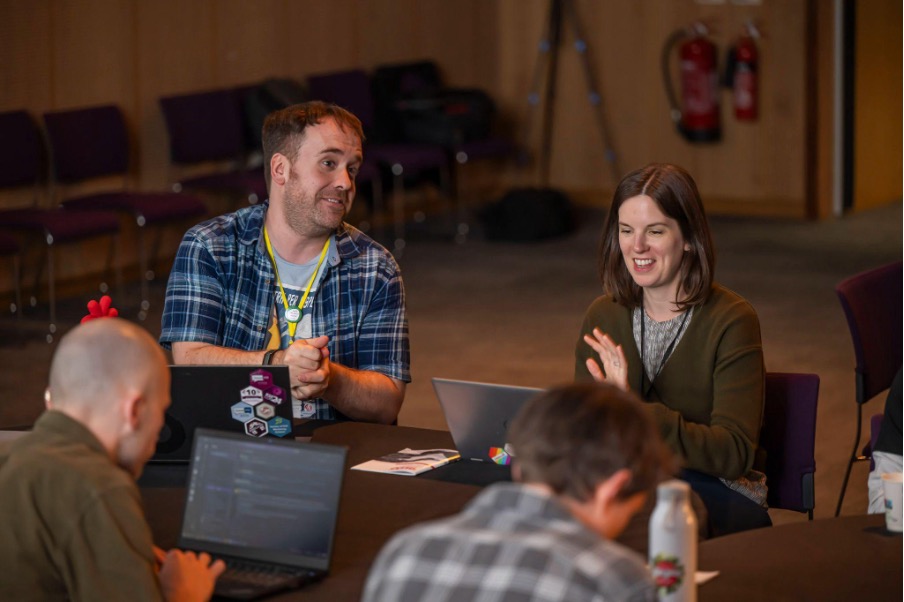
Collaborations Workshop 2026 (CW26) was hosted by the Software Sustainability Institute (SSI) at the ICC in Belfast in April 2026. It is described as “an immersive, three-day unconference, which emphasises active collaborations, dynamic discussions, and hands-on problem-solving”, and this year’s theme was ‘Strengthening the Research Software Community’. There were some keynotes and lightning talks, but the workshop mostly involved discussing topics and challenges, proposing ideas for the hack day, and then collaborating to bring those ideas to life.
I was there with several hats on. As a Research Software Engineer (RSE) and a trustee of the Society of RSE, I was obviously very interested in the overall theme. I was also there as an SSI Fellow from 2025 to promote my work supporting mental health in the research software community, and I was on duty as a Mental Health First Aider.
Let’s Talk About Mental Health
I gave a lightning talk on the first day, where I mentioned the various talks that I’ve been giving around the country over the last few years (a recording of my talk from RSECon25 is available on the Society’s YouTube Channel). Basically, I’ve been continuing the conversation around mental health, trying to understand the biggest challenges faced by our community, and collecting tips and advice for tackling those challenges. I’ve also created a website and other resources as part of the ConveRSE project. Please check out the ConveRSE website, which has a range of resources and updates about my fellowship. Any contributions or feedback would be greatly appreciated.
DIRECT Workshop
I was also involved in a workshop on the DIRECT framework. DIRECT is “a community model that defines the knowledge, skills, and behaviours that individuals need to attain to succeed in research software”. I’ve been involved in a previous workshop around how green computing and sustainability could be integrated into the framework, and I led a discussion around how to integrate mental health, neurodiversity and other EDIA considerations. Time was limited, but we had some interesting conversations that will hopefully feed into the ongoing development of the framework.
Mental Health First Aid
I was also on duty as a Mental Health First Aider. Personally, I think it’s great to have MHFAs at events like this, and it seems like the community agrees: I had several people come up to me and say, “I don’t need you, but it’s nice to know that you’re here”. I also used my lightning talk to remind everyone to take breaks, stay hydrated and get plenty of sunlight and fresh air. I’ve been particularly bad at looking after myself at conferences in the past, but I did a much better job of following my own advice this year, and felt better for it!
Other Highlights
Hui Ling Wong introduced us to ‘Up Goer Five’. Based on an XKCD comic, this challenge involves using “the ten hundred most commonly used words in the English language” to describe something in an easy-to-understand and accessible way. As someone who regularly has to explain what an RSE is to a range of audiences, this really appealed to me. One of the hack day projects involved defining some key Digital Research Technical Professional roles using these rules, and the results were both interesting and hilarious.
The Hack Day project I collaborated on was proposed by Oscar Seip, with just four words: “I want a calendar”. Oscar’s idea was to create a central calendar for the research software community, which anyone can submit events to, and which synchronises with other calendars. We spent most of our time looking at existing solutions, none of which did exactly what we needed. We developed a decision matrix (which we will share with the community) and a requirements document for our calendar, which we initially named the Open Science Calendar (OSCal) before settling on the Open Science and Research Calendar (OScAR). There are plans to take this forward beyond CW, so keep an eye out for OScAR updates!
ConveRSE Projects
I was also involved in several conversations and hack day pitches, which were connected to the topic of mental health.
Sarah Gibson proposed a community database for coaching and mentorship; a platform where users could share and access information on providers, including their specialisms and methodologies, as well as providing recommendations. This is an alternative to other mentoring schemes, which are expensive and require training and oversight. This is based on Sarah’s experience of having a buddy that she regularly meets up with. They walk around the lake on campus, taking turns to discuss a range of topics. This kind of informal support can be really useful, particularly if that person is outside your immediate team/line management structure.
The second idea was a collaboration with Eli Chadwick. We proposed an idea called Promoting Authentic Conversations for Employees (PACE). This was in response to one of the most common questions I’ve been asked during my fellowship, which is: “How do I talk to my line manager when I’m struggling?” It can be daunting to have these conversations (believe me!), and springing them on your line managers doesn’t give them time to prepare. The plan was to create resources to help facilitate these difficult mental health conversations in the workplace.
Incidentally, if you have any suggestions for how to do this (from either side of the one-to-one desk), then please check out this blog post, which includes a link to a form where you can submit your ideas and help us take this idea forward.
I was also involved in a discussion group that came up with the idea of “MOAN Club” (Motivating Others to Agree to “No”). Our idea was to organise a space at a community event where people can “usefully moan” about their work, i.e. talk about what’s not working for them and encourage others to respond effectively. The idea then is to try to determine how best to focus our effort by learning when to say no, what to prioritise, how to manage our time and balance our workload, and what to take forward from the emotions/reflections discussed, allowing us to create meaningful change without affecting our life/work balance.
Final Thoughts
As I said at the beginning, CW is always a highlight, and this year was no exception. The mixture of collaboration, networking and interesting conversations is like no other event I’ve attended. I hope we can continue some of the work that started there, and that I will be able to attend the next one!
I want to say a huge thank you to Kyro and the team for organising the event and to the SSI for giving me the opportunity to attend once again.