

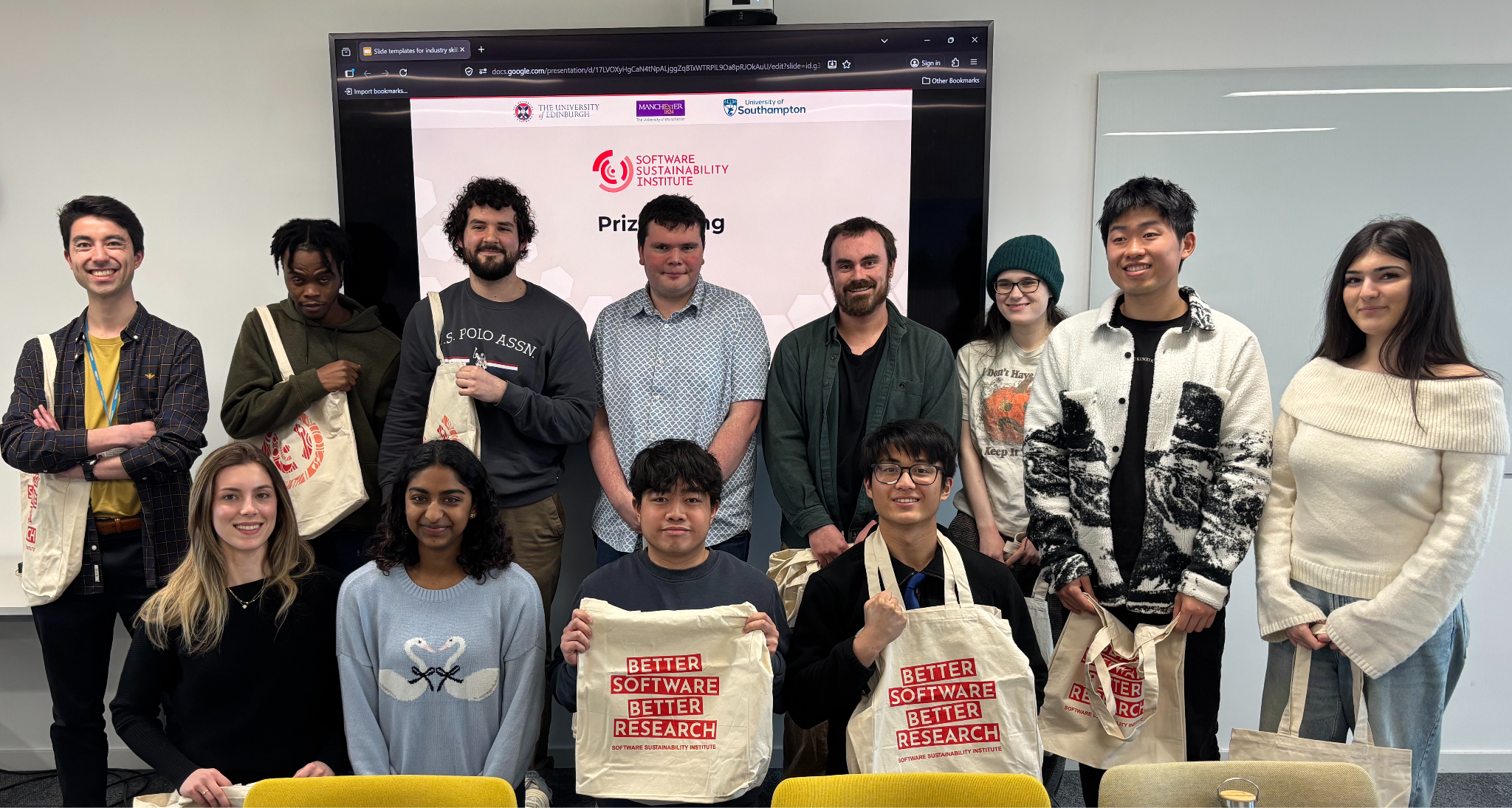
The Industry Skills Training Bootcamp, developed by the Software Sustainability Institute (SSI), addresses the skill gaps many early-career software engineers face when transitioning from study to an industry setting. The first week-long run of this in-person course was successfully piloted in March at the University of Southampton, with a cohort of both undergraduate and postgraduate students.
The curriculum is grounded in evidence from a qualitative study co-authored by Ben Thomas, Simon Hettrick, Clare Jenner (DiRAC), and Rebecca Taylor (University of Southampton), with the full report available on Zenodo. Interviews with employers and recent graduates consistently highlighted two gaps: a lack of experience applying technical skills in real-world settings, and underdeveloped professional skills such as teamwork, communication, client interaction, planning, and working within established development processes, and this course aims to target these skills gaps.
Whilst the course includes a technological and best practice component, its primary focus is to help participants put into practice their development skills within a team-based agile approach to software development. The training materials which have been developed using the Carpentries Workbench are publicly available under the Creative Commons Attribution licence, and are currently being refined prior to an official launch workshop planned for later in the year.
Our long-term aim is to offer this training as a Continuing Professional Development (CPD) programme for graduates and early-career software engineers. In the meantime, we are piloting and refining the course with undergraduate and postgraduate students to refine its content, structure, and delivery, ensuring it delivers meaningful, practical value before the wider launch.
Evidence-Based, Iterative Design Process
The course has been developed using an evidence-based and iterative approach, employing the reverse (or backward) instructional design method. Learning objectives were defined based on the identified industry skills gaps, with teaching materials and exercises designed to align with those objectives and form a cohesive narrative across the week.
Rather than designing the full course in one step, the training has been refined through a sequence of pilots:
- Pilot 1 (half-day, June 2025): validating the concept in a short pilot that covered the software development landscape and requirements analysis;
- Pilot 2 (two days, August 2025): testing the delivery of foundational topics such as requirements analysis, collaborative team working, and agile practices;
- Pilot 3 (full week, March 2026): tested the complete course structure and delivery.
This three-stage piloting ensured the foundational content was suitably tested and refined before the full week bootcamp, and even during these early stages, participants rated the learning experience highly, and consistently highlighted the relevance and practical value of the course.
A Scenario-based Approach
A sustained group project runs throughout the week. Participants work with a fictional coffee company, Itchen for a Brew (for context, Itchen is an area of Southampton). Using real data from the Coffee Quality Institute and an incomplete, inherited codebase, teams investigate which coffee-producing country the company should prioritise sending its buyers to.
The scenario is intentionally imperfect and includes data quality issues, legacy code, and ambiguous requirements to reflect common industry conditions and encourage teams to navigate uncertainty, communicate clearly, and justify their decisions.
The primary focus is on development practices and collaboration rather than on producing a single correct outcome, so whilst the project has an overall goal and stakeholders in mind, the teams have great freedom within this remit to fulfil this project in any way they wish.
The Bootcamp Pilot
The bootcamp ran over five intensive days, and interest in the event was particularly strong, with applications exceeding available places very quickly, indicating clear demand for this type of training. The training combined short lectures, live coding, hands-on exercises, group work, and a sustained team-based project, with the 12 participants randomly split into 3 teams of 4.
Days 1 & 2: Foundations
The first two days introduced key software engineering practices, including development processes, requirements gathering, user stories, estimation, and collaborative workflows. Participants were also introduced to the agile Scrum framework, and work with Git-based tools and practices such as branching, pull requests, and code reviews, alongside automated testing and continuous integration.
These topics are embedded within a pseudo-realistic setting; for example, participants took part in a simulated client meeting, gaining experience in eliciting and refining requirements.
At the end of each day, we collected feedback on positive aspects and things to improve. Participants particularly valued the interactive group work, clear Git/GitHub guidance, approachable instructors, and practical, real-world examples of Scrum and technical topics. One participant noted that "I took two modules on software design … and I can confidently say I’ve learnt more in one day than I did [from] two whole semesters studying Computer Science."
Days 3 & 4: Applied Agile Practice
The teams applied these foundations in practice by planning and running an initial sprint. In keeping with the agile Scrum framework, this was followed by a sprint review with the "client", and a team retrospective. This was also supported through team mentoring from experienced Research Software Engineers, with an emphasis on both technical progress and how teams work together.
A second sprint builds on this experience, focusing on preparing code for release, and refining how their Scrum team practices based on mentor feedback.
Participants enjoyed building on their first sprint, and indicated they highly valued the mentoring sessions. These offered useful industry insights and helped bridge the gap between theory and practice, though many wished they were longer. Participants enjoyed the sprint structure and hands-on work, finding the timing, flexibility, and immediate reflection effective.
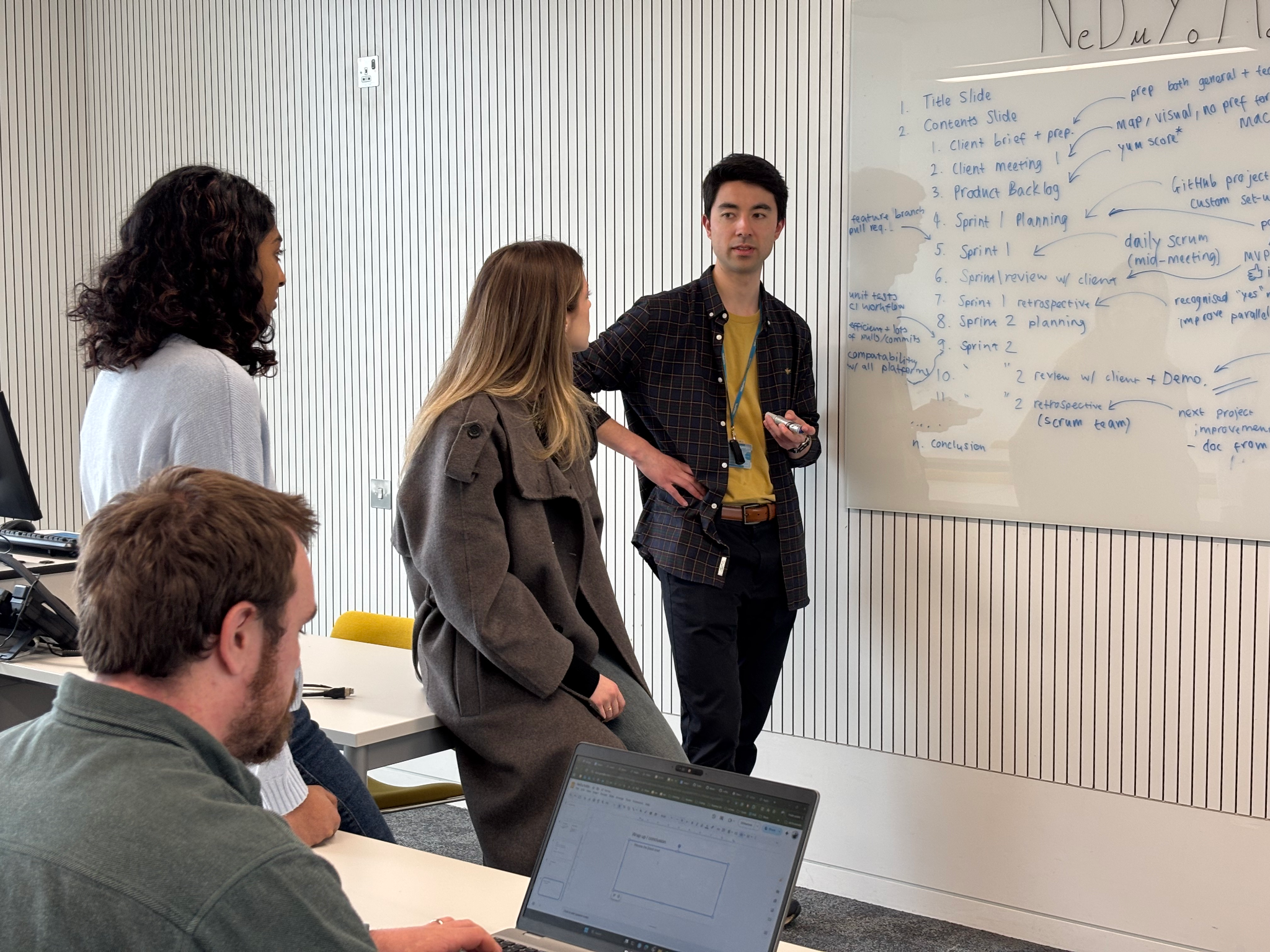 The NeDuYo team hold a presentation planning meeting |
Day 5: Delivery and Reflection
On the final day, teams presented their work to a panel who asked questions and provided overall feedback. Participants were asked to deliver presentations that addressed the following panel criteria categories:
- Presentation and Product Demonstration
- Agile-based Teamwork
- End Product
- Software Engineering Practice
The first two categories comprised 60% of the marks, reflecting that whilst the end product is the scenario project's goal, the focus of the course is on team-working and communication.
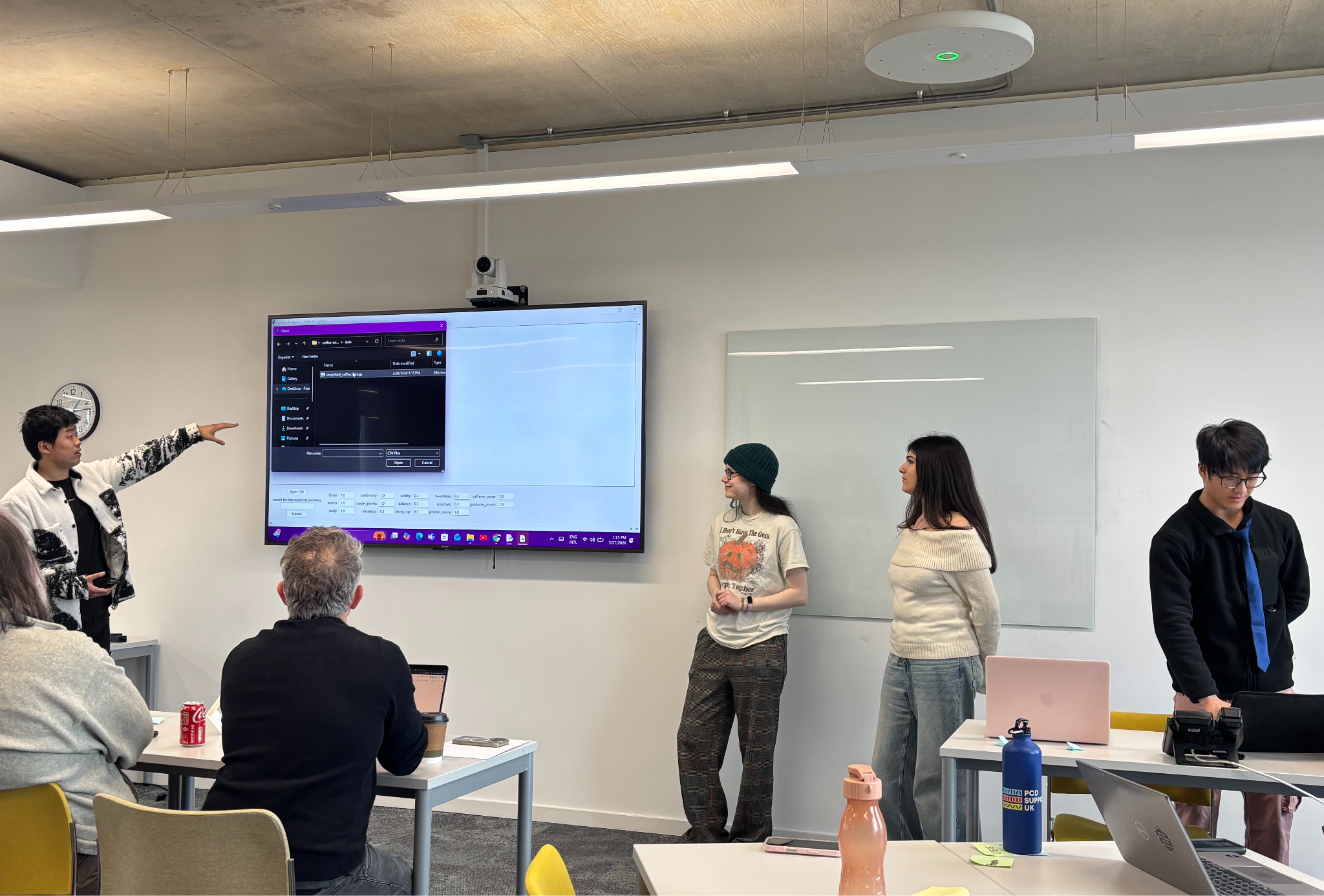 Excel Penvelope, who won the Best Teamwork Award, demonstrate their product to the judging panel |
The participants generally found that the final day was relaxed and enjoyable, with plenty of time and freedom to prepare presentations, which many found fun and engaging. Helpful guidance, constructive feedback from judges, and seeing diverse team solutions made the experience valuable.
What particularly surprised both the instructors and the panel was the level of effort the teams put into developing their products - and the level of functionality and polish shown at their demonstrations, despite only working on them for two very short sprints - showing a very high level of engagement and team-working by participants.
The day concluded by celebrating the participants' efforts with an awards ceremony (with prizes in each category, including Overall Winner) and refreshments.
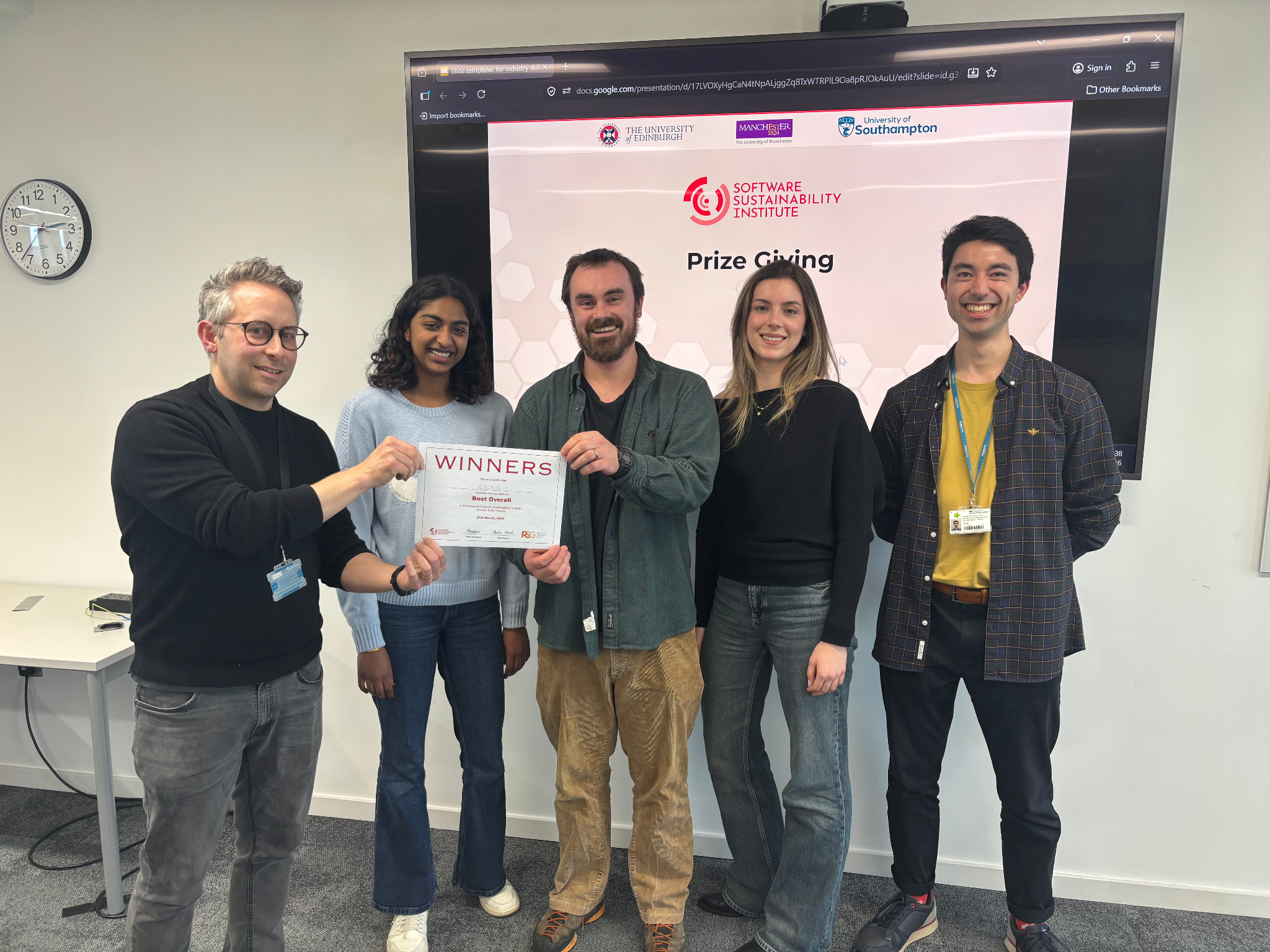 The overall winning team, NeDuYoMo, receiving their award |
March Pilot Feedback
Feedback from the March pilot was very positive. Across all 12 participants, the post-training survey indicated an average of 8.5/10 for the effectiveness of the workshop as a learning experience. In general, comments indicated the experience was a strong, engaging, and practical course with excellent teaching and teamwork elements. Some participant comments from the final survey included:
- "The course was truly excellent. I'd previously learnt a little about agile development but struggled to retain any of it. This course really helped to put that knowledge into practice. The workshop was well paced, with a good amount of content to feel satisfied without being overloaded."
- "All of it felt just right … the programme exceeded my expectations by a lot. I expected a less-interactive, lecture-based bootcamp, which is not necessarily a bad thing, but what we got was even better."
- "From lectures, and live coding sessions to working on a client project, I thought the entire workshop was excellently delivered. The lectures were engaging with plenty of solo, pair, group and class activities to add some interaction to the theory. The live coding sessions were well paced, and easy to follow. The client project was really fun."
- "The workshop was really informative and was delivered at a good pace. It provided a good opportunity for team building, leadership, technique development, and knowledge improvement."
- "All practical demonstrations with Git, MkDocs, etc were very engaging and useful - sure to put it to use in the future. The last 3 days of the course were especially enjoyable, and the inclusion of per-group support through mentoring and sprint reviews, plus feedback from an RSE, was very valuable."
In keeping with a pilot course, there were some improvements requested, notably for further tailoring it to participants' skill levels (which were quite variable), and increasing the hands-on, interactive learning (notably reducing the duration of some video-based learning exercises, and adding more time for exercises).
Summary and Next Steps
The Industry Skills for Software Engineering Bootcamp aims to complement existing education by focusing on the professional and collaborative practices that underpin sustainable software development. Through realistic projects, agile teamwork, mentoring, and reflection, the course helps early-career software engineers bridge the gap between academic study and professional practice.
As the programme continues to evolve, we look forward to refining the course based on feedback from the March 2026 pilot, and the official launch of the course with a workshop later in the year.
Looking ahead, plans include CPD versions of the course for professionals, tailored offerings for Small and Medium-sized Enterprise businesses (SMEs) and PhD cohorts, and more modular formats (such as the popular Byte-sized RSE format) that can be integrated into other SSI training activities. The training materials will continue to be shared openly, in line with SSI’s commitment to sustainable and community-driven software practice.