

This blog post is part of DataKind's sponsorship of Collaborations Workshop 2026.
Every year, millions of new research articles are published - far more than any individual team can realistically view. Yet researchers, policymakers, and funders depend on timely evidence synthesis to make informed decisions. Without better tools, critical insights risk being missed, delayed, or underutilised.
Evidence synthesis provides a structured way to map what’s already known, creating a foundation for stronger decisions and future research. But while its value is clear, conducting a high-quality literature review using traditional, fully manual approaches remains time-consuming and resource-intensive.
With global research output continuing to grow - over 3 million articles were produced in 2023 alone (according to US NCSES 2025 report) - the challenge is only increasing. A single team can spend months - or even years - completing a high-quality systematic review. As a result, there is a growing need for approaches that integrate AI-based tools with human expertise, enabling researchers to work more effectively without compromising rigor or transparency.
The growing challenge of evidence synthesis
With global research output continuing to expand, the scale and complexity of evidence synthesis has increased dramatically. Research is distributed across disciplines, geographies, and publication types, making it increasingly difficult to identify, screen, and synthesise relevant studies in a timely way.
Introducing Colandr
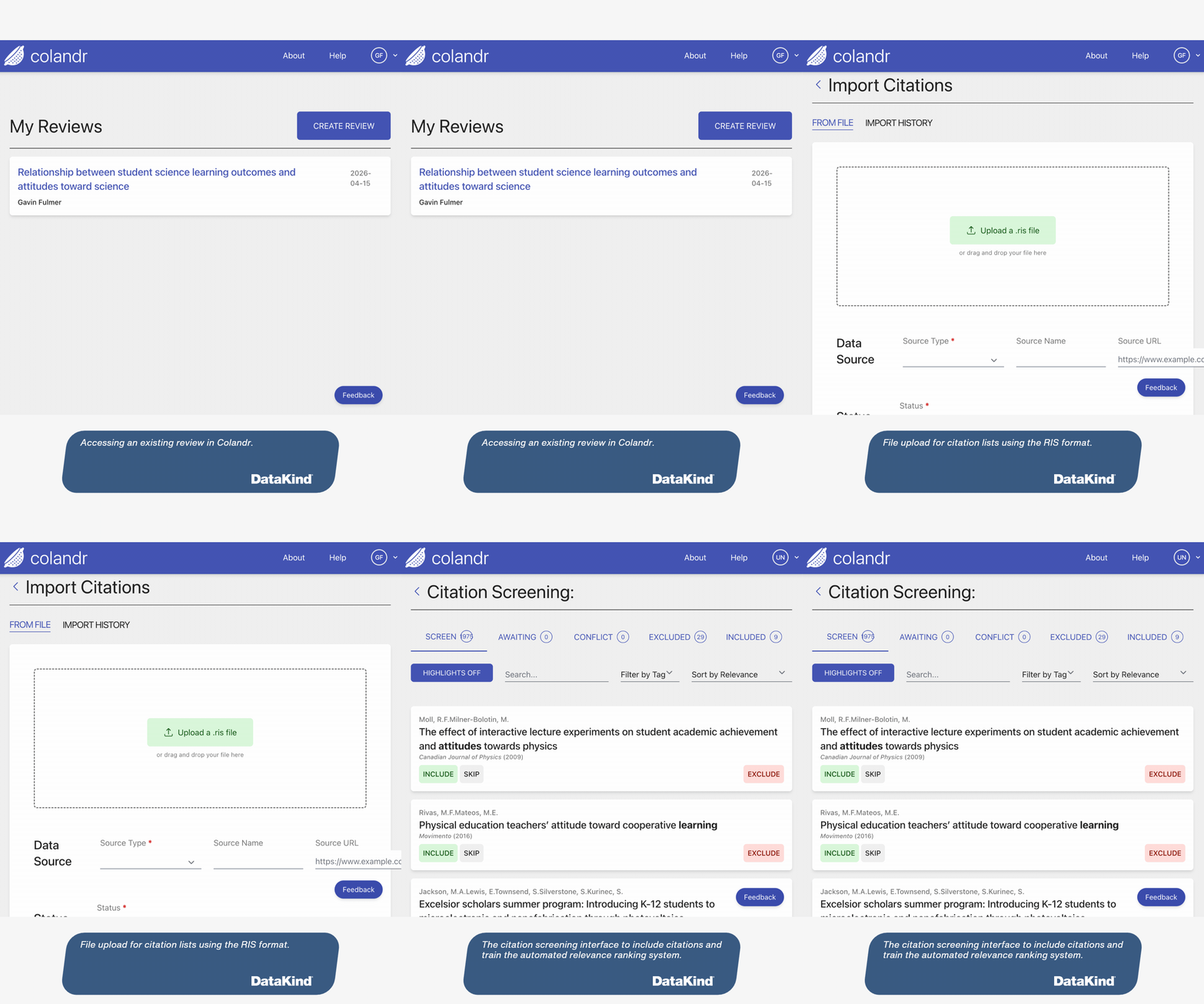
Colandr is an open-source evidence synthesis platform that combines machine learning with human expertise to help research teams manage and conduct literature reviews more efficiently, while maintaining transparency and human oversight.
Colandr supports evidence synthesis through three core capabilities:
- Collaborative workflows: A shared workspace for distributed research teams to manage and conduct reviews together, reducing manual coordination and improving consistency.
- AI-assisted screening: Machine learning models that learn from reviewer decisions to prioritise the most relevant studies - helping teams identify key evidence faster while keeping humans in control.
- Full-text analysis: Integrated tools for categorising and analysing full-text documents, enabling faster tagging and more structured synthesis as models improve over time.
A proven tool and growing community
Since its launch in 2017, Colandr has supported more than 4,000 reviewers and contributed to hundreds of published evidence syntheses, such as its 2021 collaboration with the American Museum of Natural History, with many more in progress across research and policy communities.
Beyond the software itself, Colandr has grown into a global community of researchers, practitioners, and developers working to make evidence synthesis more accessible and scalable.
Colandr is designed for researchers, scholars, policymakers, funders, and research software teams who need to synthesise large bodies of evidence but lack the time or resources for fully manual approaches. It has been used across disciplines including conservation, health, education, and social development, and is particularly valuable in contexts where access to costly commercial tools is limited.
In 2026, DataKind and its partners rebuilt Colandr’s infrastructure to improve stability, enhance usability, and enable future community-driven development. This next phase positions Colandr to better support the evolving needs of global research and expand opportunities for contribution and collaboration.
Get involved with Colandr
If you work in research, the simplest thing you can do right now is try Colandr and share this post with your network - the more teams who know about Colandr, the greater its impact.
If you're based at a research institution and want free training or hands-on support to get started with Colandr, reach out to us at the email below. We'd love to help.
And if you're excited about where Colandr is headed and want to help shape its next stage - whether as a researcher, data scientist, or developer - connect with us via the Colandr community or GitHub and tell us how you'd like to be involved.
For questions or to connect, reach out at partners@datakind.org or follow DataKind for updates on LinkedIn, X, Facebook, and YouTube.
Author |
Gavin Fulmer, PhD Senior Manager, Research |