

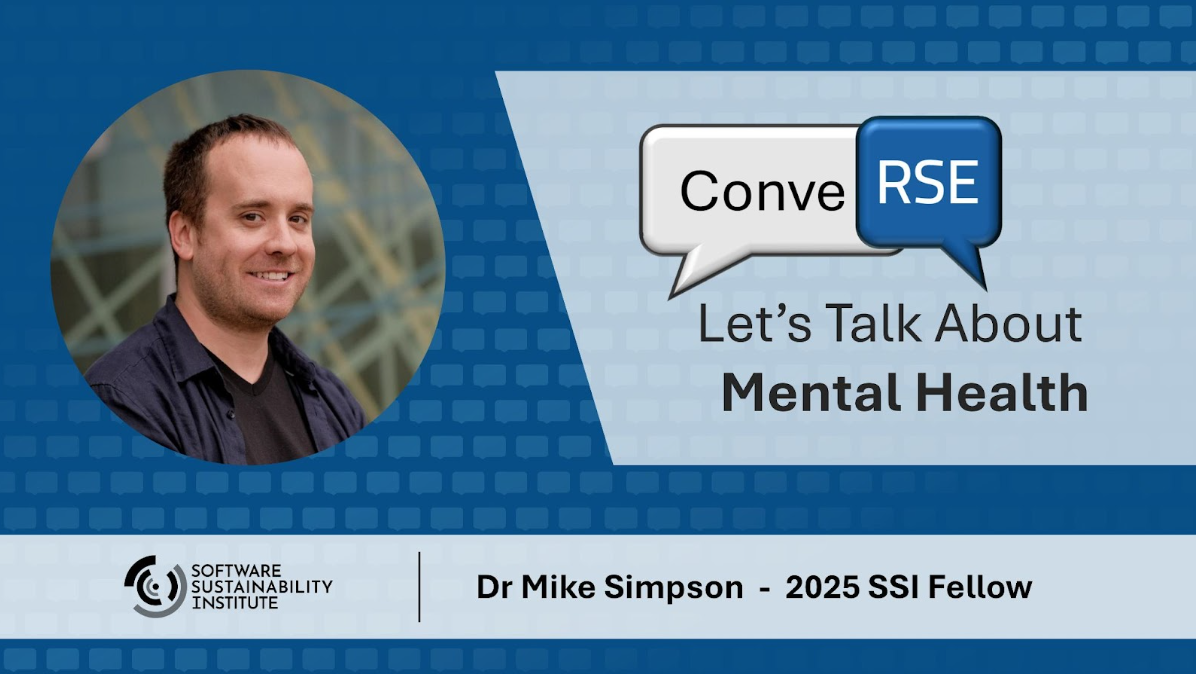
I’ve been giving a talk called “ConveRSE - Let’s Talk About Mental Health” as part of my SSI Fellowship. I most recently gave the talk at the Alan Turing Institute, and I thought I’d write a brief update on how it went. But also, during that talk, I used Mentimeter to ask the audience some questions, and in this blog post, I wanted to take an initial look at some of the responses to those questions.

ConveRSE at the Alan Turing Institute
I was invited by David Beavan and Levan Bokeria to speak at the Turing as part of their Tech Talks series. I always try to attend these events in person, because I think it's important given the subject matter. Plus, I like to hang around so I can talk to people afterwards.
I arrived at the British Library early, giving me a chance to explore the building and its amazing collections, including some of Leonardo Da Vinci’s notebooks. I then made my way past an original Enigma Machine and into the Turing itself. It’s an impressive space; surprisingly light, with fancy coffee machines, well-stocked fridges and free fruit for staff and guests. It feels like it would be a nice place to work, which was only enhanced when the big screen in the entrance changed to show that there were more than a dozen Mental Health First Aiders working there!
We went into a meeting room, and I presented to around 15 people in the room and online. The talk was a variation of the one I gave at RSE Con, but it’s constantly evolving (because I’m a perfectionist with ADHD who can’t leave the flipping thing alone!). We had lots of time for Q&A, plus I chatted to a few members of the Turing REG (Research Engineering Group) before and after the talk. I also got to meet with David (as I am Vice-President of the RSE Society and he’s the President), to discuss the onboarding of new Trustees and our plans for the next twelve months.
The talk seemed to go well; everyone was friendly and welcoming, and my meeting with David meant we got a lot more done than we would have been able to over Zoom. So, a very productive day, all in all. And I haven’t even got to the data yet!
The Questions
At the end of the talk, I switched over to Mentimeter - an interactive tool that allows the audience to use their phones or laptops to respond to questions from the presenter.
I ask two questions during the talk:
- What are your biggest challenges/barriers to mental health in the workplace?
- Do you have any tips or advice for managing mental health, or any good examples of things people have done to support the morale of their teams?
The first question helps us understand the most common issues, which tells us where we should focus the efforts of the ConveRSE project. The second question is potentially more interesting, if harder to answer. I was hoping that it would result in some good tips and advice - for individuals and for leaders - that we can feed back into conversations, advice and blog posts for the project.
The Data
So, was that the case? Well, let’s take a look at the data, but first, some context.
Participation + Responses
First, some stats:
- 108 participants logged on to Mentimeter during various talks, including at RSECon and the Turing.
- Each question received responses from around 87% of the participants.
- Participants can submit multiple responses to each question. We got 128 responses to Question 1 and 197 responses to Question 2.
Analysis
So far, we have only been able to do basic analysis on the data. The responses were free text, so the data is qualitative. To do this initial review of the data, I have taken two approaches:
- Using Power BI, I created a Word Cloud for each question. This is essentially a count of how many times each word was used. This is how the visual featured earlier in this post was created.
- I have attempted to categorise the submissions and amalgamate them, as described below.
Each response was assigned a number of categories. For example:
- Amalgamating different spellings (“impostor syndrome” and “imposter syndrome”)
- Combining similar advice: (lots of people mentioned “fresh air”, “nature”, “touching grass” or “get outside”).
- Separating multiple responses. For example, one response was: “Yoga, Work from home more often, Team lunch on pay day, No work on weekends", which was assigned four categories.
There is more work to be done, but this initial processing has allowed us to take a look at the most common responses to each question.
Question 1 Results
Question 1 was “What are the biggest challenges/barriers to mental health in the workplace?” The graph below shows the number of times each of the most common issues was mentioned.

The three most reported issues were: Workload (22 responses), Context Switching (13) and Impostor Syndrome (11). These are common issues that have cropped up in various conversations over the last few months. You could argue that these are just part of everyday life for RSEs, but there must also be more that we can do to mitigate these issues, or to support people who are struggling with them.
The next two most reported issues were Workplace Culture (9) and Management/Leadership (7). This just goes to show how important leaders and line managers are, both in supporting individuals and in supporting their teams.
This data seems to support my current conclusions from my Fellowship so far:
- Self-care is important, and we need to provide people with the information, support and tools they need to look after themselves.
- We need to give leaders and line managers the tools they need to manage not just the projects and workload of their teams, but the morale and wellbeing too.
Question 2 Results
Question 2 was “Do you have any tips or advice for managing mental health or any good examples of things people have done to support the morale of their teams?”. The graph below shows the number of times each suggestion was made.

The top three suggestions were Exercise (25), Socialising - both with colleagues and outside of work - (24) and Setting Boundaries (21). Touching Grass (i.e. getting out into nature) was another popular one, along with hobbies, mindfulness and making sure to take breaks and holidays.
Setting Boundaries is anything that involves establishing a clear separation between work and home, such as breaking up the day when working from home and protecting personal time. Similarly, there is “No Notifications” (8), which could mean not having work Slack or work emails on your phone, or having designated quiet times where you focus on work without interruptions (Incidentally, I have recently written a blog post about both of these things on the ConveRSE Website).
There were also a few interesting insights that came out of the data, even though they weren’t the top-scoring categories. For example, a few of the suggestions were specifically to find hobbies “that do not look like work”. I’m guilty of this; a lot of my hobbies involve sitting in the same room, at the same desk, using the same computer and staring at the same screen that I’ve just been using all day for work!
Final Thoughts
I think that giving these talks in person has been a very useful experience. The conversations I’ve had continue to inform the ConveRSE project, and the Mentimeter data has been a good source of information about common issues in the community.
I acknowledge that there is a balance to be struck here. It’s good to know what the most common problems are, as by focusing on them, we can make the biggest impact on the community as a whole. But we also don’t want to ignore the less common issues, as we don’t want to neglect or marginalise anyone.
However, this experience has reaffirmed my belief that we make a difference by providing leaders with tools to support their teams and providing individuals with the tools they need to look after themselves.
Thanks for reading. If you’d like me to give my “Let’s Talk About Mental Health” talk at your institution, please get in touch (the SSI Fellowship will cover travel, accommodation, etc. until the end of March 2026).
Take care of yourselves!