
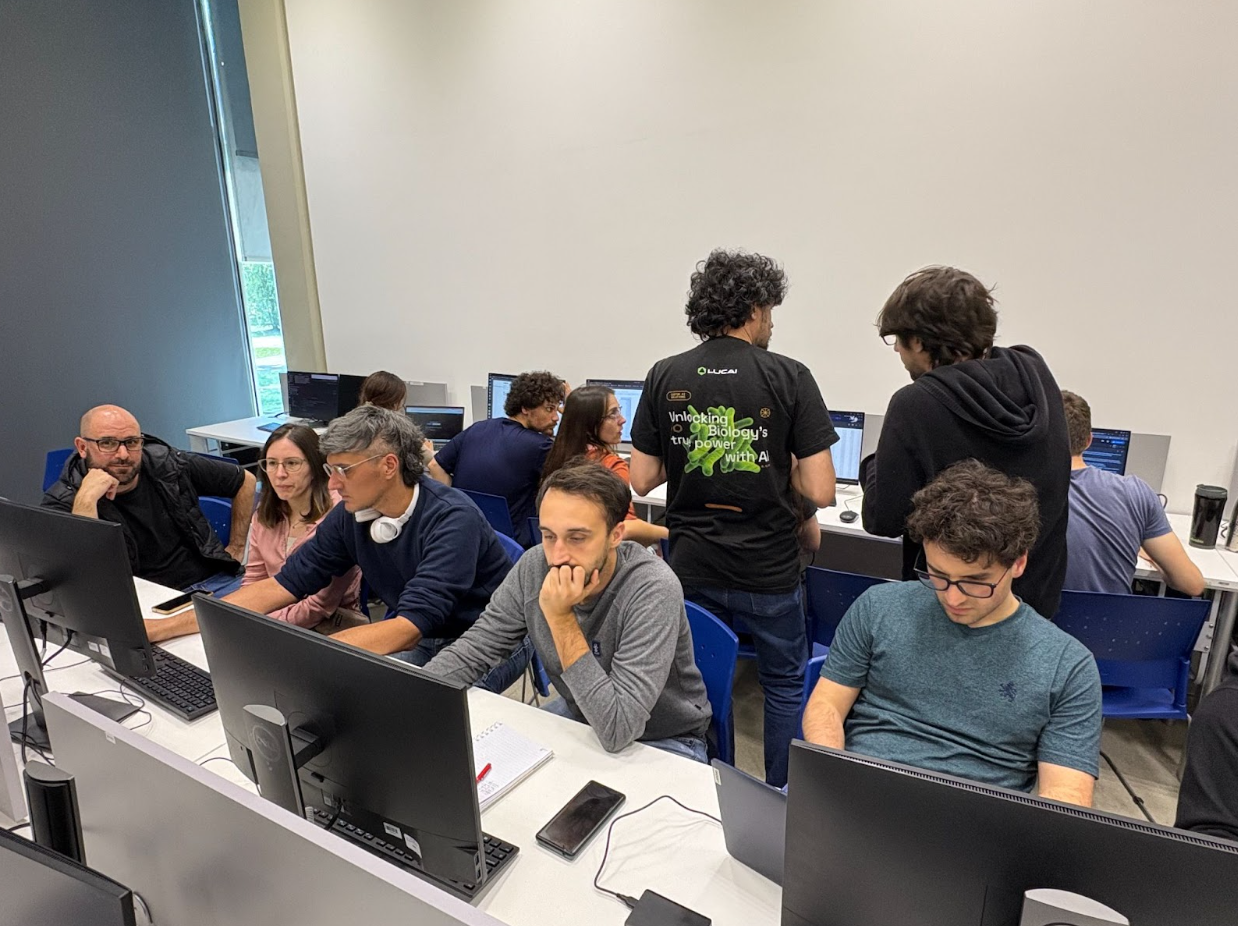
Image: Hands-on session ongoing at the Facultad de Ciencias Exactas y Naturales, UBA
The Ersilia Open Source Organisation, the research non-profit I co-founded and lead since 2020, was founded with a clear objective: equip laboratories in low-resource regions with open source AI/ML tools for infectious disease research. As part of our mission, we focus on three areas of impact: i) development of AI-based research software for drug discovery, ii) research in infectious diseases, and iii) capacity strengthening in AI. On the latter, we organise workshops on the application of AI methods for drug discovery and target medicinal chemists, molecular biologists, pharmacists and bioinformaticians in regions where these diseases are endemic. Oftentimes, we group the countries we support under the controversial “global south” term. While widely used to make a distinction between westernised or global north countries (a.k.a, Europe, North America and Australia), it lumps together very different countries, and is even geographically incorrect. Most of Ersilia’s work has so far been developed in Africa. Through a series of grant-funded events, we have delivered in-person workshops in South Africa, Cameroon, Kenya, Ghana and Zambia, and our experience in other “global south” countries, including the Latin American (LATAM) region, is scarce. Therefore, we were thrilled when the opportunity appeared to co-organise a workshop in Buenos Aires, Argentina.
For a successful event, having a local host that can support the event organisation, connect with relevant experts for course contributions and continue the networking activities after the event is key. In previous workshops co-organised with the H3D Foundation we have counted with the support of the University of Cape Town, the University of Ghana or the KEMRI, respectively. In this case, the connection arose naturally thanks to the Open Life Sciences program. After completing my own OLS training, I have acted as mentor for two Argentinian-based projects, MetaDocencia (led by Dr. Nicolas Palopoli) and TidyScreen (Dr. Alfredo Quevedo; Universidad Nacional de Córdoba). Through these collaborations, we identified a common interest in open science, LATAM-focused training and particularly, AI for drug discovery. Together, we designed an event with the following goals:
- Learn how to adopt open source AI models for drug discovery
- Understand the FAIR principles for research software
- Understand and get experience in the use of Open Source AI/ML tools for cheminformatics and drug discovery: The Ersilia Model Hub, TidyScreen, AutodockBias, and others
- Establish a community network of researchers and software developers in Argentina who are interested in utilizing open-source AI/ML tools for Cheminformatics and drug discovery.
At Ersilia, we were really keen to translate our learnings from African-focused workshops to this first event in LATAM, and adapt our content and training materials for future opportunities. Unlike other courses, on this occasion we counted with a strong local community developing their own tools for drug discovery, such as TidyScreen, which was a great starting point to consolidate a shared curriculum giving relevance to not only one, but several computational approaches to drug discovery. In addition to Ersilia’s and the University of Cordoba team, the facilitators included the hosts at the University of Buenos Aires, Prof. Marcelo Martí and Prof. Adrian Turjanski.
In this post, we try to summarise the key elements that made this course a success:
- Blending keynote sessions with hands-on practice with real examples. Previously we had to limit hands-on sessions to smaller exercises or less applied to real world, due to technical and infrastructural constraints
- Linked to the above, having a computer room set up for the entirety of the course accelerated troubleshooting and allowed for previous installation, system-wide of the needed software. This is truly location-dependent and we are really thankful to the University of Buenos Aires for their support.
- Focusing on reproducibility and training materials. Ensuring that participants will be able to reproduce the course, play with the software and propose improvements or make requirements based on their needs is essential to increase tool adoption. At Ersilia we always prepare a Gitbook for the course, and TidyScreen also has abundant and clear documentation and case examples.
- Demonstrating the relevance of open source software. The best demonstration of this is the integration of the Ersilia Model Hub, our flagship AI platform, inside TidyScreen. Dr. Quevedo and his team took the lead in integrating our software into their pipeline and showcasing how collaboration can bring more and better research outcomes
- Adapting the concepts to the local research interests. As much as possible, using context-relevant examples makes the course more appealing to scientists. In this case, we focused on antibiotic-resistant infections and Chagas disease.
- Moving beyond English. While English is the predominant language in the scientific arena, we should acknowledge the limitations it poses to non-native speakers (including the Ersilia team). For example, we struggled previously in French-speaking Cameroon. Translation can be expensive and time consuming, but we fully advocate for it as much as possible. This time around, all course facilitators were Spanish-speaking, and the entirety of the course was delivered in Spanish, even though written course contents and documentation were in English.
- Allowing for in-person interactive time. While online training enables wider access, the opportunity to spend time together with students and other researchers sparks discussion and collaboration that is slower to build in online settings. However, to ensure equitable participation, we offered a hybrid course, and online participants could join in all sessions, including the hands-on.
In sum, we offered a course that blended several open-source tools for drug discovery from local (Universidad de Buenos Aires), regional (Universidad Nacional de Córdoba) and international (Ersilia) organisations, demonstrating how different research software tools can interact and complement each other. We had fifty in-person and twenty online attendees, and after the four-days course, participants left with a solid understanding of how to use the tools, guidance for implementing the learnings in their own projects and a network of contacts to expand their career opportunities and research interests, a networking that continued in the adjunct RICiFa conference. The support through the Further Development Grant from the Software Sustainability Institute (of which I am a fellow) was key to enable the participation of Ersilia facilitators in the event.