
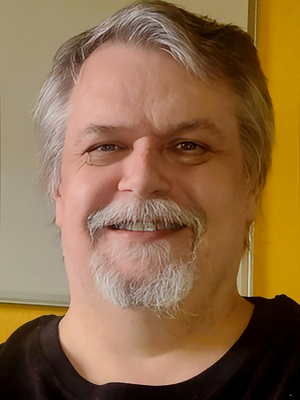
Michael Sparks
Institute for Research Software Fellow
The University of Manchester
Michael Sparks is a software engineer who does applied research. His career has been shaped by a simple recurring principle: the best way to understand an idea is to build it, share it, and help others do the same. Whether he’s building a concurrent architecture, a learning tool, a broadcast pipeline, or a piece of hardware on a kitchen table, his work starts with curiosity and ends with real systems that people use. Systems, tools, and research contributions spanning over 27 years of concurrency models, sustainable computing, educational technology, and large-scale media delivery.
He spent 22 years at BBC R&D, where ""wouldn’t it be interesting if..."" regularly turned into large-scale projects. He created the original BBC micro:bit prototype - a small experiment that grew into a national educational movement; Kamaelia, a concurrent component framework that shaped early podcasting tools and collaborative systems. He went on to help redefine how studios work as part of the IP Studio project and contributed to research on object-based media, IOT, synchronisation, and scalable media delivery. Along the way, he picked up patents, wrote open-source software, and collaborated with researchers, designers, broadcasters, and engineers across disciplines.
Community runs through his work as strongly as code. Michael was among the co-founders of PyCon UK, brought the BBC into Google Summer of Code, mentored students and early-career technologists, and repeatedly created environments where people could explore ideas together. He enjoys building things, and equally enjoys helping others build things too.
He moved into Academia earlier in 2025, and is a Senior Research Software Engineer at the University of Manchester, based in Physics & Astronomy, and with the eScienceLab. Michael focuses on research software sustainability, green computing, and high-performance scientific workflows. As part of the EVERSE project and collaborations across physics, he supports the integration of sustainable software practices, green metrics, FAIR practices, GPU-accelerated computing, and maintainable software architectures within demanding scientific environments. His work spans hands-on engineering, methodological development, and community training - always with an eye on what can scale and endure. After all, sustainability is both a technical problem and a cultural one.
