
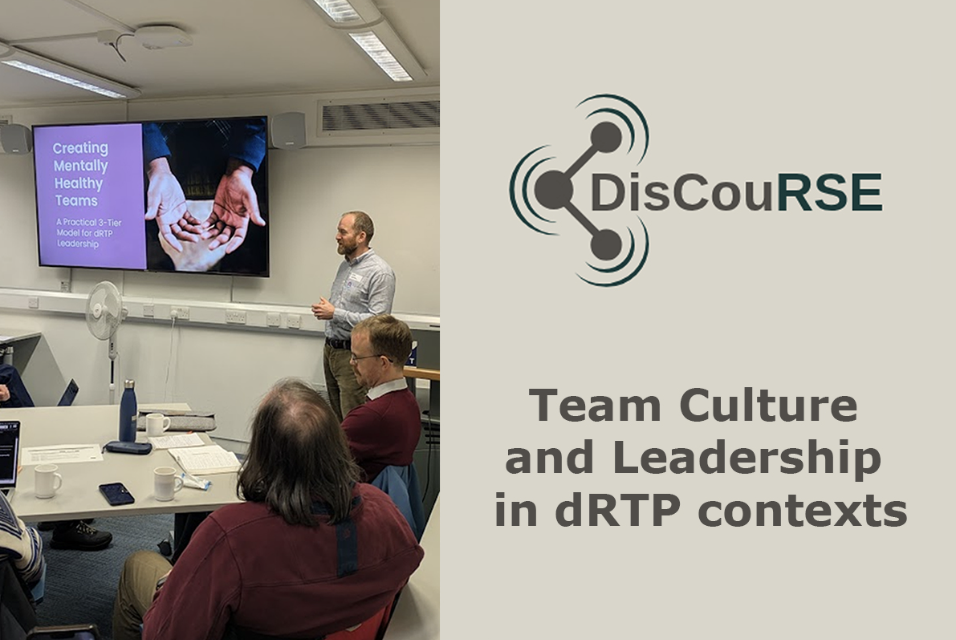
In January 2026, the DisCouRSE network ran its first focus group to explore different ideas and practices around leadership and team culture for Digital Research Technical Professionals (dRTPs). This is something I am particularly interested in, as leadership and team culture have a huge impact on our mental health.
About DisCouRSE
The DisCourRSE Network aims to connect people working in dRTP roles, including (but not limited to) Research Software Engineers, Data Managers, DevOps Engineers, Digital Librarians and those working in the Digital Humanities, as well as community managers and Professional Research Investment and Strategy Managers (PRISMs). In their own words: “DisCouRSE is designed to support leadership and career development across these boundaries, helping individuals grow and institutions value their technical professionals more effectively.”
Team Culture and Leadership Focus Group
This particular focus group was an in-person event, hosted by Arianna Ciula (a DisCouRSE co-lead) at King’s College London. The aim was “to gain multiple perspectives on the same topic rather than necessarily gain consensus or produce a specific output”, focussing on the subject of leadership and team culture. We were treated to a number of talks, presenting various views on the subject, and then given time to discuss these ideas, as well as how they might be integrated with existing tools, such as the Digital Research Competencies (DIRECT) Framework.
Why was I there?
My SSI fellowship is all about supporting better mental health in the research software community. One of the things I’ve come to realise is that your boss can have a huge impact on your mental health, and so one of the goals of the ConveRSE project has been to help managers be better leaders. We’ve been collating training to help make leaders more aware and supportive of a range of mental health issues, as well as resources for generally creating more open and inclusive teams, and ensuring they know what support is available through their institution and beyond.
Some colleagues and I have also been discussing applying for funding from DisCouRSE to produce training on the subject, and how that training might be integrated with DIRECT, so this workshop seemed like the perfect opportunity to explore those ideas further, as well as contributing to the wider conversation.
Talks and Provocations
The day included an opening ‘provocation’ from leadership coach Katie Best. Katie talked about the role of a leader in team culture and wellbeing, and how this was connected to productivity, effectiveness and retention. She also shared a model for transformational leadership, looking at areas such as how to motivate people, but also how to consider that not everyone is motivated by the same things. This was followed by a response from Emma Karoune from the Alan Turing Institute, who talked more about Community Leadership and how important it is to engage with the community and “build it with them”. Emma illustrated her point by talking about starling murmurations and how flocking birds work together without obvious leadership. I feel like these were not so much contrasting ideas as different ideas for how leadership might look in different circumstances, but there are things we can learn from both approaches.
After a break, we had five presentations on different leadership models. These included my colleague, collaborator and fellow Fellow Dave Horsfall, who introduced a model created by the charity Jonathan’s Voice. Dave talked about the importance of preventative and proactive approaches to mental health in the workplace - thinking of mental health more like health and safety - to minimise the need for reactive approaches. He also discussed the fact that we shouldn’t be rewarding unhealthy practices, such as ‘presenteeism’ (people visibly working long hours) and ‘leaveism’ (doing work when they’re supposed to be on leave). Another highlight was a talk by another SSI Fellow, Sara Villa from OLS, which included the quote “openness, clarity and inclusion are the ONLY sustainable way to lead and drive change”.
I was also delighted to see that several of the talks also described ‘Psychological Safety’ as the most important aspect of team culture. This is the idea that someone shouldn’t feel in any way punished or embarrassed to speak up with ideas and questions, or to admit mistakes. In a mental health context, it means that people should have the freedom to admit when they are struggling and to ask for help!
Discussions
The afternoon was split into two sessions. First, we split into groups to discuss some key practices and challenges, and how relevant they are to the dRTP space. Our group focused on the importance of self-reflection, as well as how some skills, such as comms, finance and recruitment, are often overlooked but critical parts of the role of a dRTP leader.
Next, we looked at a range of leadership skills from the DIRECT framework, discussing good practices, bad practices, and the activities that would allow people to develop and/or demonstrate competencies in these skills. In our group, we looked at facilitating meetings, including when a meeting should be an email (and vice versa). We also discussed documentation, how it can provide clarity, but is not always a collaborative process or a priority. Many of the topics we addressed, including requirements gathering, task creation and customer engagement, are things which tend to be part of the job not only for leaders but for most people working as dRTPs in academia.
Final Thoughts
I wasn’t sure what to expect from this focus group, but I’m glad I was able to attend. I learned a lot, felt able to contribute, and I was happy to see that issues around mental health, supportive team culture and psychological safety were being addressed in most of the conversations.
I hope that more events will follow on from this, and that we will be able to create some useful outputs (both from DisCouRSE and ConveRSE), helping managers in the dRTP space to be better, more supportive leaders.
Facilitators were taking notes throughout the day, which will hopefully be published at some point. Follow the DisCouRSE network or check their website for updates.