

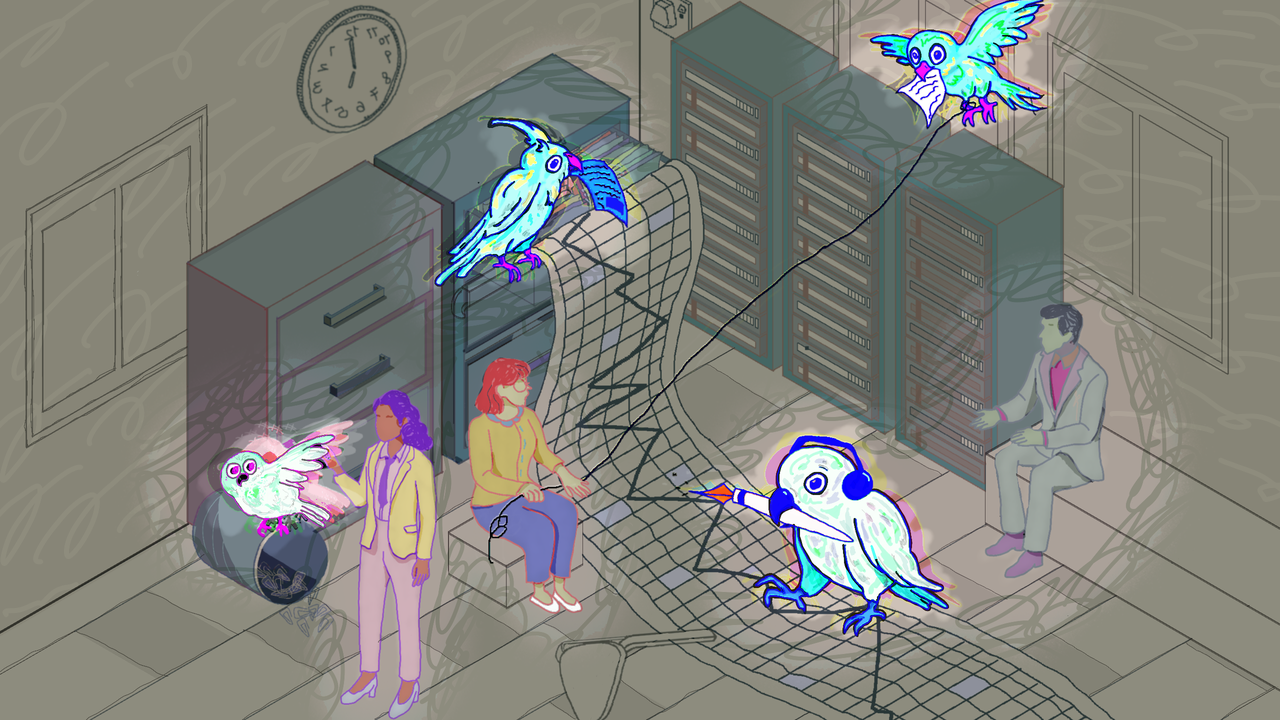
 ‘Stochastic Parrots at Work’, inspired by the widely cited 2021 paper by Emily Bender et al. (IceMing & Digit / https://betterimagesofai.org / CC BY 4.0). |
In a culture of optimisation, where the world seems to be rushing to utilise generative AI technologies for their research, should we start trusting our intuition more, particularly in arts and humanities-aligned fields where critical thinking is central to research?
Digital Humanities at Oxford Summer School 2026
I recently had the pleasure of attending the Digital Humanities summer school online at Oxford, specifically the “Using AI Tools and Technologies in Research Libraries” strand. I wanted to attend towards the end of my maternity leave to catch up and gain insight into how institutions in the GLAM sector are responding to recent AI developments. I also wanted to discover how researchers are integrating bespoke AI methodologies into their work by producing bespoke methodologies as opposed to solely using generative chat interfaces. I appreciated the opportunity to hear from alternative workflows that perhaps adopted smaller, locally-run models, alongside the production of toolkits, guidance and workflows for the use of AI in the GLAM sector.
Red flags
The message that was reiterated throughout the summer school is that slow, careful experimentation of AI technologies is key to maintaining FAIR (Findable, Accessible, Interoperable, Reusable) and CARE (Collective Benefit, Authority, Representative, Ethics) standards, considering which voices are represented in collections, and ensuring research is as open access as possible to work towards the democratisation of technology.
I had a strong sense that we should be leaning into the physical and mental sensations our nervous systems flag when working with new, fast-developing technological advancements. Claire Knowles (Acting Director of Library Services, University of Leeds), in her opening keynote, referred to the “ick”; when we uncover the potential biases, distortions and ethical issues of an AI system or tool we might think to use in research. That gut feeling and intuition – the sense that the features and principles underlining an LLM tool do not sit quite right with us – is a crucial aspect of the decision-making process for researchers and practitioners as to whether to adopt AI in the GLAM sector. Some of the questions we should be asking are: Who truly benefits from the upscaling of AI tools and the research we conduct with them? And which communities are impacted positively and negatively by the increasing optimisation of AI?
‘The intimacy factory 2’ reflecting on the increasing use of ‘companion bots’ (Jenny Kidd & Synthetic Pasts / https://betterimagesofai.org / CC BY 4.0). |
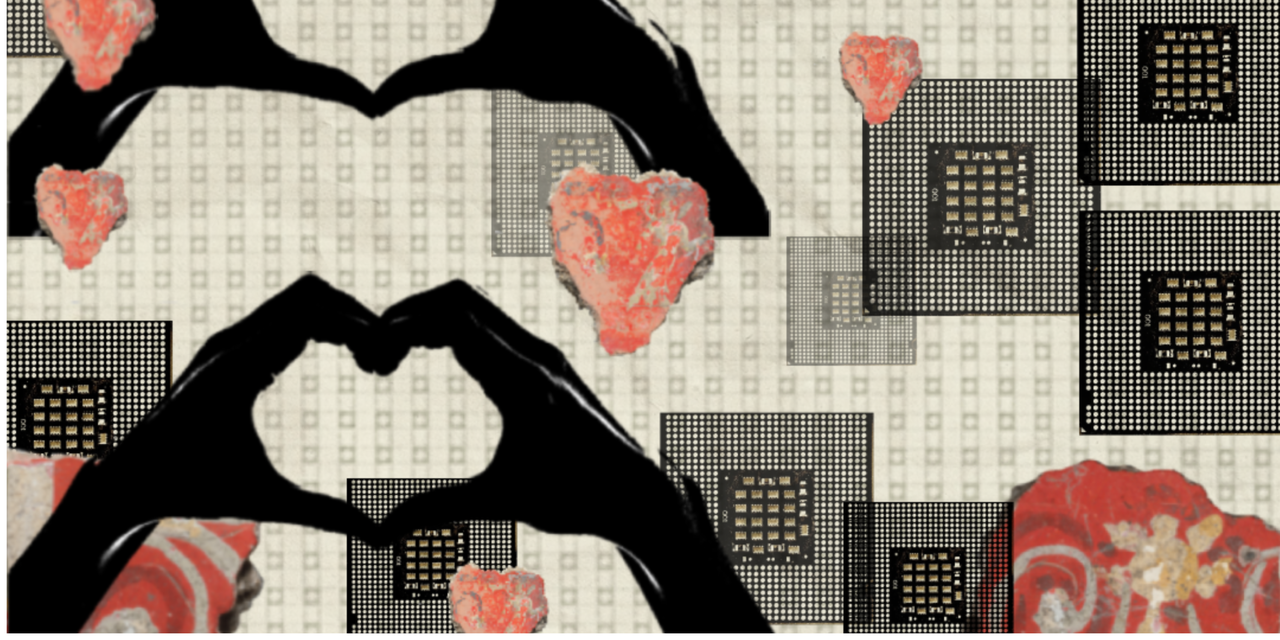
I was particularly struck by the research conducted by one of the closing keynotes, Dr Jenny Kidd (Reader in Digital Culture, Cardiff University), on synthetic “afterlives” and the generation of memory by deep learning models that allow users to talk to the deceased, or revive their loved ones by animating static photographs. The overarching message I gained from Jenny’s talk left me feeling unsettled – that these LLMs, built by large corporations, are tapping into our grief and emotion primarily for profit acceleration.
Executive functioning
In an age of black boxes, how is the GLAM sector harnessing control in the process of automating transcription, tagging, discovery and search for their collections? Many of the talks mentioned that granularity, transparency, accountability, and authenticity were key drivers for the preference of small, localised models and statistical tasks that were computationally light.
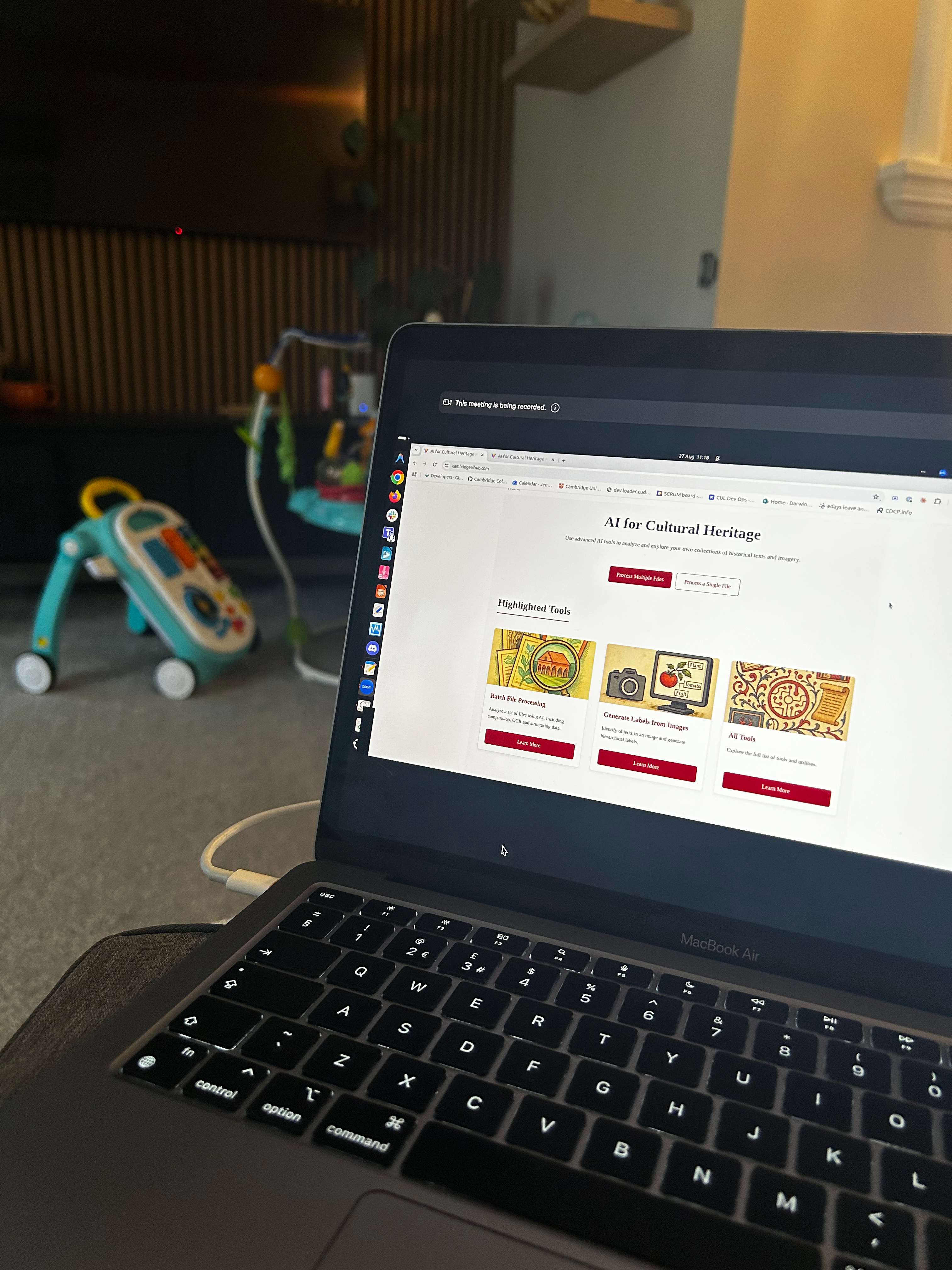
For example, the AI for Cultural Heritage Hub (ArCH) at Cambridge Libraries and Archives is a project developing a workspace and Community of Practice to support non-technical users analysing cultural heritage data. They use language models of various sizes to improve accessibility to and reassemble fragmentary and dispersed cultural data. In the metadata and paradata of manuscripts and objects in their collections, they aim to improve the transparency and traceability of their methods, documenting uncertainty in the model’s transcriptions and ensuring human verification is at the heart of use cases.
Additionally, Their Finest Hour, presented by Catherine Conisbee (Digital Preservation Officer, Bodleian Libraries, University of Oxford) is a project that crowdsources and preserves diaries, testimony and ephemera linked to the Second World War. Catherine discussed the responsibility of trusted stewards of crowdsourced collections to maintain the agency of contributors and their ownership over their submissions when automatically tagging aspects of the database. She emphasised that it is a living collection; that no matter the selected method of NLP (including controlled, statistical approaches and local neural networks) and its accuracy or recall precision, the outcomes of such tasks must not stray from the nuance and humanness of the collection’s entries.
When it comes to researching generative AI tools in particular, I often think back to the guidance circulated within my academic coaching community (Beatha Coaching) around how some academic tasks describe “hot” executive functions: they are built to be time-sensitive, reactive and offer short-term dopamine-boosting, such as responding to emails, filling in forms and other administrative tasks. Many academic tasks, however, describe “cold” executive functions: they are time-consuming, require deep concentration, yet are innately creative and rewarding, such as writing for publication, producing teaching materials, and delivering presentations (here is the neuroscience behind these cognitive functions).
Is it possible for us to work slowly in this culture of optimisation? While the act of prompting generative AI on a search platform might at first appear to be a “hot” task, there is little from the output that can be taken at face value. I learnt that, at the heart of the GLAM sector and its adoption of AI, is researchers’ ability to pause, make informed decisions based on experience of critiquing a wide range of sources, and “say no” to methods if they do not align with community or institutional values. Communities of practice, and their ability to collaborate, explore, experiment, argue and pushback, further encourage agency in the decision to adopt LLMs.
Slowness
I finished the summer school by watching a Research Libraries UK Digital Shift Forum talk on “Thinking Fast and Slow about Artificial Intelligence” by Prof. Paul Gooding (Professor of Library Studies and Digital Scholarship at the University of Glasgow), who reiterated slowness as ‘not a flaw but a productive state’.
Participating in the virtual summer school with my little one’s toys in the background – two worlds starting to collide! |
When I reflect on slowness as a practice, I think about my experience of matrescence, of becoming a mother over the last year and finding joy in the smallest moments. Yet in a digital age dominated by social media, distracting AI-generated content, and new generative AI app features being developed at an alarming rate, there is a pressure from black-and-white advice on motherhood which is focused on the experiences of the few. It is understandable that users in the arts and humanities and GLAM sector might take a back-seat approach to AI adoption, focusing on what they can control via thorough experimentation. Rather than simply staying “ahead of the curve”, this exploration might focus on the choice of localised or statistical models as opposed to models trained on vast amounts of data.
Moving forward
My outlook following the summer school is now shifting to community-building as part of my Fellowship at the Institute for Research Software. Dr Anna-Maria Sichani (Institute for Research Software Fellow, BRAID Research Fellow & Research Associate in Digital Humanities at the School of Advanced Study, University of London) showed how Explainable and Responsible AI work in tandem. These principles are naturally aspects of cultural heritage contexts, which spend time and energy developing and disseminating collections and knowledge in ethical ways.
As I conduct research in a higher education setting, much of my time is spent contemplating whether generative AI poses a risk for students new to research practice. The focus in HE appears to be directed toward plagiarism, but as part of my Fellowship I would like to draw attention to a specific community, neurodivergent students, and explore whether the introduction of LLMs in academia has shifted perspectives on how best to conduct research (=Explainable AI). How do we encourage neurodivergent student researchers to consider a variety of machine learning and NLP methods in ways that go against neuronormative modes of research (=Responsible AI)? For instance, how might language models support academic thought that is meandering and non-structured? How do we encourage students to conduct granular and nuanced research, similar to the approaches conducted in cultural heritage organisations when making decisions about AI use?
A huge thank-you to the DH at Oxford Summer School organisers for putting together a thoughtful and considered programme of speakers, whose work has left me with food for thought as I return to research.