
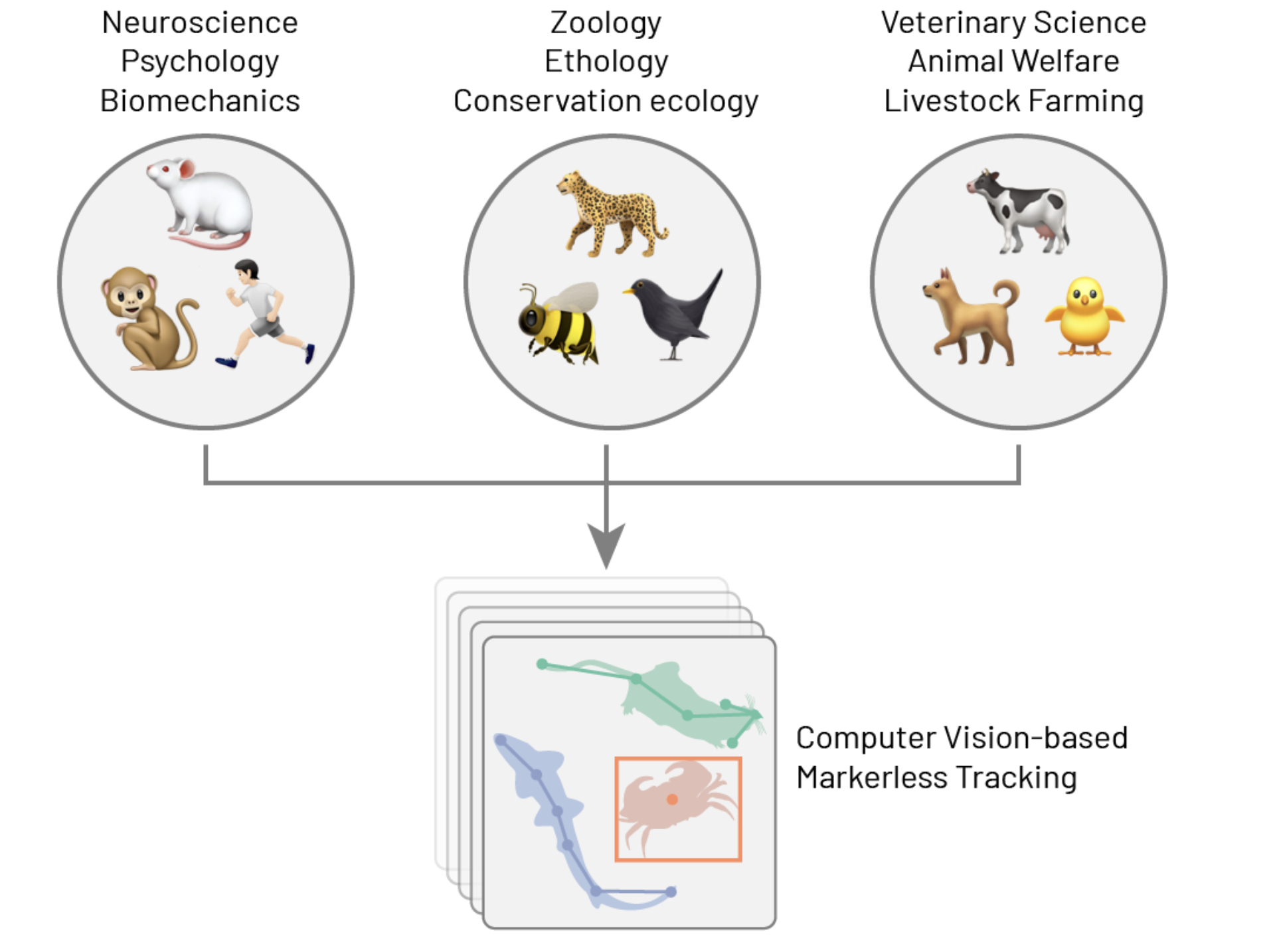
Figure 1. Scientific fields converging on computer-vision-based methods for quantifying behaviour. Deep-learning approaches extract user-defined body parts directly from video without markers, enabling high-throughput, non-invasive motion tracking across species.
Overview
Niko Sirmpilatze is a 2025 Software Sustainability Institute (SSI) Fellow and Senior Research Software Engineer at the Sainsbury Wellcome Centre, a neuroscience research institute affiliated with UCL in London. He builds open-source tools to study brains and the behaviours they produce, and leads movement—a Python package for analysing animal motion.
I organised the first Animals in Motion workshop in London, which was the central goal of my Software Sustainability Institute (SSI) Fellowship. The event brought together early-career researchers from diverse disciplines, all united by a shared aim: quantifying animal behaviour using open-source software.
Animals in Motion formed part of a broader Open Software Week held on 11–15 August 2025, which I co-organised with SSI Fellow Alessandro Felder, supported by many of our colleagues at the Neuroinformatics Unit. You can read more about the wider week in this companion post, where Alessandro and I reflect on the added value of combining our Fellowship activities.
In this post, I share highlights from the Animals in Motion workshop, reflect on what we achieved, and outline what comes next. Throughout, I use “we” to refer to the full team behind Animals in Motion—including Sofía Miñano and Chang Huan Lo, who were instrumental in designing, developing, and delivering the workshop materials.
Fellowship goals
When proposing my Fellowship project, I argued that several scientific fields interested in animal behaviour—from neuroscience to behavioural ecology—are converging on shared, computer-vision-based methods for measuring motion. Thanks to advances in machine learning, researchers can now track body movements directly from video, at scale and low cost (see Figure 1).
I saw this convergence as an opportunity to bring together researchers from these diverse communities and train them in using sustainable, open-source tools that support their common workflows. The goal was to build bridges between these communities and to create a two-way exchange between researchers and tool developers:
- Researchers would gain theoretical grounding, practical skills, and a new peer network.
- Tool developers (including the organising team) would learn from real users, building relationships and gathering feedback to guide future work.
By blurring the lines between these groups we hoped to consolidate and strengthen the shared ecosystem of open tools for behavioural analysis.
Workshop attendees
We promoted Animals in Motion widely across social media, mailing lists, online communities, and Slack channels, as well as through targeted outreach to graduate programmes and institutes focused on animal behaviour. As this was the first event of its kind, we were unsure how much interest it would attract. The response exceeded all expectations: we received 60 applications from around the world, most of them of high quality.
We selected 25 participants, the maximum number we could accommodate for hands-on teaching, and were delighted that 24/25 attended both workshop days—dispelling our concerns about potential no-shows. Thanks to support from the SSI and our other funders—described in the companion post about the Open Software Week post—we were able to charge no registration fees, provide catering for all, as well as fund travel for four Animals in Motion attendees. This helped us achieve strong geographic diversity: 9 attendees from London, 7 from the rest of the UK, 6 from Europe, and 2 from India.
We succeeded in bringing together diverse disciplines, species, and experience levels. Based on an opening poll (Figure 2), we welcomed researchers working with animals ranging from mice to… “flying” frogs—and spanning fields including neuroscience, behavioural ecology, biomechanics and conservation. Career stages ranged from Master’s students to early-career principal investigators. Two-thirds of attendees identified as women, likely reflecting the underlying demographics in these fields.
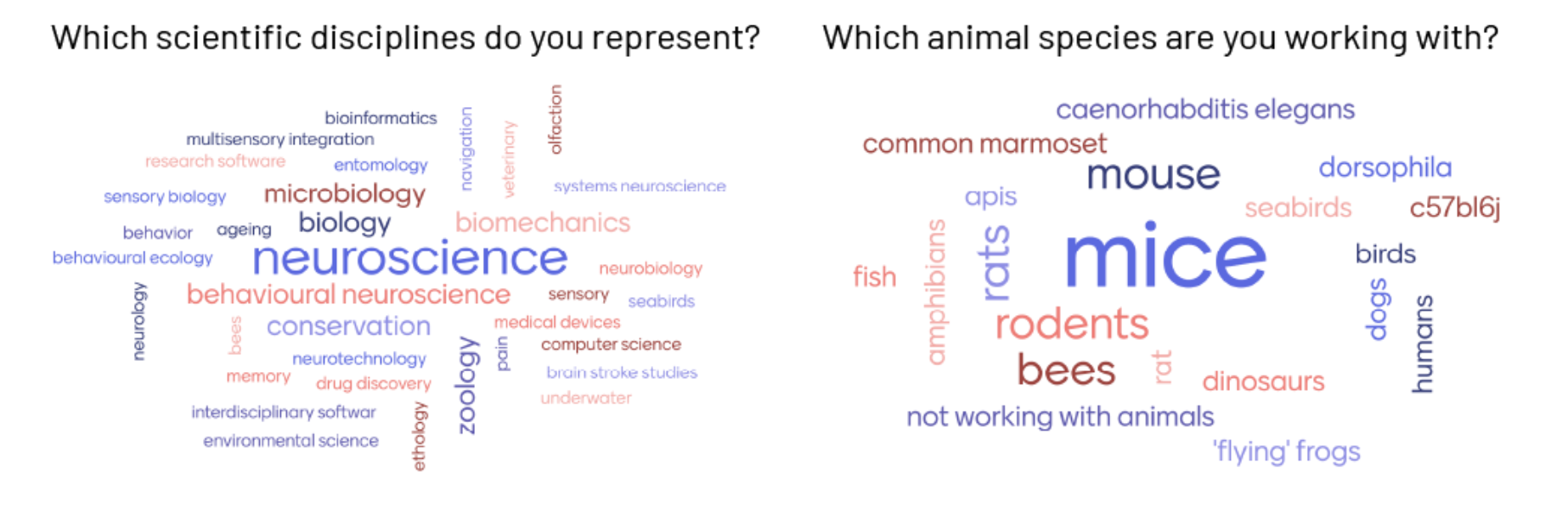
Figure 2. Word clouds generated using mentimeter.com show the range of scientific disciplines and model species across attendees.
From both direct observation and participant feedback, this mix of varied backgrounds and shared technical interests worked extremely well. Engagement levels remained high throughout the workshop and participants felt enriched by the diversity of attendees.
Workshop content
We began the workshop with a primer on deep learning for computer vision, in which Sofía Miñano introduced the concepts and technologies that underpin modern animal tracking tools. Several participants appreciated the accessible introduction to what can often feel like a complex and opaque field.
I liked the fact that we got an overview of the theoretical aspects as well. Hailing from a non-computational background, it always felt like a blackbox while trying out multiple software… Lavanya Ranjan, Indian Institute of Science Education and Research, Pune |
In the afternoon, we switched to practical training with SLEAP, using materials prepared by Chang Huan Lo. Participants learned how to annotate videos, train computer vision models, and use them to track animals. We provided sample videos to ensure everyone could follow along, although some people experimented with their own data, resulting in a fun showcase of diverse animals.
Day two focused on analysing motion tracking data using our open-source Python package movement. Participants worked through exercises that introduced them to loading, cleaning and visualising data, as well as asking questions about the animals’ kinematics. We finished with two real-world case studies that demonstrated how the tools covered in the course support ongoing scientific research.
Catering to the wide range of coding experience among attendees proved to be a challenge, especially during the Python-heavy second day. We had offered an optional introductory Python session before the workshop, but that could only go so far. To address this, we encouraged more experienced coders to support classmates, which had the added benefit of contributing to a strong sense of community.
I loved how it felt like nobody was left behind in the course, without this having a hard impact on those with more experience in computational methods. The heterogeneity of the attendees was truly enriching and gave me perspective on a wide-range of needs that movement wants to target. Carlo Castoldi, Institute of Molecular and Cellular Pharmacology, France |
Participants told us they would have appreciated even more time for exercises and discussion, and that is something we are keen to build into future editions. It was also extremely rewarding and useful to see our movement package in action, crash-tested in the hands of so many users.
We have chosen to openly share all workshop materials in the Animals in Motion Online Handbook. The handbook contains chapters written by Sofía, Chang Huan and myself, and it can be followed independently as a self-paced resource. We intend to keep expanding and updating it in response to feedback gathered during the workshop, so that it remains a freely accessible and reusable teaching tool for the community.
Blurring the lines between users and developers
A healthy open-source ecosystem relies on helping users become contributors. Hence a key aim of my SSI Fellowship was to give animal behaviour researchers the skills and confidence to take that step.
The Hackday, held on the final day of Open Software Week, was our main way of putting this into practice. About half of the Animals in Motion participants stayed on, joining attendees from other tracks of the week. To help everyone get started, we preceded the hackday with an optional half-day workshop on Collaborative coding with git, delivered by Joe Ziminksi and Laura Porta.
The hackathon itself followed a format inspired by the SSI Collaborations Workshops. You can browse the projects on this board. Some teams explored open-source tools using their own data, while others made contributions upstream—including several pull requests to movement, two of which have already been merged. One participant, Carlo Castoldi, also wrote a blogpost about his contribution, published on the movement website.
I will take this opportunity to especially thank Sofía Miñano, who proposed no less than five project ideas, mentored multiple teams during and after the hackday, and helped Carlo with finalising his contribution. She was the true hackday hero.
What's next
Organising and leading Animals in Motion has been the most rewarding experience of my professional career. I’d had ideas like this floating around for some time, but the SSI Fellowship was the catalyst that turned them into something real. The process of articulating those ideas for the Fellowship helped give them structure, and feedback from colleagues—as well as from my SSI mentor Colin Sauze—further refined them into a concrete plan.
I’m excited to keep building on this work. It’s been wonderful to see Animals in Motion so warmly supported by my team and our host institute. Animals in Motion will return on 17–21 August 2026, as part of the Neuroinformatics Unit Open Software Summer School—an event we aim to make an annual tradition.
My hope is for the workshop, alongside its online handbook, to form the nucleus of a growing community of practice for open-source tools in animal behaviour. In the long run, I’d love to see other teams around the world running their own versions of the workshop, building on the open materials we’ve created. If you would be interested in supporting such an effort, I'd love to hear from you. You can find my contacts through nikosirmpilatze.com.