
Skip to main content Site map
Old Tag
Fellows 2013
Fellows 2014
Fellows 2015
Fellows 2016
Fellows 2017
Fellows 2018
Fellows 2019
Fellows 2020
Fellows 2021
Fellows 2022
Fellows 2023
Fellows inaugural meeting
Fellows newsletter
Fellows selection
Category
HomeNews and blogs hub

Exploring RSECon 2023: A Conference Recap

Bookmark this page Bookmarked

Exploring RSECon 2023: A Conference Recap

Author(s)
Saranjeet Kaur Bhogal

Saranjeet Kaur Bhogal

SSI fellow

Posted on 11 March 2024

Estimated read time: 4 min
Sections in this article
Share on blog/article:
LinkedIn

Exploring RSECon 2023: A Conference Recap

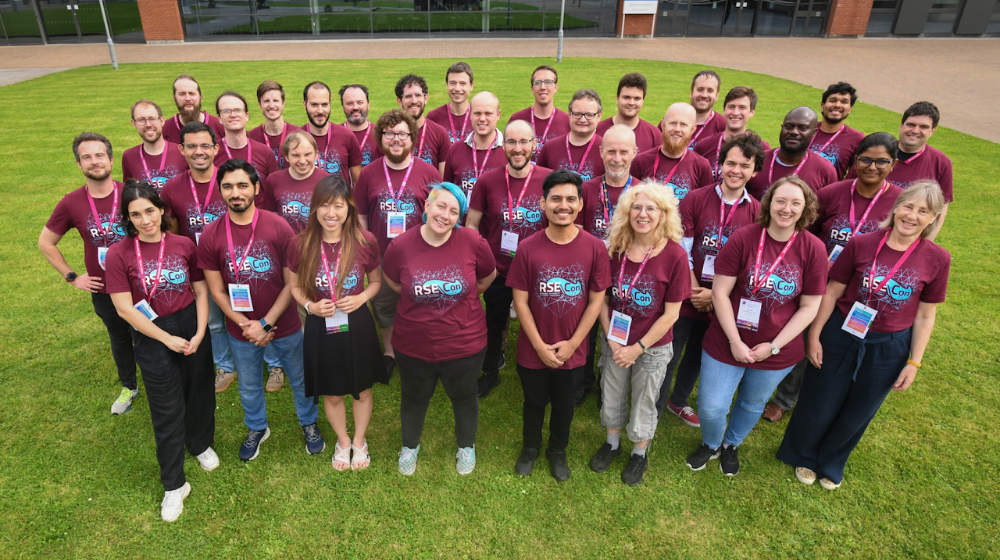
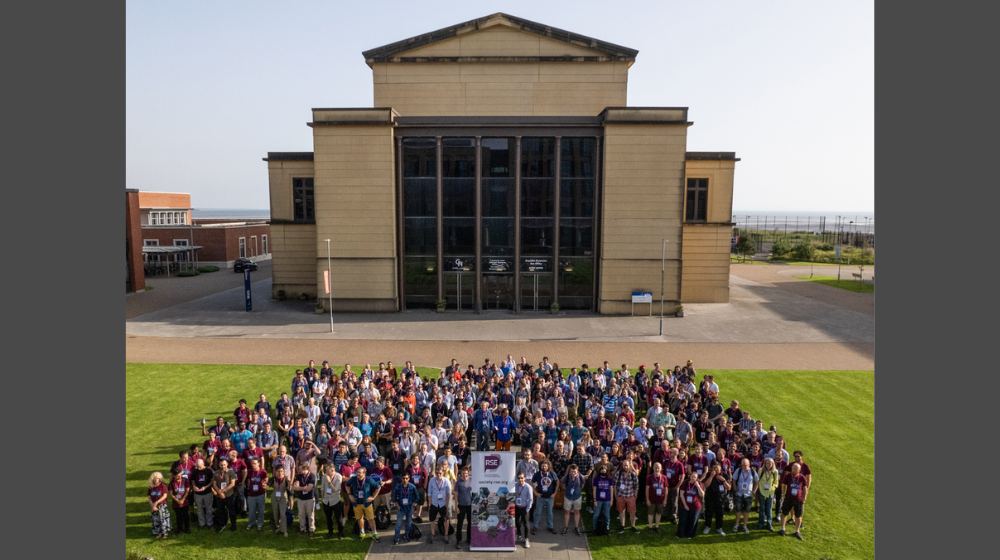
Volunteers’ group photo at RSECon23, Swansea

Between September 5 and 7, 2023, I had the chance to participate in the seventh annual research software engineering conference hosted at Swansea University's Bay Campus, UK. My involvement included volunteering at the conference, serving on the conference committee as the co-chair of the RSE Worldwide team, and presenting a poster. This blog post aims to recount and share my experiences from this conference.

Conference Committee and Volunteering

Being a part of the Conference Committee, I was involved in the planning phase of RSECon23 from the very initial phase. For planning the conference, the Conference Committee met remotely and developed different parts of the conference. I was the co-chair of the RSE Worldwide team along with Jannetta Steyn and Angel de Vicente. After several discussions and iterations, we invited Claire Wyatt to help us design and facilitate the RSE Worldwide session.

I also had the opportunity to be an in-person volunteer at RSECon23. The volunteer team was managed by Becky Smith. All the volunteers were assigned different tasks that ensured the smooth running of the event. 

Sessions during the conference

A number of different sessions were conducted during the conference like training, workshops, unconference tracks, birds of a feather, posters, lightning talks, hackathon, walkthroughs, etc.. The keynote by Dr Gaël Varoquaux titled “Saving the world one line at a time?!” was a reflection on the successes and failures of open computational science to make a better society. Another Keynote by Daniel S. Katz was on the “State of the US-RSE”. There were several training sessions and workshops conducted during the conference. The talk “Is RSE coming of age” given by Neil Chue Hong focused on how research software engineering can be meaningful and relevant to society. The plenary panel session brought together members of the RSEng community to share their experiences of RSE work across industry, national laboratories, charity, and the public sector. This panel explored the similarities and differences between the sectors, particularly in comparison to a university setting. The underlying aim of this panel was to showcase alternative careers to the more traditional RSE roles within an RSE team or embedded within a university research group.

My poster presentation

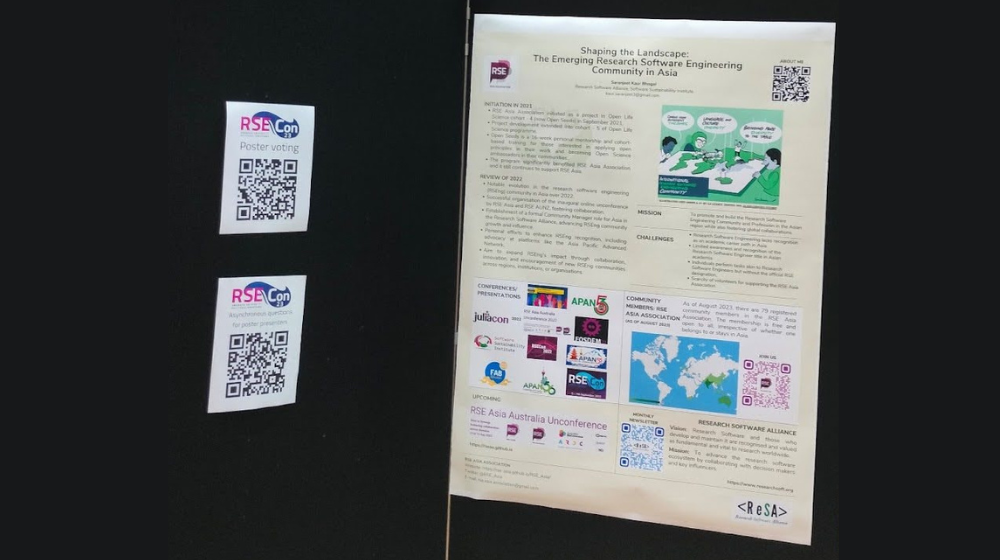
At RSECon23, I had the opportunity to present a lightning talk and a poster titled "Shaping the Landscape: The Emerging Research Software Engineering Community in Asia." This poster highlighted the journey of RSE Asia in 2023 and my work as a Community Manager (Asia) for the Research Software Alliance.

My poster at RSECon23, Swansea, UKMy poster at RSECon23, Swansea, UK

RSE Worldwide session

There was a hybrid RSE Worldwide session during the RSECon23 which was organised and co-chaired by Jannetta Steyn, Angel de Vicente, and myself. This session was facilitated by Claire Wyatt. The purpose of this session was to update the RSE community about the advancement of international RSE Groups and the advancement of the recognition and importance of Research Software in different countries. This session was divided into two parts. In the first part speakers from different regions (Africa, UK, South Africa, Germany, Asia, US, Netherlands and eScience Center) provided their updates. The second part focused on international RSE community building. During this session, Lou Woodley from the CSCCE talked us through some of the fundamentals of building a community of practice, and what works and what doesn't! The agenda for this session also included the launch of a “How-to handbook on international RSE community building” (Communal note taking for the handbook). However, due to time constraints, it was not launched during this session. 

Conclusion

In summary, attending RSECon23 was a wonderful experience which provided many learning opportunities. It was enriching to learn about the developments in the RSE community from across the globe!

Group photo at RSECon23, Swansea, UKGroup photo at RSECon23, Swansea, UK
Images by Saranjeet Kaur Bhogal

HomeNews and blogs hub

Exploring the APAN56 Conference in Colombo, Sri Lanka

Bookmark this page Bookmarked

Exploring the APAN56 Conference in Colombo, Sri Lanka

Author(s)
Saranjeet Kaur Bhogal

Saranjeet Kaur Bhogal

SSI fellow

Posted on 29 February 2024

Estimated read time: 4 min
Sections in this article
Share on blog/article:
LinkedIn

Exploring the APAN56 Conference in Colombo, Sri Lanka

APAN 56 logo

Introduction

From 21-25 August 2023, I had the privilege of attending the 56th Asia Pacific Advance Network (APAN56) meeting held in Colombo, Sri Lanka. This event allowed me to pick up where I left off after the APAN55 meeting in Nepal. In this report, I'll take you through my journey at APAN56, sharing valuable insights, experiences, and the exciting new developments that unfolded during this conference.

Day 1: Setting the Stage

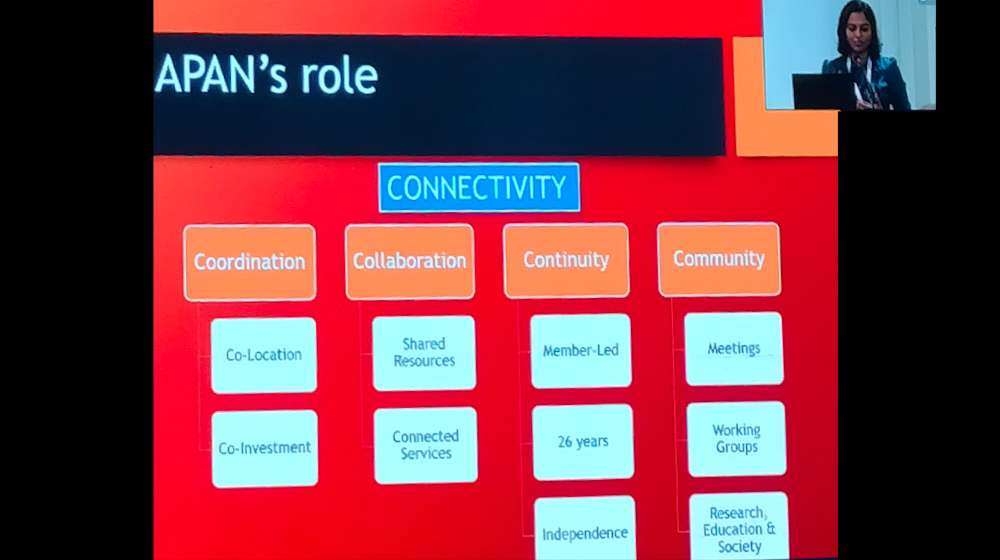
The opening day of APAN56 began with a session on 'Introduction to the Asia Pacific Advanced Network (APAN)' led by Liana Jacinta. This session laid the foundation for the entire conference, delving into critical topics such as reach, performance, collaboration, trust, innovation, and community within the National Research and Education Networks (NRENs). We explored the diverse models of NRENs, ranging from private companies to government agencies, and the unique challenges they face across various economies. APAN's pivotal role in uniting these networks through coordination, collaboration, continuity, and community involvement was a central theme. Additionally, the APAN Fellowship program, which fosters global collaboration by supporting fellows to attend APAN meetings, was highlighted. It was heartening to see all the APAN56 fellows share their objectives for participating in this event.

Liana Jacinta presenting “Introduction to APAN”

Liana Jacinta presenting “Introduction to APAN”

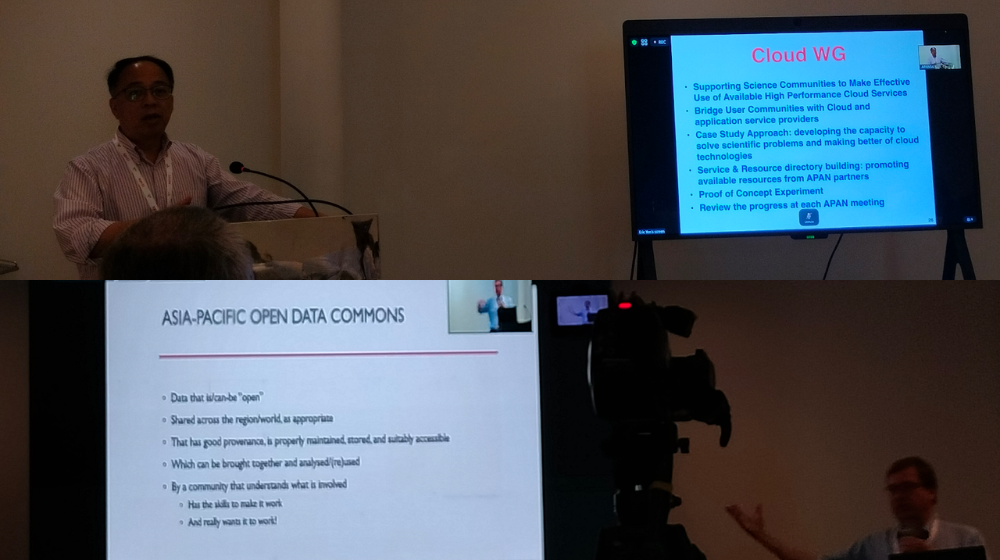
In the following sessions, I had the opportunity to learn about the Cloud working group's efforts to facilitate science communities' effective use of high-performance cloud services. At the open and sharing data group session, Markus Buchhorn painted a vision of the Asia-Pacific Open (research) Data Commons and discussed the apprehensions researchers have about working openly. Markus emphasised the importance of demonstrating change rather than merely talking about it, a crucial takeaway for all attendees.

Presentations at the Cloud Working Group and the Open and Sharing Data Group sessions

Presentations at the Cloud Working Group and the Open and Sharing Data Group sessions

Keynotes, Magazine Launch, and More

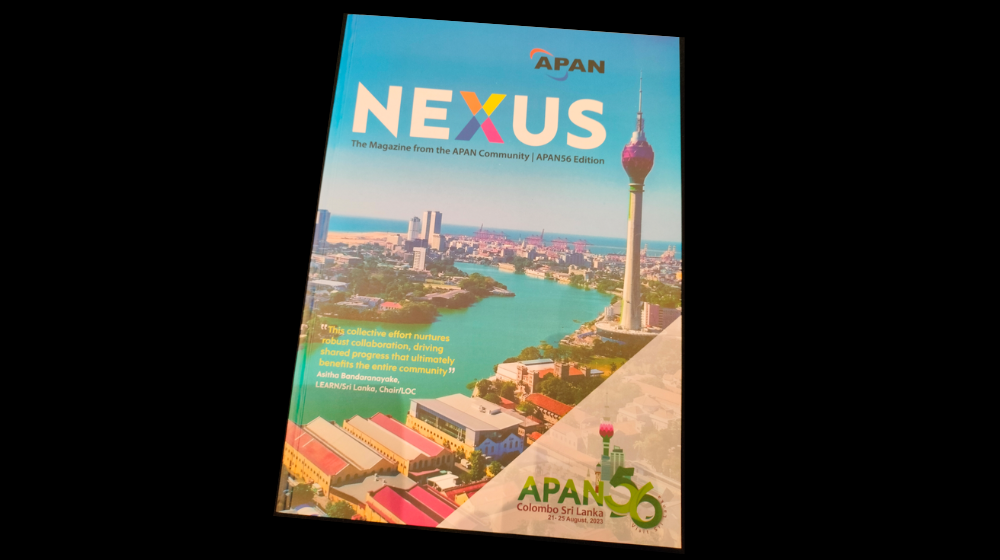
As the day progressed, I attended the keynote speeches and witnessed the launch of "Nexus," the official magazine of the APAN community. The magazine promises to be a valuable resource, providing insights and updates on the latest advancements in the field.

Nexus, the Magazine of the APAN community (APAN56 Edition)

Nexus, the Magazine of the APAN community (APAN56 Edition)

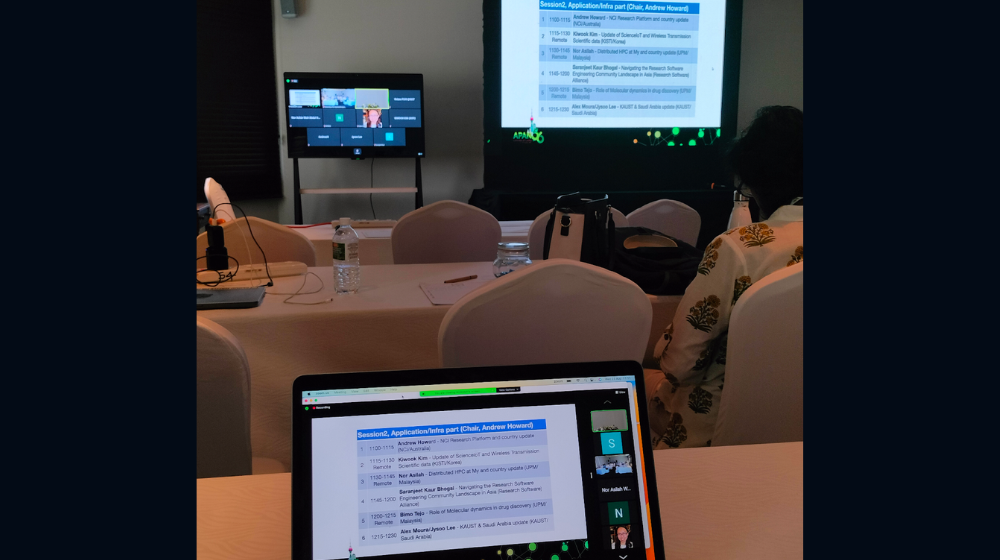
I also joined the Asia Pacific Research Platform (APRP) session, where I delved into the history of APRP. During this session, I had the opportunity to present my talk on "Navigating the Research Software Engineering Community Landscape in Asia," which was chaired by Andrew Howard.
 

My presentation at APAN56

My presentation at APAN56

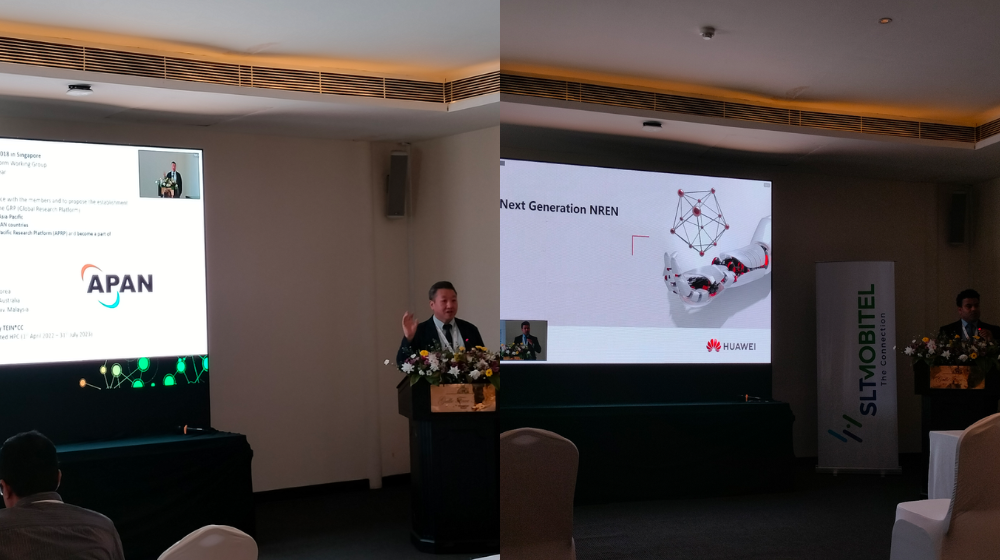
The industry session was particularly interesting, featuring engaging presentations by industry representatives who shared their visions for the next generation of NRENs. It was fascinating to envision the future of network research and education.

Presentations at the Asia Pacific Research Platform session and those by the Industry representatives

Presentations at the Asia Pacific Research Platform session and those by the Industry representatives

Conference Tracks

Throughout the conference, I explored a variety of tracks, with a particular focus on those related to artificial intelligence (AI). The diverse range of topics and presentations provided new perspectives. 

Conclusion

APAN56 was a truly unique experience. I was privileged to witness the introduction of new conference tracks, the launch of "Nexus'' magazine, and the emergence of countless opportunities and friendships. This meeting deepened my understanding of network research and education and reinforced the significance of collaboration and community in advancing our collective goals. I'm excited to take these newfound insights and connections forward and look forward to what the future holds for APAN and its vibrant community.

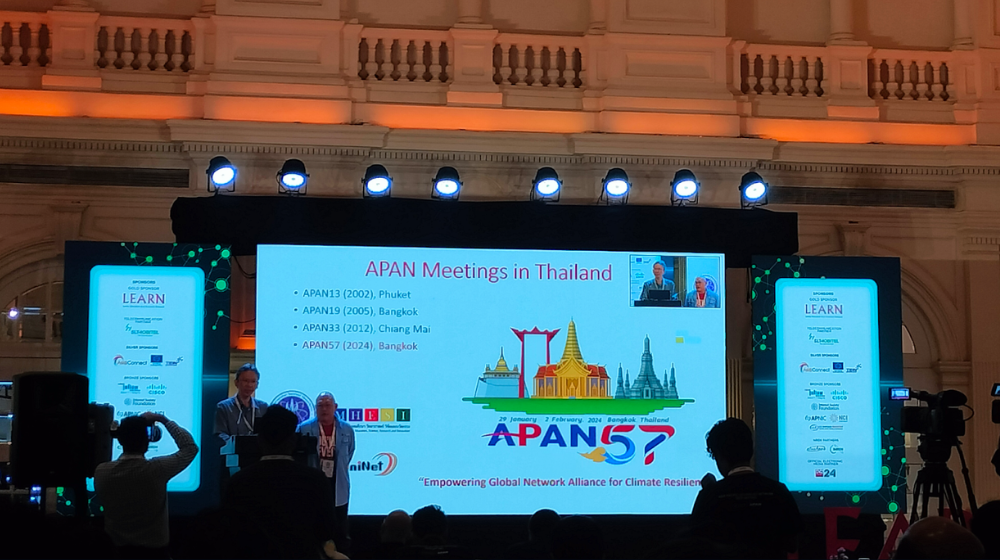
APAN57 in Thailand!

APAN57 in Thailand!

Images by Saranjeet Kaur Bhogal

HomeNews and blogs hub

BrazMedChem: attending the largest medicinal chemistry conference in Latin America

Bookmark this page Bookmarked

BrazMedChem: attending the largest medicinal chemistry conference in Latin America

Author(s)
Gemma Turon

Gemma Turon

SSI fellow

Posted on 13 February 2024

Estimated read time: 3 min
Sections in this article
Share on blog/article:
LinkedIn

BrazMedChem: attending the largest medicinal chemistry conference in Latin America

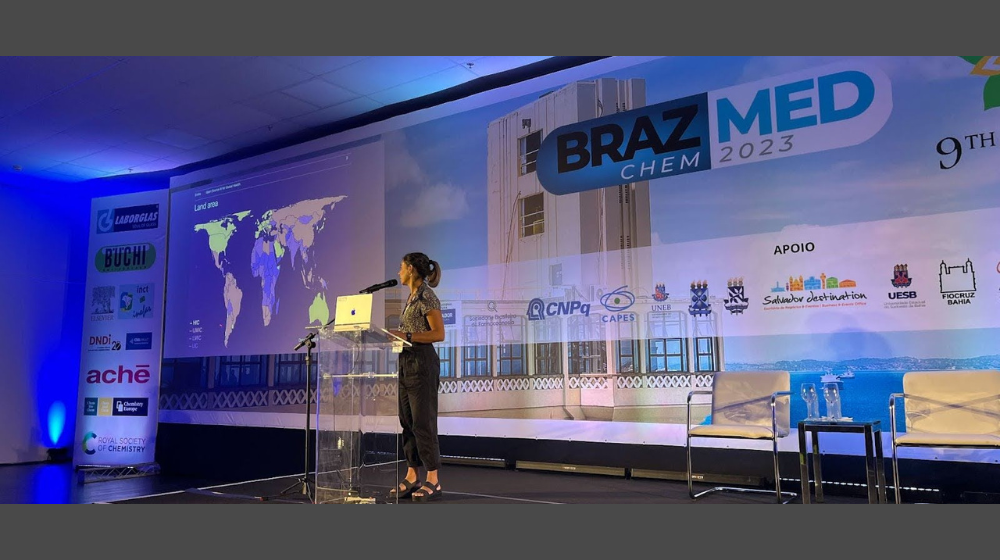
Gemma Turon presenting at BrazMedChem

An unexpected, yet very welcome outcome of our work at the non-profit Ersilia Open Source Initiative has been the opportunity to network with people from many diverse backgrounds; computer scientists, infectious disease researchers, open source enthusiasts, pharma companies, educators, big tech, other non-profits… and attending conferences and seminars has proven to be the best way to strike new collaborations, learn about the needs related to AI modelling for infectious diseases and get inspired by amazing teams and projects. 

As part of my SSI Fellowship, I’ve been able to attend a wide range of events, including the H3D Symposium (focused on drug discovery for infectious diseases), the RDA Plenary seminar (Research Data Alliance, particularly the FAIR for ML track), The Global PyData 2022 (in a joint talk with three other SSI Fellows) and of course the SSI Collaborations Workshop. Earlier this year, I was invited as a main speaker at BrazMedChem2023, the largest medicinal chemistry conference in Latin America (LATAM), and I am really grateful for the SSI support that has once more allowed me to attend. 

So far, most of my organisation’s partnerships have been in Africa, so BrazMedChem presented a unique opportunity to learn more about the drug discovery landscape in LATAM. I gave a keynote lecture in the session “Overcoming the gap between academia and industry”, where I could share Ersilia’s unique approach as a non-profit to supporting the discovery of new drugs against infectious and neglected diseases from the countries where these diseases are more prevalent. I also had the opportunity to learn, during the other keynote lectures as well as a highly active poster session, about the major challenges in drug discovery for Leishmaniasis and Chagas disease, two Neglected Tropical Diseases highly endemic in LATAM regions. Combined, they affect more than 30 million people yearly, but the treatment options are extremely limited and present mild to severe toxicity in patients. We hope to leverage the fantastic work of many of the conference attendees to build AI models that could help identify new candidates for these hard-to-treat, neglected conditions.

Finally, I’d like to highlight the fantastic initiative of the BrazMedChem organisers to hold space in the scientific schedule for much needed discussions, such as the round table “Challenges for med chemist women in academia and Industry”, in which I participated as an invited speaker, together with Dr Lori Ferrins (Northeastern University) and Dr Julia Monteiro (Eurofarma).

HomeNews and blogs hub

Fellows Newsletter: January 2024

Bookmark this page Bookmarked

Fellows Newsletter: January 2024

Author(s)

Catherine Inglis

Posted on 6 February 2024

Estimated read time: 7 min
Sections in this article
Share on blog/article:
LinkedIn

Fellows Newsletter: January 2024

A series of red outlined envelopes with the icon of the SSI.

Welcome to this month's SSI Fellows Newsletter which shares activities and opportunities taking place within the SSI Fellows' community. Read on for:

  • Fellows' Spotlight: Jannetta Steyn, Magesh Chandramouli, Ugur Yilmaz
  • January 2024 Community Call recap
  • Fellows' and related activities
  • Upcoming events and calls

Fellows’ Spotlight

Jannetta Steyn, Senior Research Software Engineer, Newcastle University

  • Updates from call - The original aim for CarpentriesOffline was to develop an SD card image with an operating system (OS) for the Raspberry Pi single board computer that would turn it into an access point and web server. This would allow a Carpentries instructor to run a workshop without any access to the Internet. We now have an image available for downloading in our GitHub repository. However, suggestions from the community have also led us to start work on a FlashDrive version of the OS that would turn any PC or laptop that can boot from USB into a server with the same functionality. We also have been working on a miniHPC (High Performance Computer) that would enable any instructor to set up a cluster using Raspberry Pis to teach the HPC intro lesson in the Carpentries Incubator. See more on https://carpentriesoffline.org
  • My non-work highlight - I find it difficult to separate my fun from my work, but I think I mostly manage when I start 3D printing things. So for the first time in many years, I actually managed to get some Christmas presents done, in time for Christmas 2023, which included personalised keyrings, flower pots, cookie jars, bobble heads etc. I also managed to print some CarpentriesOffline swag and Raspberry Pi cases.
  • My recommendations - If you would like to start 3D printing stuff, have a look at the Bambu A1 Mini (or a bigger model if you want to spend more). I have the Bambu P1S but it is my fourth 3D printer.

Magesh Chandramouli, Professor - Computer Graphics Technology, Purdue University Northwest (USA)

  • Updates from call - Several interesting activities were conducted after becoming an SSI International Fellow. For dissemination and ease of access, all the results are being presented through a dedicated website (https://www.xreal-xperienz.org/). With the support from the SSI fellowship, I have been conducting international panel meetings with two panel groups involving academia and industry professionals in extended reality (XR). The discussions with the panellists and eminent international faculty and administrators have provided new insights and enhanced understanding of the UI/HCI aspects of XR and how these can be improved for sustainable applications. I delivered an invited lecture at the Technological Institute of the Philippines, Manila, on Virtual Reality (VR) applications that covered multiple modes of XR including VR, Augmented Reality (AR), and Mixed Reality (MR). With support from the SSI fellowship, I have recently delivered invited lectures at the Indian Institute of Technology (IIT), Madras, and Shiv Nadar University, Chennai, on Virtual Reality Applications.
  • My non-work highlight - I have received my Black Belt in Karate. This especially is memorable to me as my two teenage kids and I obtained our first degree Black Belt together. I love martial arts as they are not just about physical strength but also about building mental strength and perseverance. 
  • My recommendations - The Secret Teachings of The Vedas (Kindle Edition) by Stephen Knapp

Ugur Yilmaz, DevOps Engineer, SKA Observatory

  • Updates from call - Continuous Integration (CI) is vital for Research Software, ensuring reproducibility, version control, enhanced quality, security, and easier contributions, all contributing to long-term sustainability so I am planning two workshops titled “How can you package your software using CI/CD pipelines to make it more accessible and reusable using containers?” and “From first commit to a software release in under 15 minutes!” to highlight the importance of using Continuous Integration practices and to increase knowledge with hands-on experience. The idea is that having templates that just work and learning how to integrate them in 15 minutes would help us keep our software sustainable. The workshops will be in SKA Observatory Headquarters located in Jodrell Bank, Macclesfield, UK. It will be a 1.5-day event starting in the afternoon and finishing the next day - dates to be confirmed soon.
  • My non-work highlight - I started tinkering with 3D printers, printing and designing various things. I am hoping to bring some SSI-themed prints to this year’s CW24. Overall, it’s been an eye opener into another field of engineering.
  • My recommendations - The Dawn of Everything, by Graeber and Wengrow: a book that changes the perception you would get from Sapiens book (by Harari) and challenges the conventional wisdom of human history. I recommend this to anyone who liked Sapiens and wants a more science-backed book on the topic.

Community Call Recap

During the January SSI Fellows Community Call, we heard Fellows’ updates from Jannetta Steyn, Magesh Chandramouli and Ugur Yilmaz. After the updates, we moved into breakout rooms, with one speaker in each room, which gave the other attendees a chance to ask more questions and continue the discussion. You can watch the recordings here:

Fellows’ and related activities

  • Publication plan - looking for inspiration from Fellows (from Kim Martin) - “I’m working on putting together a ‘publication plan’ to try to secure funding for 2024 - anyone want to chat to give me inspiration (including suggesting potential co-publications)? Feel free to connect on LinkedIn.
  • Software development meetings (via Oscar Seip) - Should you have any software development meetings you’d like to invite other fellows to or bring to their attention, please don’t hesitate to share the details on the “running software project” channel on Slack.

Upcoming events and calls

  • Software in Polar Science 2024 (via James Byrne, 2022 Fellow). This event is intended to highlight the role software plays in polar and environmental research, championing sustainability in its use and helping attendees to gain visibility and training in digital infrastructure. We're running a software carpentry and the SSI's own Shoaib Sufi has kindly stepped up to be the keynote speaker and on a panel also including SSI fellow Sadie Bartholemew! 
  • Job vacancies: 6 x Research Software Engineers (via Michael Tso, 2023 Fellow). Michael’s group at the UK Centre for Ecology and Hydrology is hiring six research software engineers (4 Research Software Engineers and 2 Senior Research Software Engineers). They will be based in Michael’s group but also embedded in groups and projects tackling specific environmental challenges. They are also hiring a data steward. Please help to publicise the vacancies.
HomeNews and blogs hub

Ersilia: AI as a tool for drug discovery in Africa

Bookmark this page Bookmarked

Ersilia: AI as a tool for drug discovery in Africa

Author(s)
Gemma Turon

Gemma Turon

SSI fellow

Posted on 19 January 2024

Estimated read time: 3 min
Sections in this article
Share on blog/article:
LinkedIn

Ersilia: AI as a tool for drug discovery in Africa

Ersilia and SSI logos

The Ersilia Open Source Initiative, the small non-profit organisation I co-founded 3 years ago, has achieved a major milestone: completing its first end-to-end implementation of AI-based tools for drug discovery against infectious diseases in an African institution where no prior AI expertise was available. In particular, we have focused on building AI models that predict the outcome of each one of the experimental assays used in malaria and tuberculosis drug discovery cascades, from bioactivity to toxicity. In this blogpost, I want to highlight the three major challenges we overcame while doing this work, and why we hope to see more and more of this kind of AI applications in science!

First, conducting high quality research in non-standard settings. Ersilia, a small research non-profit linked to, but outside traditional academia, partnered with the Holistic Drug Discovery and Development Centre (H3D), a non-profit drug discovery centre associated with the University of Cape Town (South Africa). To make this collaboration a success, two of Ersilia’s scientists (myself and Dr. Miquel Duran-Frigola) spent up to 6 months (along 2021 and 2022) at the H3D Centre, to understand the existing capabilities, train its staff in AI tools for drug discovery and ensure successful implementation of the AI models developed as part of the project for ongoing research projects. 

Second, extending AI use to non-expert scientists. AI is becoming increasingly used throughout research fields, but many experimental scientists (like I was once, see this SSI blogpost about the transition from the bench to computer sciences) do not yet leverage its potential. We have focused on making our tool, ZairaChem, fully automated, so that maintaining the existing AI models and training new ones is simply a click away.

And third, balancing our open source and open access statements with working with IP-protected data. ZairaCehem features an option “anonymize”, that allows the researcher to build a model with IP-sensitive molecules and release it without disclosing the nature of the compounds used as training data. This way, we can leverage data that would otherwise remain shelved and convert it into AI models that might help other researchers. All AI models developed in this project were made available through the Ersilia Model Hub, and we have published the code under a GPLv3 licence. Importantly, the work has just been published in Nature Communications in Open Access, thanks to the support of the SSI fellowship.

In summary, we hope this project sets the basis for expanding the use of AI to accelerate drug discovery against infectious and neglected diseases in institutions located where these diseases are more prevalent, reducing the digital gap and producing state-of-the-art science in traditionally underfunded settings.

HomeNews and blogs hub

Helping people from underrepresented groups enter the world of software

Bookmark this page Bookmarked

Helping people from underrepresented groups enter the world of software

Author(s)
Kasia Banas

Kasia Banas

SSI fellow

Posted on 11 January 2024

Estimated read time: 3 min
Sections in this article
Share on blog/article:
LinkedIn

Helping people from underrepresented groups enter the world of software

A person working on a laptop, the codebar logo

One of my aims as a 2023 SSI fellow is to contribute to the software and data community locally – in Edinburgh and Scotland. As part of this work, I have become a co-organiser of the Edinburgh chapter of codebar. Codebar is an international organisation working “to enable minority group members to learn programming in a safe and collaborative environment and expand their career opportunities.” The format of a typical codebar workshop is an hour of networking over pizza and drinks, followed by 2 hours of pair programming, where each learner is paired with an experienced coach. The workshops are usually hosted by local tech companies, who provide the space and involve their staff members, providing opportunities for the learners to meet people working at that company and make connections that way.

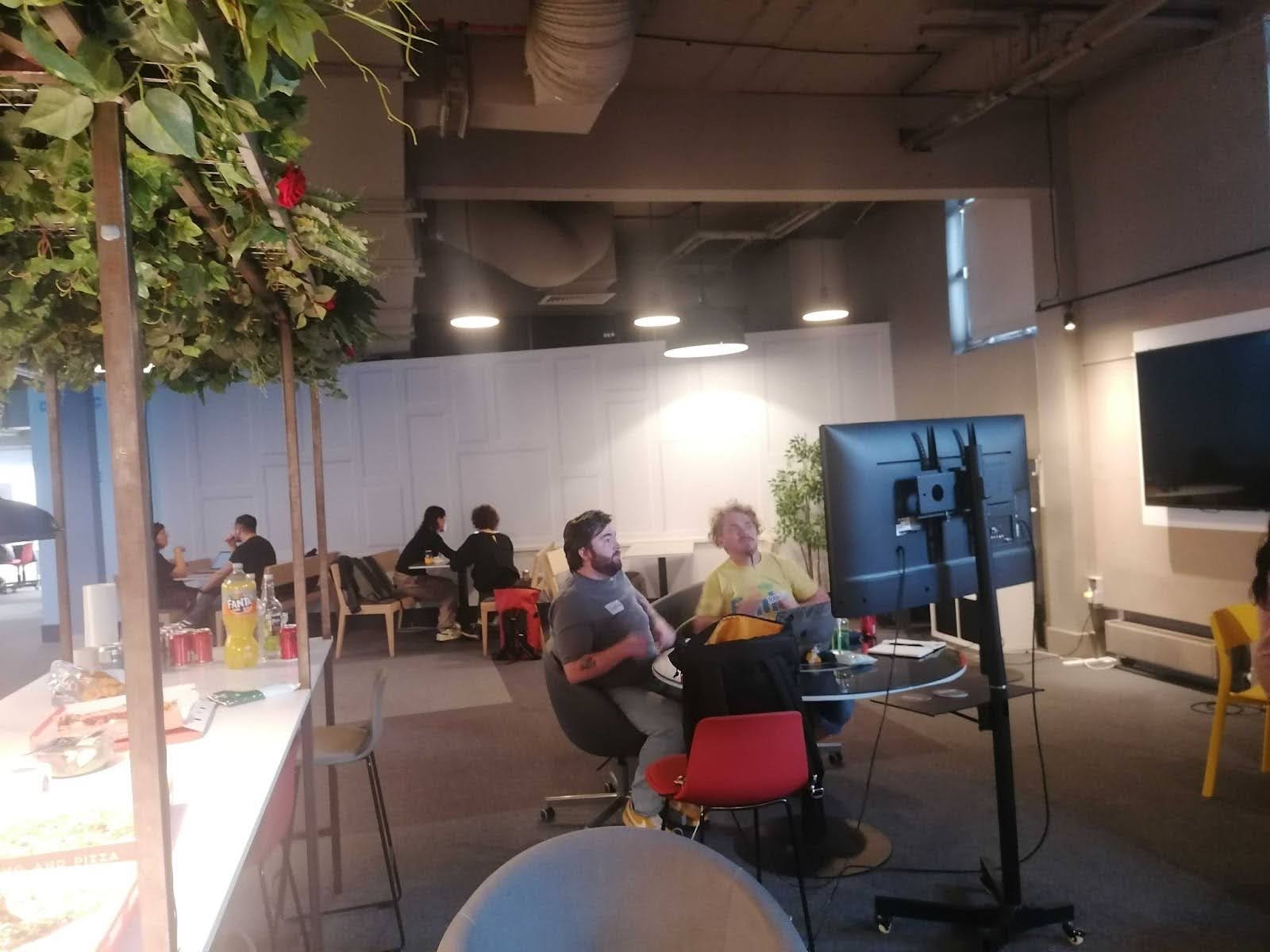
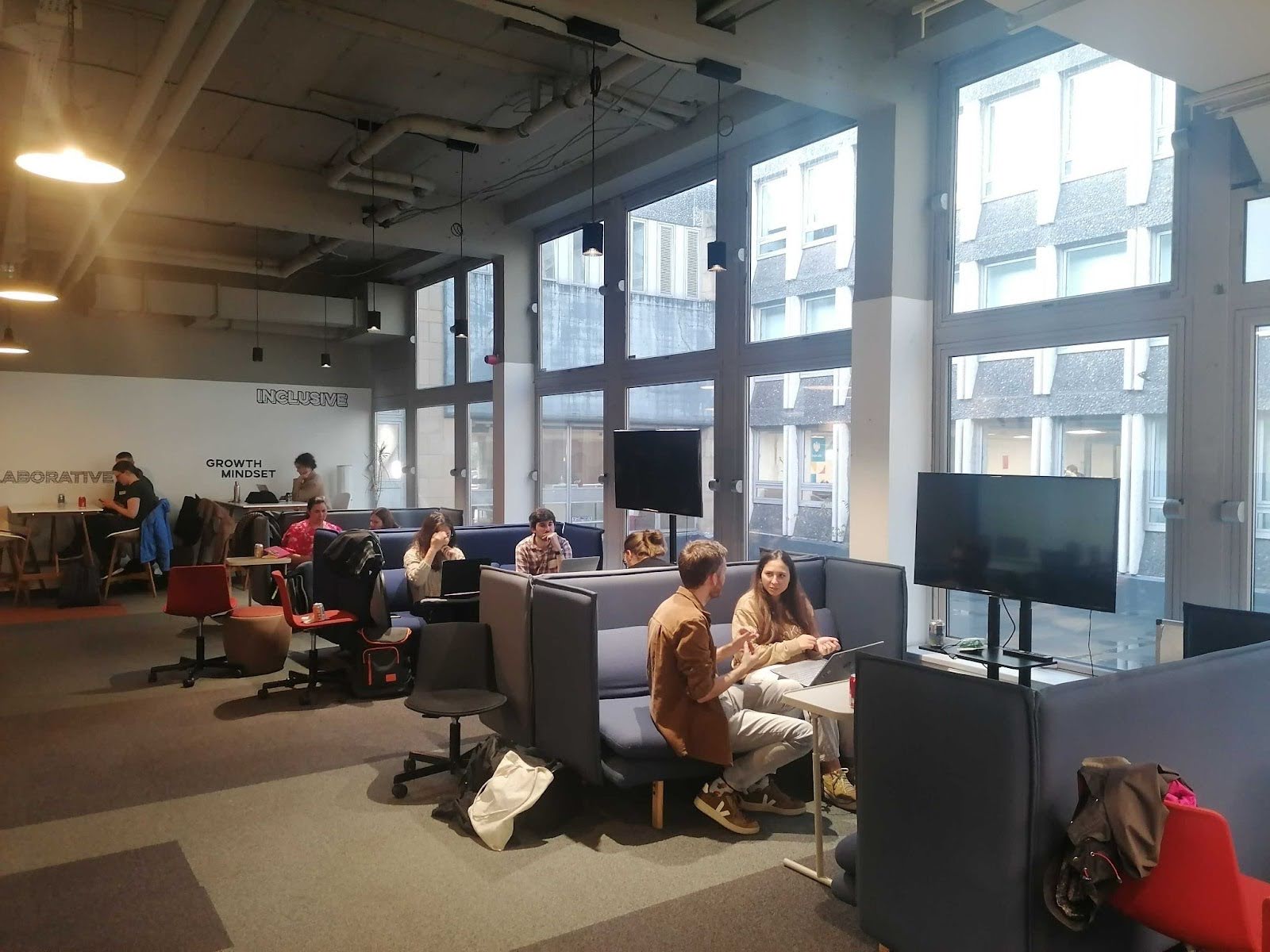
The September 2023 workshop was held at the premises of CodeBar Edinburgh – a coding bootcamp provider that was vital to Scotland’s digital skills development, but unfortunately went into liquidation earlier this year. It was the largest workshop since the Covid-19 pandemic, with 13 students and 11 coaches in attendance. I personally was working with a university student who will be using R for her dissertation and was looking for a refresher on using R and running linear mixed effect models. Other coaches were helping learners progress their projects in JavaScript, Python and SQL. Some learners were looking to enhance their portfolios in preparation for job hunting, some had large projects that they had been working on for months, others were complete beginners looking to start their adventure with coding by learning the basics of Python. Regardless of their experience level, each learner got personalised support and was able to make good progress over the course of the 2 hours.

Codebar coaches come primarily from the commercial tech industry, but some are academics or research software engineers. In the Edinburgh chapter, we have about a 50/50 split of coaches: half have a formal computer science or related background, and the other half are graduates of coding bootcamps.

There are codebar chapters around the world, and they are always looking for enthusiastic coaches. There is even a virtual codebar, which you can join from the comfort of your home, anywhere in the world. You don’t need teaching experience to join in – all we are looking for is a positive attitude towards other people and some technical experience in at least one programming language (you can specify your skills when you join in). The organisers then ensure that each learner is paired with a coach who can help them with the project at hand. If you would like to join in (as a coach or as a learner), have a look at www.codebar.io for more information and the joining form (you’ll need a GitHub account to register).

HomeNews and blogs hub

An overview of FOSDEM 2023

Bookmark this page Bookmarked

An overview of FOSDEM 2023

Author(s)
Colin Sauze

Colin Sauze

SSI fellow

Posted on 10 January 2024

Estimated read time: 11 min
Sections in this article
Share on blog/article:
LinkedIn

An overview of FOSDEM 2023

A theatre room, the FOSDEM logo on top

Introducing FOSDEM

For those who aren’t familiar with it, FOSDEM, or the Free and Open Source Developers European Meeting, is one of, if not the biggest, Free and Open Source conference in the world. It takes place at the Université Libre de Bruxelles Solbosch campus in Brussels, Belgium, on the first weekend of February every year and attracts over 8000 attendees. It is completely free to attend, there’s not even a registration process and the whole thing is run by volunteers. 

Deciding what to see

As there are so many talks, it is simply impossible to see everything you want. Sometimes rooms fill up and it isn’t possible to get to some talks, and sometimes two back to back talks you want to see are on opposite sides of the campus. It definitely helps to plan what you are going to see and at least have one backup option during each time slot. For this, I used the FOSDEM Companion app which has an offline copy of the schedule, lets you mark which talks you’re interested in and alerts you when they’re about to start. 

Open Source Infrastructure and Volunteers Running the Conference

Every FOSDEM talk is recorded using their own open source video capture solution (if this interests you, see this talk from the infrastructure team). Talks were also streamed live and there were also several remote only tracks, including the Research track which featured talks by SSI Fellows Rachael Ainsworth and Saranjeet Kaur Bhogal. Not only was this a great way to allow online participation, but it also gave people attending FOSDEM in person a way to see a talk live when the room was full or they couldn’t get across the campus fast enough. 

The whole conference would not have been possible without a small army of volunteers who do everything from running the video streams and network infrastructure, to setting up rooms, dealing with lost property and running a help desk. I was particularly impressed to see several people whom I knew from when they were students and had come on student trips to FOSDEM now returning as volunteers and sometimes with support from their graduate employers.

My Highlights from the talks I saw

I could probably write several blog posts about all the great talks I saw and several more about the talks that I didn’t see during FOSDEM. Here are just a few highlights that I think might be interesting to readers of this blog. 

Consulting for digital humanists

This talk by Marie Dubremetz covered the culture shock involved with getting humanities researchers working with software developers and computer scientists. Many of the issues encountered sounded like they’d be very familiar to many research software engineers. At times it was difficult to find a common language and it shows the importance of software engineers asking the right questions of people they build software for. There are also big cultural differences with most humanities researchers being Windows or Mac users, being interested in answering a research question, not developing a technology. Humanities researchers are slightly more likely to be female than male whereas software engineers are still overwhelmingly male. 

Tackling Disinformation using Open Source Software

This was a great talk by Hervé from Openfactor about tracking down and tackling disinformation online using open source tools. The speaker described himself as a techy but not a coder and made this clear by being one of the few people at the conference wearing a suit and stating “I'm not a coder as you can see". This work focussed on identifying the key person behind Qactus, often dubbed the French QAnon. 

The other kind of Software Sustainability

One theme I hadn’t seen discussed much at previous FOSDEMs was environmental sustainability and the impact of computation on the environment. I attended four talks that covered this subject. 

The first was “Open source in environmental sustainability” by Tobias Augspurger which discussed:

  • Several open source tools that are helping in sustainability including: 

     Biodiversity and satellite image analysis tools  

     Pvlib for designing solar panel arrays 

     Pypsa for simulating power grids.

  • The problem of academic projects where code is thrown onto Git Hub but isn’t really reusable. 
  • How openness is key to traceability in environmental modelling, we shouldn’t blindly trust somebody else’s model and doing so can propagate uncertainty and errors from one model to another. 

The second and third talks were by Chris Adams from the Green Web Foundation, the first was in the Sovereign Cloud track on “Responsible clouds and the green web triangle” and the second in the Energy track on “Getting to a Fossil Free Internet by 2030”. In these, he talked about:

  • The need to make code more efficient to reduce energy consumption
  • How the Firefox Energy Profiler (discussed in another talk that I didn’t make it to) can help developers target their optimisations.
  • Moving performance critical parts of programs to compiled languages to improve performance and reduce computational overheads.
  • Reducing the overall consumption of computing
  • The Kepler project’s carbon intensity measurement tool for Kubernetes
  • Timeshifting when computation happens to when the grid emissions are lower
  • Carbon aware routing protocols that minimise carbon emissions instead of performance
  • To meet the goal of being net zero by 2050 we need to halve IT emissions by 2030. Organisations that are serious about doing this will need interim targets as soon as 2025 to achieve that. They’ll need to start measuring the impact of their computing very soon to determine if they’ve met their 2025 targets.
  • Creating environmentally aware design patterns for software developers to follow.
  • A mention of the Environment Variables podcast from the Green Software Foundation. I subscribed to this after the conference and it has taught me a lot more about this growing movement. It was part of my inspiration behind proposing the Climate Aware Task Scheduler idea at Collaborations Workshop in May. 

The final talk on this topic was “Combatting software-driven environmental harm with free software.” by Joseph De Veaugh-Geiss. He talked about:

  • How the ICT sector represents 1.8 to 3.9% of global greenhouse gas emissions and by 2050 this will be 30% if nothing changes.
  • Improving the efficiency of software can reduce the amount of electricity it uses. 

     Comparing a popular proprietary word processor with a popular open source one, the open source one used four times less energy performing the same task. Millions or even billions of people use word processors daily, a small change in the software might have big impacts.

  • A lot of the ICT sector’s emissions come from the production of hardware, not from the operation of it, this is especially true with mobile devices. 

     Cited the example of an iPhone 7 where 78% of the lifetime greenhouse gases came from its production.  

     We can have a big impact by not making functional hardware obsolete so quickly and open source software often does a better job at supporting older hardware.

  • There are now mechanisms for certifying the sustainability of software.

     The talk mentioned the KDE Project being granted the German Blueangel environmental certification. 

     This was achieved through resource efficiency and transparency of the energy measurements, running on older hardware, long term support and user autonomy to disable unwanted features. 

There were several other talks in the Energy track that I didn’t get a chance to see around this subject, but I’d suggest anybody interested in it have a look at these on the Energy track page. In particular, the talks on Carbon Intensity Aware Scheduling in KubernetesGreen Software Engineering and the Firefox Power Profiler all looked very interesting.

Other Talks 

There were many other great talks that I saw at FOSDEM that I simply don’t have time to write about in detail. But here are links to some of them:

  • Similarity Detection in Online Integrity, by Alberto Massidda from Meta. This covered a set of techniques used to detect images to be blocked such as child exploitation, revenge porn and terrorism. They ranged from some very computationally simple techniques up to deep learning models. 
  • I attended two talks [12] about how to support FIDO hardware tokens such as Yubikeys and Titan Security Keys in your applications.
  • Openstreetmap: open your emergency eyes, by Nicole Martinelli covered using OpenStreetMap to plan emergency responses. She focused on the example of heatwaves and efforts to tag “cool centres” where members of the public could shelter from the heat. 
  • Bizarre and Unusual Uses of DNS by Peter Lowe was a great look at all kinds of weird and wonderful (ab)uses for the DNS protocol. Including a reverse polish notation calculator, geocaching via DNS, a text adventure game, tunnels and VPNs over DNS and even filesystem over DNS.
  • The PolyVent FLOSS ventilator by Robert Read about an open source ventilator design and how it was being built using a Unix-like philosophy with modular components that “do one thing well” that would facilitate training people to understand and repair the device. 
  • Can Genode on the PinePhone question the notion of a smartphone?  By Norman Feske presented work to use the highly secure Genode operating system on the open source Pinephone to create a phone experience where the user has complete control over what it runs.
  • Practical Computerized Home Automation covering 10 years of the presenter’s experiences with various home automation technologies that he’s deployed in his house and thoughts on non-technical people using and accepting these. 
  • There was a launch of an open source pico balloon called TinyGlobo. Unfortunately, I only found out about this after the conference. 
  • Celebrating 25 years of Open Source: Past, Present, and Future a keynote talk by Nick Vidal set out the history of the Open Source movement and gave an overview of how we got to where we are and future challenges and opportunities for open source.
  • Making the world a better place through open source collaboration by Gabriele Columbro discussed how popular and ubiquitous open source has become and how it now underpins large amounts of the economy. 
  • Free culture CV by Pablo Hinojosa Nava presented the idea of trying to build free culture CVs that reflect people’s contributions to free culture projects. This includes open source software contributions and non-code contributions such as Wikipedia, OpenStreetMap, translation and documentation efforts. 

There were many more that I didn’t get to see and that I’m gradually working through watching the recordings of. Some recordings are up on the FOSDEM YouTube channel and all of them are available via the FOSDEM 2023 website

FOSDEM 2024

If you’re thinking of attending FOSDEM in 2024 the dates have been announced already as the 3rd and 4th of February 2024 in the same location. Keep an eye on https://fosdem.org/2024/ for updates.

HomeNews and blogs hub

CarpentriesOffline at RSECon23

Bookmark this page Bookmarked

CarpentriesOffline at RSECon23

Author(s)
Jannetta Steyn

Jannetta Steyn

SSI fellow

Posted on 5 January 2024

Estimated read time: 7 min
Sections in this article
Share on blog/article:
LinkedIn

CarpentriesOffline at RSECon23

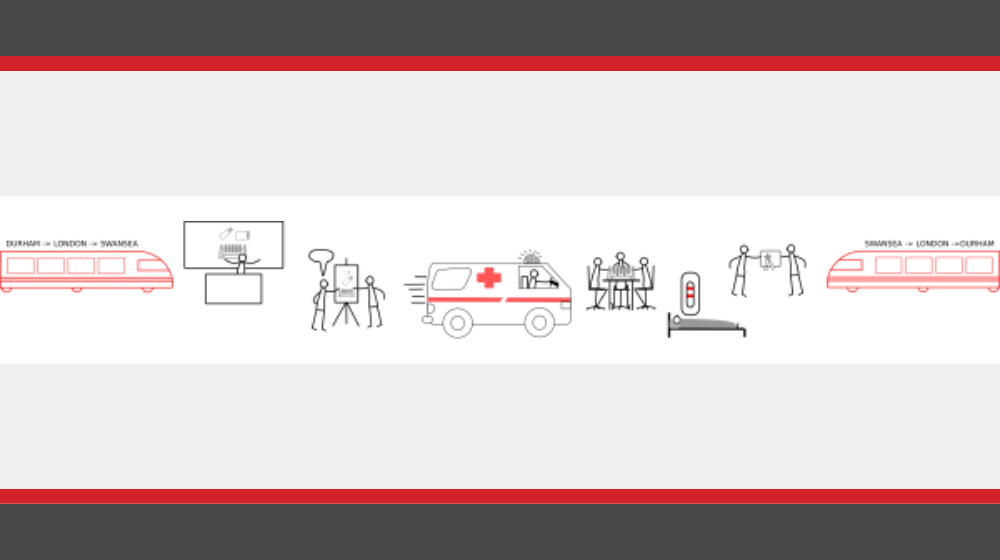
Icons resuming the event described in the blog

I do love RSE Conferences; this year was my fourth. But I didn’t quite expect so much to happen in such a short time as it did this year. This blog post is to serve as a story recalling the adventures of a research software engineer leading up to and attending an RSE conference and to thank all the people that made the adventure possible. Obviously, I’m the hero in my own story but I would not have been able to get anything done if it wasn’t for Colin Sauze, Ethan White, Samantha Finnigan, Frances Hutchings and Abhishek Dasgupta.

In the run up to the conference, a few things had to happen. Since I am an SSI Fellow (2022 cohort), I was still spending my Fellowship money and as part of this, I decided to build a miniHPC that can be used for training. This is an extra strand to the project in addition to the other two options, which are turning a Raspberry Pi into a server and also producing a flashdrive option that turns a laptop into a server, all to deliver Carpentries workshops without access to the Internet. With these things in mind, we the CarpentriesOffline team decided to submit abstracts to RSECon23 for a poster and a hackathon.

I never could have imagined, though, how difficult some companies make it to get educational discounts. It was impossible to get Raspberry Pi computers earlier this year, so I decided to go for Rock Pi and then made the mistake of asking for an educational discount. I had three weeks before leaving for Argentina and wanted to get as far as possible with setting up the miniHPC but, alas, it took me three weeks to get an educational discount code for a next day delivery order.

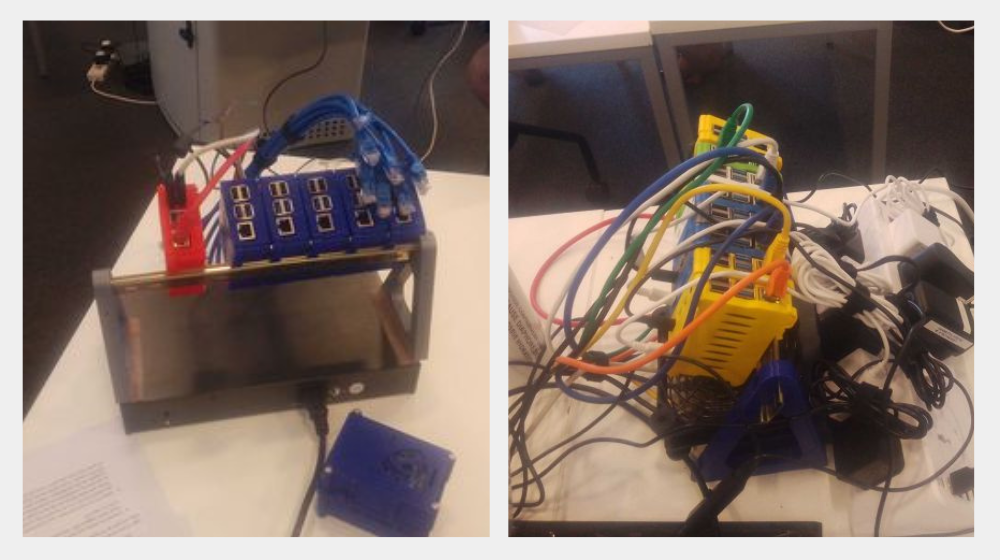
Hoping to have a working HPC if our hackathon proposal was accepted, I spent the next three weeks chasing the Rock Pi order. Not one to sit still and wait, I started getting all the Pis in my house together and built a five node HPC with 4GB Pi 4s. With the help of Sam Finnigan, we 3D printed a rack and cases for the Pi.

I was off to Buenos Aires for the Carpentries’ Executive Committee retreat at the time that the abstracts had to be submitted and had to rely on Colin to do the submissions. With the help of the rest of the team, Frances, Abhishek, Ethan and Samantha, all was done in time.

We were quite pleased when we learned that both our poster and a hackathon proposal were accepted. Over the next few months, we worked on our poster and the RPi miniHPC, which we named Pixie. I was eventually able to order the Rock Pis and all the bits that were needed for the HPC. Sam and I 3D printed some more cases, but I did not have enough time left to start installing software on it so it became one of the things on the list for the hackathon attendees to do.

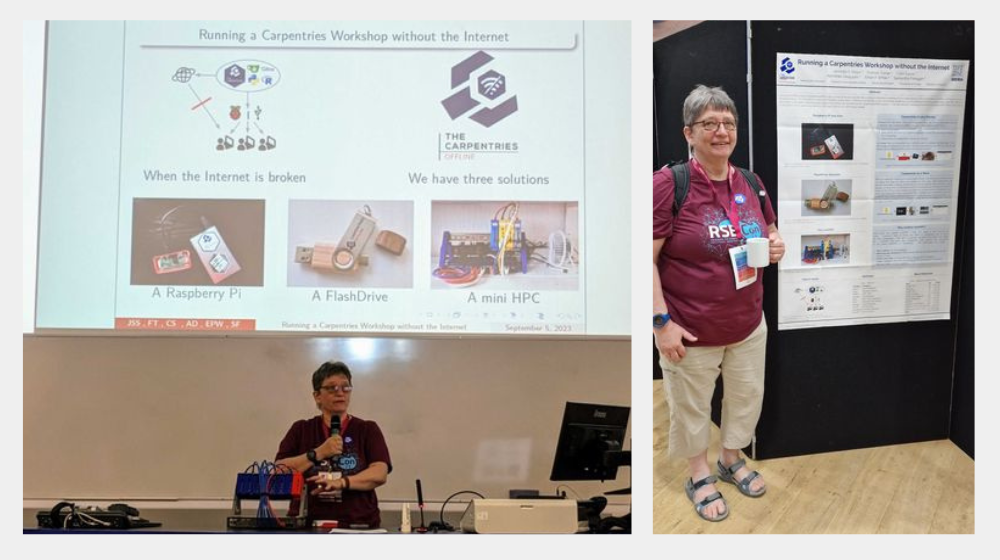
A couple of weeks before the conference I realised we were supposed to deliver a two minute poster presentation. As everyone knows, things become hectic the closer you get to a conference. A two minute presentation was the last thing on my mind. Especially since I had a poster, a hackathon, and a WorldWide session to organise. I knew what had to be said, but it wasn’t until the morning of the presentation that I actually sat down, typed out what I wanted to say and checked that it would fit into two minutes. That was also when I finally decided that I was going to make it a show and tell. I mentioned it before, but Colin thought two minutes would be way too little time to include a show and tell. However, I decided to go for it and placed a Raspberry Pi and the miniHPC under the desk before the presentations started.

I was pretty nervous, but, as usual, once you start talking, things just go as they go. I pulled out the RPi, then showed the flashdrive and finally brought out the miniHPC. At the time, I couldn’t quite sense how things went because the session chair had stood up, which meant I had 30 seconds and I was focused on finishing and getting back to my chair. But once the session was over, my colleagues seemed pretty pleased and loads of people came up to ask questions. Phew!! That was Tuesday.

Jannetta Steyn at RSECon23

Wednesday started with the hackathon. We had worksheets prepared and printed (thank you Frances) as we knew what had to be done, but it was difficult to decide just how we would go about it. So, I think we pretty much played it by ear. We told people what the things were they could work on, and then they divided themselves into groups trying to work on those things. I hope participants weren’t too disappointed. At least they managed to get hands on experience with everything that can go wrong when you work with a project like this. The time we had was a bit short, but as long as their experiences made it into the documentation, their efforts will help us a great deal.

Devices presented at RSECon23

This year, I was a member of the RSE Conference committee and I was co-chair for the WorldWide session, which was scheduled for Wednesday afternoon. Unfortunately, halfway through the session, I received an urgent call from a colleague whom I then had to escort to A&E where I spent the night to keep her company. Fortunately, all turned out fine and we are all okay. Except that Thursday morning I decided to do a Covid test… and guess what? No good deed goes unpunished! I tested positive.

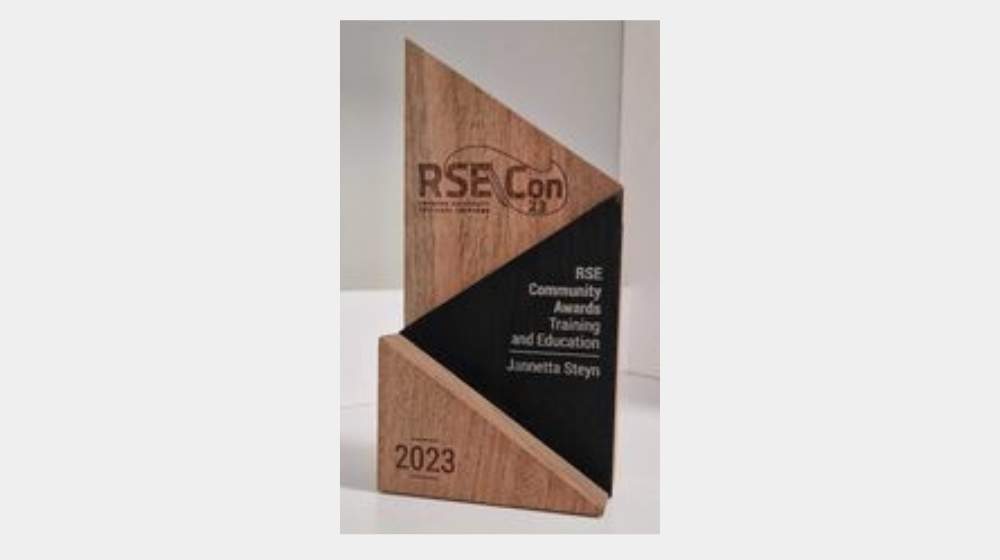
At least I was able to watch the awards session on Zoom, and it was a great honour to learn that we received the best poster award and that I was chosen to receive the RSE Community award for Training and Education. My manager accepted the awards on my behalf, but he did a very bad job of looking like me. Note to manager: I’m short and chubby, not tall and handsome!

RSECon23 award

This brings me to the point where I have to thank everyone involved that led to me receiving these awards. I mentioned everyone involved in creating the poster, but they are also the people who have been putting a great deal of work into CarpentriesOffline. With regard to the Training and Education award, I obviously could not do this on my own. I have to thank the wonderful Carpentries and RSE communities, which include my colleagues, for their support and infectious enthusiasm. I have to thank the Software Sustainability Institute for the support and funding to work on CarpentriesOffline, and the RSE Society and its community for recognising our efforts and providing an environment where we can share our thoughts and ideas with like minded people while having fun doing our jobs.

HomeNews and blogs hub

Fellows Newsletter: December 2023

Bookmark this page Bookmarked

Fellows Newsletter: December 2023

Author(s)

Catherine Inglis

Posted on 20 December 2023

Estimated read time: 6 min
Sections in this article
Share on blog/article:
LinkedIn

Fellows Newsletter: December 2023

A series of red outlined envelopes with the icon of the SSI.

Welcome to this month's SSI Fellows Newsletter which shares activities and opportunities taking place within the SSI Fellows' community. Read on for:

  • Fellows' Spotlight: Daniele Procida, Gemma Turon and Hannah Williams.
  • November 2023 Community Call recap
  • Actions for Fellows
  • Fellows' and related activities
  • Upcoming events and calls

Fellows’ Spotlight

Daniele Procida, Director of Engineering, Canonical

Updates from call

  • This year I took my work on documentation https://diataxis.fr to data scientists in southern Africa (February) at PyCon Namibia. I also had a deeper research community encounter at FAIRmat in Berlin, where a colleague and I ran a two-day documentation workshop for the team behind NOMAD (this engagement continues). 
  • At other events, I spent time with SREs and others working on research software to discover their challenges. The theme that has emerged from the year is: the product model of software transfers well to research software, and seems to clarify its documentation problems effectively.
  • Not only that, but the response I had to “Practices for quality at scale” workshops I’ve run this year suggest that pragmatic and lightweight methods to advance good engineering practice in general at the organisational level also seem to have value for research contexts.

My non-work highlight - I was part of the organisation of the first-ever DjangoCon Africa, which took place in Zanzibar in November. We started planning the conference in 2018, only to be derailed by successive global and regional events. The outcome was a huge success: 200 people gathered for six days, from 22 countries, and another step forward for open-source grassroots organisation in Africa.

My recommendations - I finally read the “new” (i.e. 2011) Bill Johnston translation of Stanisław Lem’s Solaris. It’s still only available in digital editions, and far more lucid than the much earlier Polish to French to English translation. It must be the funniest novel about the history of science I’ve ever read. It’s also painfully sad (about human beings) and on the idea of the possibility of being able to understand non-human intelligence, still more deeply insightful than anything I’ve seen in the last year in the froth of conversation about LLMs.

Gemma Turon, Co-founder and CEO, Ersilia Open Source Initiative

Updates from call - The SSI Fellows call is a fantastic opportunity to reflect all the work done in the context of the Fellowship (whether it has been economically supported by the Fellowship or not). In the latest call, I presented briefly what our young non-profit organisation, Ersilia, is trying to achieve in the field of data science for infectious disease research. With the goal of reducing inequalities in global health, we are building a set of open-source Artificial Intelligence tools to support scientists working in low resourced settings. Thanks to a huge community effort, our main platform, the Ersilia Model Hub, now features over 120 AI models for drug discovery, and covers disease areas like malaria, tuberculosis, schistosomiasis and HIV. 

My non-work highlight - I’ve started working on my solo circus act. As my side-job and long-time passion, I perform and teach aerial acrobatics. I have started working on my first long solo show, with the idea of premiering at the end of 2024!

My recommendations - The latest Cannes Palme d’Or awarded movie: Anatomy of a Fall

Gemma’s slides from the Fellows Community Call can be found here.

Hannah Williams, Research Software Engineer, Dstl (previously, and whilst completing fellowship activities, Mathematical Modeller, UKHSA)

Updates from call - During my fellowship period (2021) I worked with colleagues to establish a UKHSA-wide Software Community of Practice. This was a larger undertaking than my original proposal, but (hopefully) a more comprehensive forum to facilitate sharing and learning best practice and internal knowledge. We hosted seminars, coffee-and-coding, workshops and built a network for one-on-one support.

  • Unexpected time-consuming activity: talking to people; ensuring that teams/individuals would support the community, and securing senior approval.
  • Could have done better: measuring impact. 
  • Biggest mishap: collaborative documents going wrong.
  • Highlight: the opportunity to learn from people (huge shout-out to the SSI Community Building study group)

My non-work highlight - A holiday (8 years in the pipeline) with a friend to Disney World Florida. It was even more than supercalifragilisticexpialidocious. The highlight of the trip was Fantasmic; a musical-pyrotechnic-laser-water show.

My recommendations - My go-to podcast for my commute is “It’s a Fair Cop” by Alfie Moore (available on BBC Sounds) – highly entertaining and informative insight into life as a police officer, giving the audience an opportunity to decide what course of action they would take if they were in Alfie’s shoes.

Hannah’s slides from the Fellows Community Call can be found here

Community Call Recap

During the November 2023 SSI Fellows Community Call, we heard Fellows’ updates from Daniele Procida, Gemma Turon and Hannah Williams. In breakout rooms, we discussed dealing with management, RSE & Python (especially in LMIC), and handing over things.

Fellows’ and related activities

Collaborations Workshop 2024 - The Collaborations Workshop 2024 (CW24) will bring together researchers, developers, innovators, managers, funders, publishers, policy makers, leaders and educators to explore best practices and the future of research software. The themes of CW24 will be: Environmental Sustainability, AI/ML tools for science, Citizen science

Upcoming events and calls

  • RSE Conference 2024 - The eighth annual conference for Research Software Engineering will take place in Newcastle. See the link below for more details and submission deadlines.
HomeNews and blogs hub

The siren call of AI alignment: How can scientists avoid harm while using Machine Learning?

Bookmark this page Bookmarked

The siren call of AI alignment: How can scientists avoid harm while using Machine Learning?

Author(s)
Jesper Dramsch

Jesper Dramsch

SSI fellow

Posted on 13 December 2023

Estimated read time: 5 min
Sections in this article
Share on blog/article:
LinkedIn

The siren call of AI alignment: How can scientists avoid harm while using Machine Learning?

Everyone has read at least one paper lately that started “Machine learning has made an impact in the entire field”.

Doesn’t matter which field.

Then ChatGPT happened, and even those peddling crypto and web3 suddenly talked about AI.

We've got AI hype on top of our AI hype.

Two hobbits staring ahead, a caption in bold white letters reads We've had one AI hype, but what about seconds

But with that, a few conversations became disproportionately harder.

The Emergence of Alignment

It happened when chatGPT was released.

People, including myself, couldn’t believe how good this type of model had become. The texts were fluent. Depending on your instructions, there was what seemed like coherent thought.

It seemed a bit like magic, or maybe even gifted with consciousness to some.

Machine learning papers had already been published without peer review at a break-neck pace before chatGPT was released. Some models, like the popular Yolo models, were even released completely without formal publication.

So, publishing claims that chatGPT showed sparks of Artificial General Intelligence, without peer review and as quickly as possible, fit into the culture of machine learning research.

It’s a compelling narrative.

What if we created an intelligence? Wouldn’t that at least be cool?

But quickly, questions emerged about the long-term safety of humanity. If we created superhuman intelligence, how do we ensure it doesn’t turn against us? How do we ensure AI is aligned with humanity's goals or even survival?

The idea of AI alignment was born.

The sudden interest in Long-term Ethics

Suddenly companies with big well-paid AI teams, especially those that recently fired their entire ethics teams, were talking about the long-term view.

AI alignment was everywhere.

These companies were even pushing for regulation of these AIs and future development of AIs. Some researchers started comparing themselves to Oppenheimer. Quite the emotive comparison. Let’s ensure the long-term survival of humanity by regulating the alignment of AI development.

Yet behind the scenes, those same companies pushed for de-regulation behind closed doors in the EU, where the AI Act would have wide implications.

It’s compelling, though. We all want to survive. We’re all a bit scared of the long-term effects of this un-known entity. It’s the Siren call. Or it’s a good set-up for a trick.

The Magic Trick

From street magic to David Copperfield, magicians all work with one simple trick.

Attention.

A magician will direct your attention to the hand they don’t want you to look at. Then they can perform the sleight of hand with the other, non-observed hand.

When we get enough people to pay attention to the long-term harms and be satisfied with the regulation of long-term goals, we can divert the attention from short-term impacts.

Not too dissimilar to other industries that have spent resources to divert our attention from lung cancer and climate change.

What are we missing in the Short Term?

In the short term, we know machine learning can already do harm.

From surveillance to increased premiums. Rejected loan applications that can’t be explained by random blips in The Algorithm. Biases in machine learning models and algorithmic decision processes are well-documented.

And then there’s, of course, the CO2 footprint of AI model training, which will be an actual proven problem in the future. We don’t have to speculate in this case.

These biases and discriminatory correlations can be present in the training data, exacerbated through exploratory data analysis and then reinforced by humans through automation bias. And then there is, of course, the loss of privacy through widespread data collection practices.

Something that already affects us every day and could be addressed by data cleaning practices and regulations. (Coincidentally, why Google Bard is not available in the EU right now.)

Scientists using Machine Learning

As researchers, this goes even deeper.

The use of machine learning in different fields of science has been proven extremely potent. However, many basic tutorials don’t adequately reflect the realities of real-world data.

It can be computer vision models that recognise the hospital code of places that treat patients that were advanced cases, therefore cheating through this shortcut. Or it could even be researchers training on the test data to improve the score, beat the state-of-the-art and be able to publish. There are accidents and questionable behaviours that can be hidden in machine learning scores.

These publications can chart the entire trajectory of a field, like we unfortunately recently discovered with fabricated data in Alzheimer’s research.

We have a responsibility for AI safety, even if it’s just our tiny little field.

Why I created ML.Recipes

I wrote the resources ML.recipes to empower scientists to quickly learn about best practices.

The Jupyter book has code examples everyone can easily re-use and explanations throughout the entire book as to how to work with this information and the benefits of each section.

These are generally divided into “ease review” to make it easy for others to gauge the quality of a machine learning contribution, “increase citations” to be able to verify and re-use your code and model, and “foster collaboration” which is about standards and share-ability of your science.

Let the billionaires and effective altruists discuss AI alignment while we build useful tools and insights to advance science and humanity. Tools that are safe and science that is valid.

Large language models may not be our end just yet.

Subscribe to Fellows
Back to Top Button Back to top