
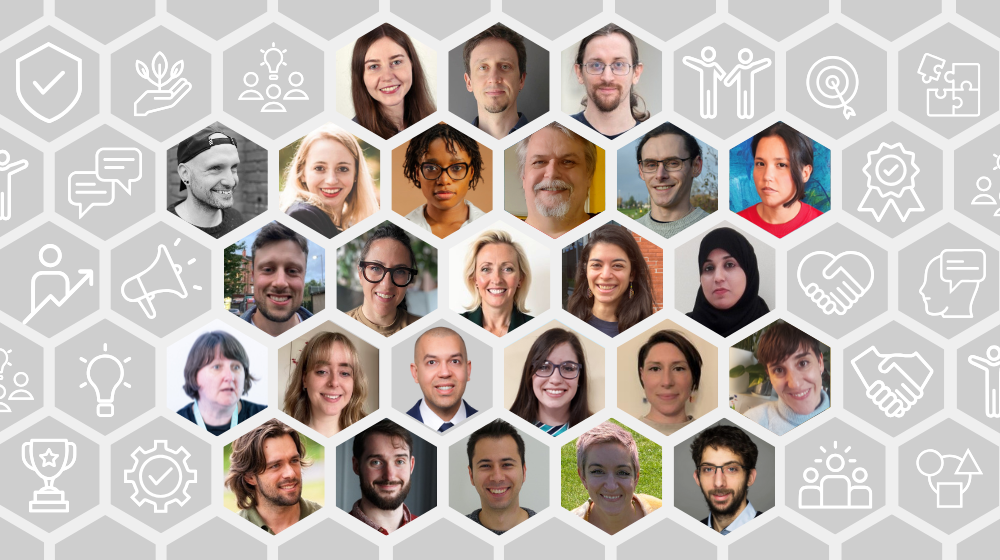
The SSI Fellowship Programme supports passionate individuals in research and software, empowering them as ambassadors of good practice to shape the future of research software. The selection process for this year’s cohort has now ended and we’re excited to introduce the 2026 Fellows and share their plans for the Fellowship.
For the 2026 cohort, we received 85 applications from 57 institutions, spanning 38 research areas based in 16 countries. After rigorous review – 255 assessments by 39 reviewers, mostly SSI Fellows, staff, and collaborators – we shortlisted 39 candidates.
The shortlisted applicants participated in our Online Selection Day, featuring group discussions and event planning activities that tested collaboration, communication, and contribution. Based on these activities and initial scores, 25 wonderful new Fellows were selected to join the Fellowship Programme.
Insights from the 2026 Selection
Continued improvement of support
Following last year’s changes to improve transparency, including clearer eligibility criteria and the publication of our shortlisting and online selection day criteria, we continued to build on this momentum. We expanded our ‘Ask Me Anything’ sessions and doubled the number of Fellows available for support to applicants, increasing from 10 to 20. While it’s difficult to draw a direct link, we saw a notable rise in high-scoring applications with submissions rated 4/5 or higher increased by nearly 50% (from 20 to 31), alongside a 23% rise in total applications (from 69 to 85, a new record). Importantly, all 85 applications progressed for review this year, compared with 69 out of 75 last year.
Broadening horizons
In relation to our continued dedication to broaden our engagement, the 2026 cohort includes Fellows from six institutions that have never been represented before in the Fellowship Programme. We also welcomed applicants from fields that have historically been underrepresented in the programme, including the Creative Arts, Education, Medicine and Dentistry, Linguistics, Sociology, and most notably the Biological Sciences, from which five Fellows were selected.
Gender and career trends
While most applicants continue to be men (55%), candidates who identified as women, non-binary, or preferred not to disclose their gender had higher success rates at every stage of the selection process, making up 64% of selected Fellows, mirroring trends from last year. Early-career applicants represented 48% of selected Fellows. Under current criteria, Research Software Engineers (RSEs) are placed in the early-career category. However, we recognise that RSEs vary widely in experience. To support clearer and more accurate alignment, we plan to review how the RSE career path corresponds to our current (academic) career stages. We also see limited applications and lower success rates from Phase 4 applicants. Since we value applicants at this stage, we are reviewing our processes, criteria, and communications to clarify expectations for both applicants and reviewers.
Evolving leadership in the community
Last year’s strong participation from RSEs highlighted both the growing recognition of technical and research software roles and their increasing confidence to step into leadership positions. This year, we again saw strong representation, with 10 of the 25 selected Fellows (40%) working in RSE or similar technical roles. However, we also selected more Research-Focused Academic roles (7 Fellows, or 28%), which creates a well-balanced cohort. We would love to see even more junior and early-career researchers apply in future cycles to maintain this balance.
In addition, this year we saw an increase in applications from those in Leadership or Community Management roles, with 5 Fellows (20%) selected. This reflects the growing recognition of community-building roles within the research software ecosystem and – like their RSE colleagues – their confidence to take on leadership positions in the research software community. This also highlights how the SSI Fellowship Programme is becoming a hub of expertise for people who create, sustain, and professionalise communities of practice across the research software landscape.
The Plans of the 2026 SSI Fellows
The new Fellows bring forward a broad array of plans that highlight the broad impact of the Fellowship Programme. They are establishing diverse Communities of Practice (CoPs) and peer networks across areas including ethical and reproducible AI, green and sustainable computing, inclusive and neurodiverse research practices, creative computing, and specialised research domains such as chronobiology, high-energy physics, and taxonomic research.
Their projects combine practical training, workshops, hackathons, and community-led events to improve coding practices, build grassroots networks, and foster collaboration between research software engineers, domain specialists, and artists. Several Fellows are developing tools and resources to enhance reproducibility, sustainable computing, and open science, including lightweight computing environments, workflow templates, and AI fairness frameworks.
These initiatives extend globally, linking communities in the UK, Latin America, Asia, and Australia, while addressing inclusivity, mental health, and professional development across research software and data-science communities. By connecting training, open-source development, and community-building efforts, the 2026 cohort advances research software practice, fosters responsible AI adoption, and strengthens the foundations of open and collaborative science.
(The new 2026 Fellows are listed here in alphabetical order by first name, followed by their institutional affiliations and JACS subject area) |
Adrian D'Alessandro (Imperial College London) Building an open source developer community around the DIRECT Framework through a series of hackathons and contentathons. |
Alan O'Callaghan (University of Edinburgh - Biological Sciences) Creating two short Carpentries-style courses to teach image analysis (and other) researchers how to effectively use version control and how to easily publish blogs and protocols. |
Andre Piza (Alan Turing Institute - Creative Arts and Design) Starting a community of practice that brings together arts practitioners and digital research technical professionals to develop digital skills, methods and creative projects through a facilitated knowledge exchange programme. |
Anne Steele (Freelance - Creative Arts and Design) Connecting computational artists to sustainable software practices. |
Carlos Cámara-Menoyo (University of Warwick - Social Studies) Creating CriticAI, a community of practice to critically enquiry about AI’s adoption in HE and influence in the decision-making processes to ensure that AI usage is aligned with academia’s ethos. |
Cassandra Gould van Praag (Open Life Sciences - Mathematical Sciences) Facilitating conversations around the ethical implications of automated monitoring of community engagement and health. |
Christian Gutschow (University College London - Physical Sciences) Empowering the next generation of particle physicists with tools and training resources that lower the barrier to sustainable software practice. |
Christina Bremer (University of Cambridge - Computer Sciences) Organising a workshop and developing a toolkit for RSEs to learn about systems thinking, including different methods and relevant application areas. |
Gabriel Mateus Bernardo Harrington (Cardiff University - Computer Sciences) Delivering a Software Carpentry–inspired version control training, enhanced with a practical code review component to foster grassroots peer-mentoring, for researchers across the UK Dementia Research Institute. |
Johanna Bayer (Donders Institute for Brain, Cognition and Behaviour - Medicine and Dentistry) Quantifying and assessing community health in various software and open science communities. |
Kevin Rue-Albrecht (University of Oxford - Biological Sciences) Representing the Bioconductor community at external events (e.g., ELIXIR BioHackathon, Galaxy Community Conference) to connect communities and foster collaborative work between developers, users, and curators of communities working to coordinate their FAIR practices. |
Liam Pattinson (University of York - Physical Sciences) Establishing a community of practice for Fortitude, the Fortran linter. |
Mamoona Humayun (University of Roehampton - Computer Sciences) Enhancing secure software development practices among University IT staff and research software engineers through awareness, knowledge-sharing, and practical training. |
Michael Sparks (University of Manchester - Computer Sciences) Create CompilePython.com - a community-driven, sustainable knowledge hub for Python compilers, for environmental sustainability. |
Nicole Whippey (University of Exeter - Computer Sciences) Building inclusive research and user communities to co-design a menstrual health app and ethical data ecosystem, enabling high-quality women’s health research and laying the foundation for sustainable innovation and future grant collaborations. |
Pao Corrales (Australian National University - 21st Century Weather Centre - Physical Sciences) Growing the movement of green computing in Asia-Australian region by promoting and adapting existing tools and taking the next steps toward making climate and weather research more sustainable. |
Precious Onyewuchi (OSPO Now - Engineering) Educating, advocating, and enabling researchers to build open and reproducible AI practices. |
Raniere Gaia Costa da Silva (GESIS Leibniz Institute for the Social Sciences - Computer Sciences) Promoting the use of WebAssembly (Wasm) and JupyterLite in the context of teaching programming skills and research reproducibility. |
Salma Thalji (Technical University of Munich - Biological Sciences) Creating a community of practice around open, reproducible, and sustainable software in circadian neuroscience |
Samantha Ahern (University College London - Education) Identifying and mapping funded projects in the dRTP skills space to highlight synergies. |
Sara Villa (Open Life Sciences/Data Science for Health Equity - Education) Analysing and aligning best practices and strategies for community building in different scientific Communities of Practice, to support the creation of a network of professionals working in Research Community Management |
Sarah Wyer (Durham University - Computer Sciences) Understanding, detecting, and mitigating bias in AI, enabling the collective development of fair AI for everyone |
Sofía Miñano (University College London - Biological Sciences) Connecting Spanish-speaking research software engineers in the UK and the Americas through the "Charlas RSE", a seminar series featuring RSE talks in Spanish. |
Sophie Whittle (University of Sheffield - Linguistics, Classics and Related Subjects) Develop a community of practice that empowers university students (particularly neurodivergent students), teachers and academic researchers to navigate the challenges that come with (un)welcome change related to new AI technologies and software, ultimately informing best practice in the use of AI for teaching and research in the humanities. |
William Haese-Hill (University of Glasgow - Biological Sciences) Undertaking an EDIA study on the impact of hybrid and remote working on RSE executive function, with a focus on mental health and neurodiversity. |
Challenges and Opportunities
While we’re celebrating this year’s successes, we’re also reflecting on where we can improve:
Improving diversity
Applications this year show a trend of increased ethnic diversity, with good representation across all ethnic groups. However, the data highlighted some disparities during shortlisting and selection. For example, applicants from Asian or British Asian backgrounds saw a drop from 17.7% of applications to 10.3% shortlisted, and ultimately 8% confirmed in the cohort. Applicants from Mixed or multiple ethnic groups and Other ethnic backgrounds also experienced small decreases during selection, but this is an improvement on last year. We are constantly reviewing our selection procedures to identify barriers and ensure our processes are fair, transparent, and inclusive, reflecting the diversity we aim to support.
Reaching new disciplines
While Computer Science continues to be the largest applicant group, applications from Physical Sciences and Social Sciences have slightly improved on last year, with a notable increase in selected Fellows from the Biological Sciences (+5 on a total of 24 Fellows within the entire Programme historically). Encouragingly, outreach to Arts and Humanities researchers last year has continued to strengthen representation from these disciplines in this year’s cohort. Expanding engagement with underrepresented fields such as the Creative Industries and the Social Sciences in future calls will help build a more multidisciplinary Fellowship Programme that reflects the full spectrum of research software needs.
Refining evaluation
Differences between shortlisting scores and final selections indicate areas where evaluation criteria could be clearer and more consistent. In particular, we are reviewing the processes around the Online Selection Day to make expectations clearer for both applicants and reviewers, ensuring that everyone can engage fully and confidently in the process. More broadly, we are considering how the format and criteria can be more inclusive by accounting for diverse cultural norms, communication styles, and ways of presenting oneself, so that all candidates are evaluated fairly and equitably. Finally, we also aim to put in place financial support where needed (e.g. to cover costs such as upgraded internet packages) so that all candidates can fully participate in the Online Selection Day.
Looking Ahead
The SSI Fellowship Programme is about more than professional development. It’s about building a vibrant, supportive, and inclusive research software community. The 2026 cohort illustrates this mission, bringing together diverse backgrounds, a wide range of disciplines, and ambitious projects that advance open science, reproducible research, sustainable computing, and community-building. Their work spans AI ethics, creative computing, green computing, high-energy physics, chronobiology, and beyond, connecting researchers across the UK, Europe, Latin America, and Asia.
To our new Fellows: welcome to the SSI community! We can’t wait to see how your work takes shape and the positive change you’ll inspire.
To everyone else: keep an eye out for updates on these exciting projects and if you’re interested in what they are doing consider getting in touch via fellows-management@software.ac.uk.
If you’re passionate about research software, think about applying next year. Together, we can shape the future of sustainable, inclusive, and innovative research software.