Skip to main content Site map
Old Tag
Hackdays
HomeNews and blogs hub

Understanding the dRTP Training Landscape Workshop

Bookmark this page Bookmarked

Understanding the dRTP Training Landscape Workshop

Author(s)
Denis Barclay

Denis Barclay

Communications Manager

Posted on 20 October 2025

Estimated read time: 2 min
Sections in this article
Share on blog/article:
LinkedIn

Understanding the dRTP Training Landscape Workshop

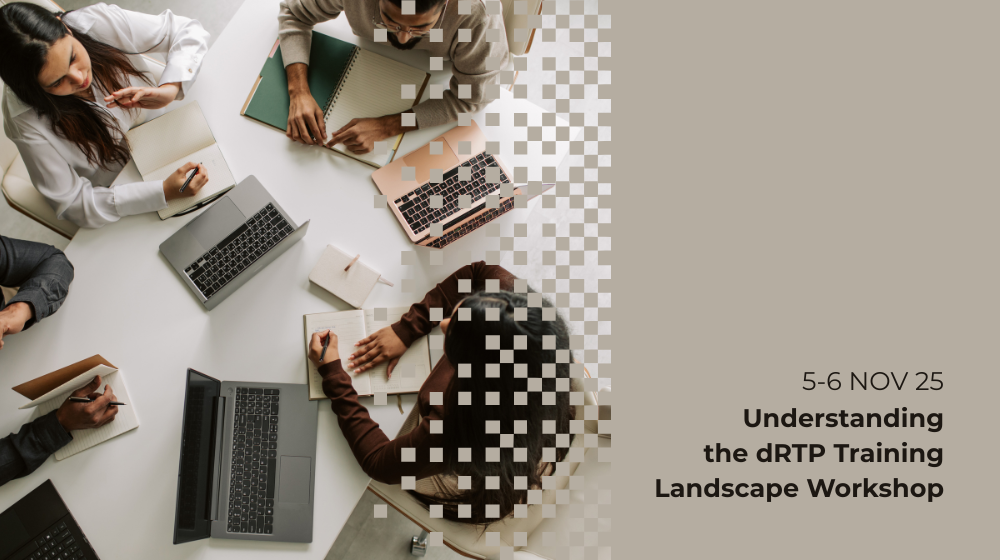
Understanding  the dRTP Training  Landscape Workshop, people working on laptops

Funded by the UKRI dRTP Skills NetworkPlus Programme, the Understanding the dRTP Training Landscape Workshop will take place on Wednesday 5 and Thursday 6 November 2025 at Bidborough House, UCL, London. The deadline for registrations is noon Tuesday 28 November.

The workshop aims to:

  • Identify existing dRTP roles,
  • Identify existing training courses and resources,
  • Link those roles to specific skills / competencies,
  • Align those skills / competencies with the existing training materials. 

The workshop will also identify gaps in provision and areas where new or adapted content is needed, and where teams are working on similar materials and could fruitfully collaborate. These efforts are another step towards making professional skill development easier and improving career prospects across the whole dRTP ecosystem. The workshop outcomes will be shared with the dRTP community. 

This event aims to better outline and understand the whole dRTP ecosystem. Therefore, the organisers would like to extend an invitation to dRTPs working in different roles and at different institution types, and engaging with a wide range of research communities. 

There will be plenty of opportunities for discussion during the interactive sessions and the organisers look forward to seeing many of you at the event. Please complete the registration form to join. There is no registration fee for the event. The detailed agenda will be circulated close to the event date. 

The organisers are be happy to provide support for a few participants whose organisation/projects cannot cover travel costs. If you would like to attend the event but need any travel support, please apply for the travel support by answering the relevant questions in the registration form.

If there are any questions for the registration, please contact Xu Guo, the event organiser.

HomeNews and blogs hub

Upcoming event: Git’s 3 Magic Words – add, commit, push

Bookmark this page Bookmarked

Upcoming event: Git’s 3 Magic Words – add, commit, push

Author(s)
Hui Ling Wong Profile Picture

Hui Ling Wong

SSI fellow

Posted on 16 October 2025

Estimated read time: 1 min
Sections in this article
Share on blog/article:
LinkedIn

Upcoming event: Git’s 3 Magic Words – add, commit, push

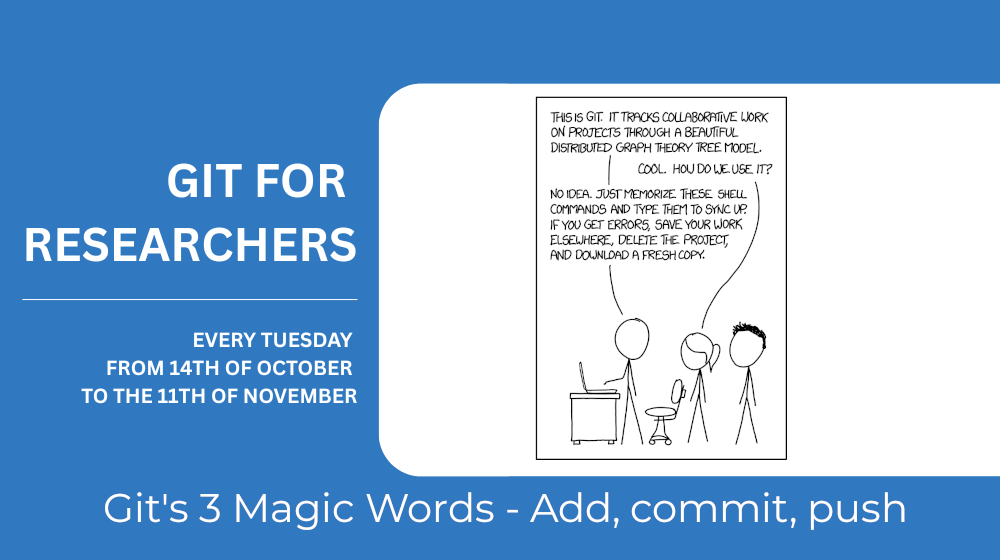
Git's 3 magic words

We are pleased to share details of the second event of an upcoming hybrid series of short talks featuring SSI Fellow Hui Ling Wong, focusing on practical, research-oriented approaches to using Git. The series runs every Tuesday from 14 October to 11 November, with refreshments provided after each talk. 

For the next event, now that you’ve discovered Git – or if you’re just starting to get the hang of it – you’re ready to keep your code in sync between your local and remote repositories. However, a veil of mystery still shrouds Git.

This talk demystifies the core commands of Git. You’ll explore the file status lifecycle, learn what types of files belong in Git (and what to leave out), discover strategies for versioning data, and get introduced to helpful tools that work alongside Git to streamline your workflow. 

Register for this talk here! [forms.office.com]

Image: XKCD 1597 [xkcd.com]

HomeNews and blogs hub

Final Governance Fireside Chat: Good Governance for Healthy Open Initiatives

Bookmark this page Bookmarked

Final Governance Fireside Chat: Good Governance for Healthy Open Initiatives

Author(s)
Oscar Seip

Oscar Seip

Research Community Manager

Posted on 14 October 2025

Estimated read time: 1 min
Sections in this article
Share on blog/article:
LinkedIn

Final Governance Fireside Chat: Good Governance for Healthy Open Initiatives

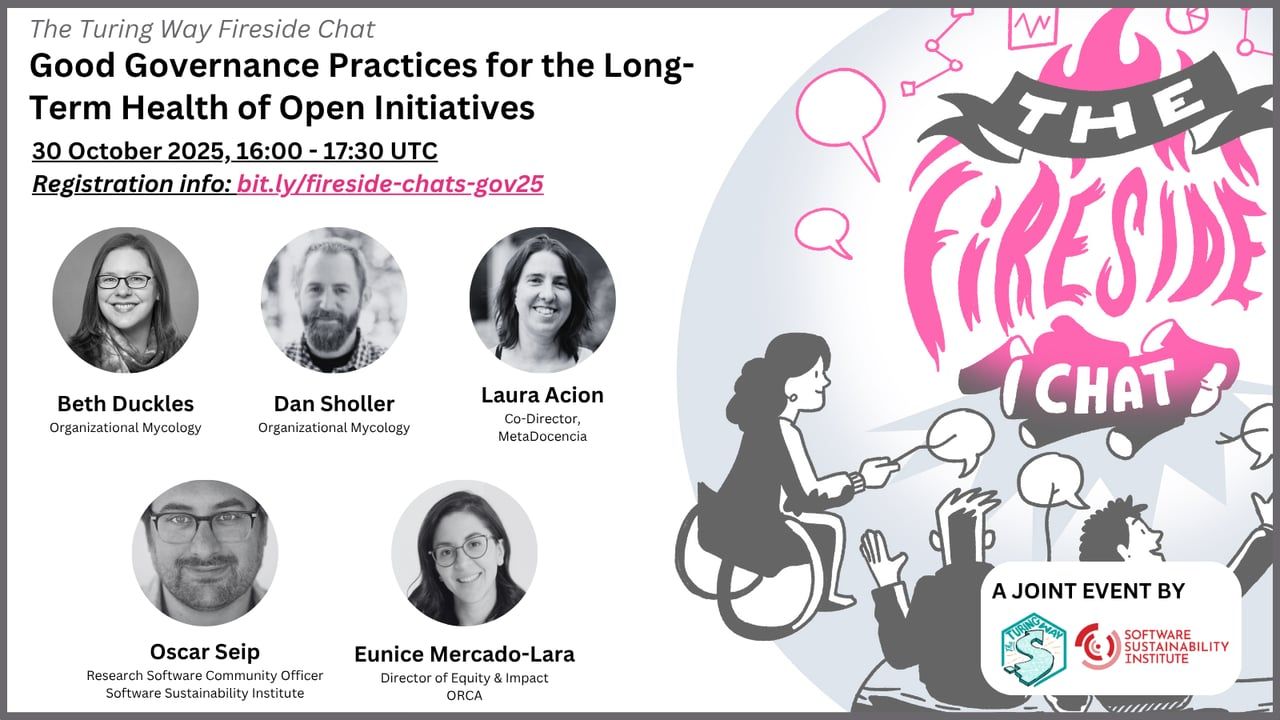
Banner with three speakers and two chairs for the Turing Way/SSI Fireside chat of Good Governance Practices for the long term health of Open Initiatives.

Join us for the final edition of our Governance Fireside Chat series on Thursday 30 October at 16:00 UTC.

This session brings together speakers from Organizational Mycology and MetaDocencia to explore Good Governance Practices for the Long-Term Health of Open Initiatives.

We will hear from Beth M. Duckles, Dan Sholler, and Laura Acion, chaired by Eunice Mercado-Lara and Oscar Seip. These wonderful speakers will share their experiences and insights on sustainable, inclusive governance in open communities. Please join us!


HomeNews and blogs hub

Upcoming Event: Git for Researchers

Bookmark this page Bookmarked

Upcoming Event: Git for Researchers

Author(s)
Denis Barclay

Denis Barclay

Communications Manager

Hui Ling Wong Profile Picture

Hui Ling Wong

SSI fellow

Posted on 8 October 2025

Estimated read time: 2 min
Sections in this article
Share on blog/article:
LinkedIn

Upcoming Event: Git for Researchers

Git for researchers

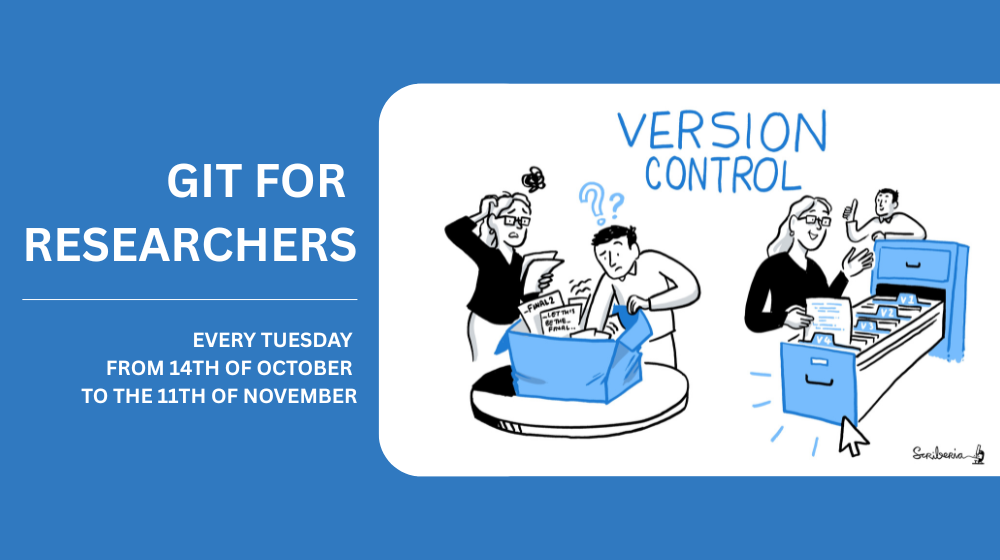
We are pleased to share details of an upcoming hybrid series of short talks featuring SSI Fellow Hui Ling Wong, focusing on practical, research-oriented approaches to using Git.

Researchers often find themselves managing countless “final” versions of code, unsure which one produced the results they are analysing. Version management can be a significant challenge, consuming valuable time and energy. When used effectively, however, Git can ease this burden while enhancing productivity and research reproducibility.

This series of 15-minute talks offers practical, research-focused guidance on how to use Git. Rather than simply teaching commands, the sessions explore the workflows that make them meaningful, helping participants understand not only what to do, but why and how. The series also highlights insights the presenter wishes they had known when first starting with Git, allowing attendees to avoid common frustrations and benefit from best practices from the outset.

Participants will learn how to leverage Git’s history to better understand codebases, streamline debugging, and make coding more efficient when tackling complex research problems.

The series runs every Tuesday from 14 October to 11 November, with refreshments provided after each talk.

HomeNews and blogs hub

Nordic-RSE conference 2025

Bookmark this page Bookmarked

Nordic-RSE conference 2025

Author(s)
Samantha Wittke

Samantha Wittke

SSI fellow

Richard Darst

Matteo Tomasini

Luca Ferranti

Jarno Rantaharju

Posted on 31 July 2025

Estimated read time: 3 min
Sections in this article
Share on blog/article:
LinkedIn

Nordic-RSE conference 2025

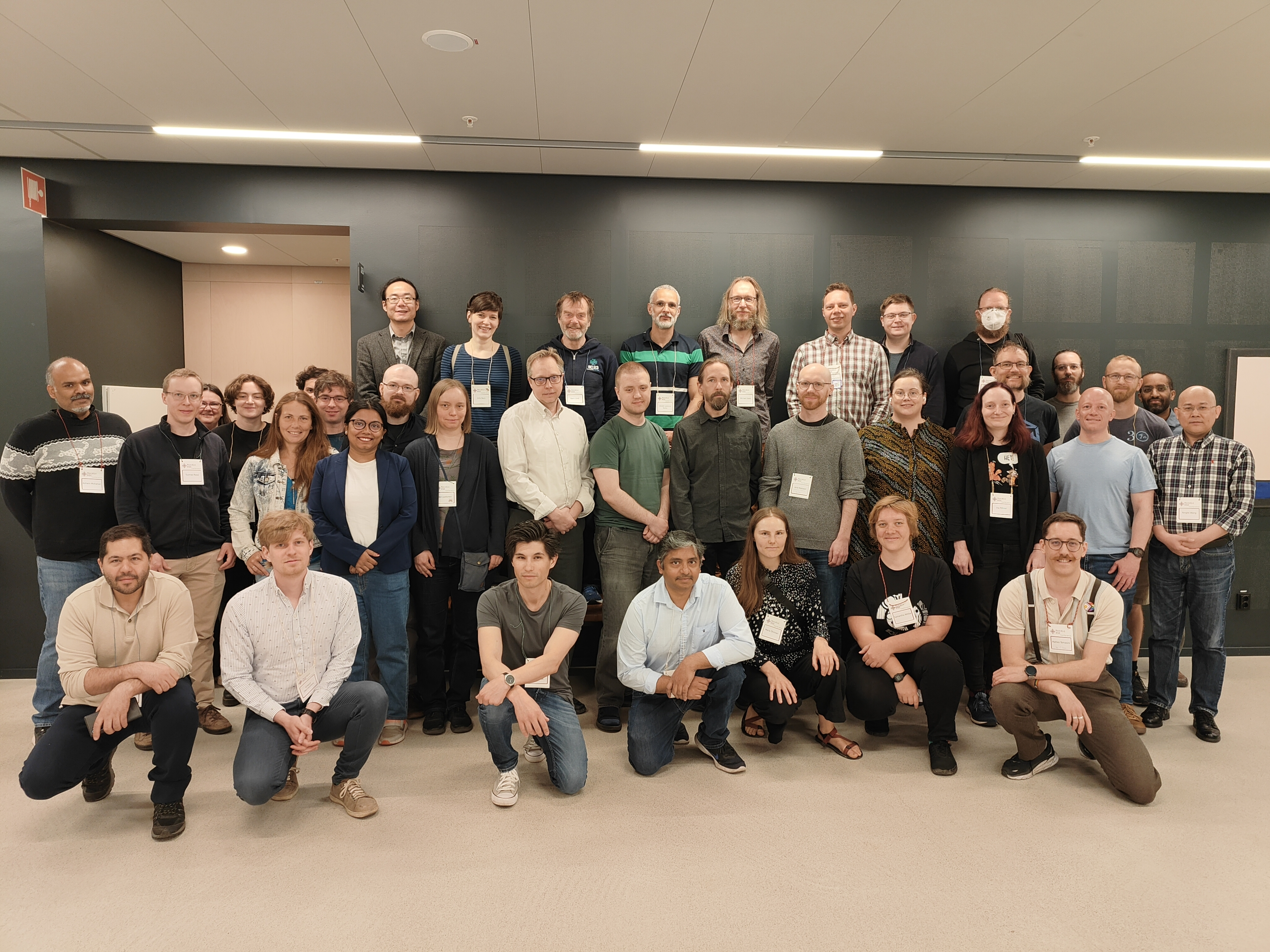
Nordic RSE 2025 Participants photo

This blog was originally posted on the Nordic RSE website.

The second Nordic-RSE in-person conference took place on May 20-21 2025 in Gothenburg, Sweden. The conference was made possible thanks to the support of the Gothenburg Research Institute in Digital Humanities and the Software Sustainability Institute, and it was for anyone passionate about research software engineering (RSE) - whether by writing research tools, supporting scientific software, or just being curious about the field. We built this event to be a space where people can learn, connect, and share knowledge.

And that’s exactly what happened in Gothenburg this May!

A Look at the Numbers

This year, we welcomed 45 participants to the Humanisten building at University of Gothenburg over two full days. We had a packed program, with:

  • 1 keynote talk
  • 14 talks
  • 3 discussion sessions
  • 2 tutorials
  • 4 posters

What We Talked About

The range of topics was wide and reflected the diversity of interests within the Research (Software) Engineering enthusiasts community in the Nordics. To name just a few:

  • Open Science
  • Design patterns in code
  • The history of free and open source software
  • Vim (yes, really!)
  • 3D visualization techniques
  • Static web interfaces
  • Peer review processes for reproducible research software
  • RSE group structures, funding and career paths
  • Data processing and (3D) visualization with game engines and other tools
  • Training experiences in RSE and adjacent fields
  • Data handling tools and techniques
  • Graphical tools for working with supercomputers
  • "Real-world" software engineering that can mess up someone's night in case of malfunction

And then there were all the spontaneous conversations - during lunch breaks, over coffee, and at the conference dinner - covering even more ground. The small size of the conference made it possible for each person attending to meet (almost) all the other participants: this fostered a very constructive and dynamic environment.

Getting There

The lead-up to the conference was its own journey. Early on, we also ran a conference info event in form of an interview with the conference chair and local chair, which we summarizes as a blog post titled "Join Us at Nordic-RSE conference 2025: A Home for Research Software Enthusiasts!". Abstract submission was open until March 16, and we hosted a dedicated “Night of Unfinished Abstracts” on March 12 to help people shape their ideas and get peer support finalizing their abstracts and ideas. Registration ran until early May, all through our website.

Staying Involved

The conference might be over, but we’re always looking for ways to keep the momentum going - especially online. Do you have a suggestion for a seminar speaker? Have you got a topic you’d like to present? Want to help organize the next conference?

Join us in the Nordic-RSE Zulip chat and help shape what’s next. Nordic-RSE is built from the bottom up, by RSE themselves for other RSEs.

Thank You

A heartfelt thanks to everyone who made Nordic-RSE 2025 happen:

  • Our code of conduct committee, Heli and Julia
  • The organizing team: Matteo, Radovan, Luca, Richard, Jarno, and Samantha
  • Our funders: the Software Sustainability Institute and GRIDH
  • And of course: every participant - for coming, sharing, discussing, and generally contributing to the great atmosphere that we felt

Want to Read More?

Here are a couple of reflections and highlights from others in the community:

See you next year Tromsø, Norway, June 9-10 2026!

  • The Nordic-RSE 2025 Organizing Team
     
HomeNews and blogs hub

Reflections from OHBM 2025: The Future of Neuroimaging in Brisbane

Bookmark this page Bookmarked

Reflections from OHBM 2025: The Future of Neuroimaging in Brisbane

Author(s)
Gaurav Bhalerao

Gaurav Bhalerao

SSI fellow

Posted on 28 July 2025

Estimated read time: 4 min
Sections in this article
Share on blog/article:
LinkedIn

Reflections from OHBM 2025: The Future of Neuroimaging in Brisbane

OHBM 2025 logo

The Organization for Human Brain Mapping (OHBM) 2025 conference just wrapped up in the stunning city of Brisbane, Australia, and I’m still processing all the exciting ideas, people, and collaborations it brought together. Held at the Brisbane Convention & Exhibition Centre, this year’s event was nothing short of inspiring, bringing together thousands of neuroimaging researchers from around the world to explore cutting-edge technologies, global challenges, and the future of our field.

Kicking Off with the Neuroimaging Statistics Workshop

My OHBM journey began with a satellite workshop on Neuroimaging Statistics. In a time where AI dominates conversations, this workshop served as an important reminder: robust statistical foundations still matter. These talks bridged classical statistical thinking with modern AI applications, showing how we can integrate both to advance research in uncovering the structural and functional organisation of the brain.

Talairach Lecture: Global Data, Local Impact

The conference officially began with the prestigious Talairach Lecture by Dr. Paul Thompson, who spoke about the ENIGMA consortium, a global neuroimaging collaboration combining data from across continents. Dr. Thompson’s talk highlighted how AI and global data sharing are reshaping our understanding of brain health and disease. It was a powerful message on how far we’ve come and how much more we can achieve.

Themes That Shaped OHBM 2025

1. AI Meets Open Science

One of the strongest themes this year was the intersection of AI and open science. Educational sessions emphasised tools and standards designed to make neuroimaging reproducible and transparent, including:

·    FAIR (Findable, Accessible, Interoperable, Reusable) practices in neuroimaging.

·    Growing awareness around the environmental impact of AI models and big data neuroimaging analyses, from carbon emissions to digital waste.

·    Open-source imaging protocols that reduce vendor-specific biases.

2. Making Neuroimaging More Inclusive

Accessibility was front and centre, with powerful discussions around how to make neuroimaging research feasible in lower-resource settings. Talks showcased how low-field MRI, coupled with AI upscaling methods, can democratise access to brain imaging. There was also a critical conversation around AI model explainability, especially when applying these tools in clinical settings across diverse populations.

3. Tackling Mental Health with Data

Several talks focused on data-driven approaches to mental health, including dementia and depression. Researchers are now using techniques like normative modelling and insular cortex biomarkers to identify subgroups within disorders and personalise treatment pathways. This is precision psychiatry in action.

4. Brain Geometry, Consciousness, and Development

We also saw exciting theoretical advances, from geometric brain models (going beyond classic networks) to mapping consciousness through imaging. Another highlight was a session on fetal programming and maternal mental health, exploring how early life brain development is influenced by maternal depression.

5. Neuroimaging at the Clinical Interface

Talks on connectome mapping for surgical interventions offered real-world clinical applications, emphasizing the importance of industry-academia collaboration to turn neuroimaging insights into usable tools for hospitals.

6. Sex and Gender Differences in the Brain

A dedicated track on sex/gender neuroscience sheds light on global research findings, reminding us why considering sex and gender differences is crucial in brain research and clinical practice.

Posters, People, and Possibilities

With over 2,000 posters spanning everything from AI-powered predictions to analysing large-scale datasets like UK Biobank, ABCD, and HCP, there was no shortage of learning opportunities. Personally, it was incredibly rewarding to meet researchers who had already been building on my previous work. These interactions are what make OHBM so special: a space for collaboration, growth, and inspiration.

Final Thoughts

OHBM 2025 wasn’t just about new methods and big datasets; it was about rethinking how we do science, making it more sustainable, inclusive, and collaborative. From open-source tools to climate-conscious computing, the neuroimaging community is evolving in thoughtful, future-focused ways. Here’s to carrying that momentum forward and building a more connected, equitable, and insightful future for neuroimaging.

A heartfelt thank you to everyone listed below for your generous financial support, invaluable guidance, and encouragement throughout my participation at OHBM 2025. Your contributions made it possible for me to attend, engage meaningfully with the global neuroimaging community, and proudly showcase my work.

NIHR BRC Brain Technologies theme, Oxford University Centre for Integrative Neuroimaging (OxCIN), Supervisors, and Co-authors, Software Sustainability Institute.


HomeNews and blogs hub

The Turing Way Fireside Chat Series on Governance

Bookmark this page Bookmarked

The Turing Way Fireside Chat Series on Governance

Author(s)
Oscar Seip

Oscar Seip

Research Community Manager

Malvika Sharan

Malvika Sharan

SSI fellow

Arielle Bennett

Arielle Bennett

SSI fellow

Yo Yehudi

Yo Yehudi

SSI fellow

Aleksandra Nenadic

Aleksandra Nenadic

Training Team Lead

Posted on 4 July 2025

Estimated read time: 3 min
Sections in this article
Share on blog/article:
LinkedIn

The Turing Way Fireside Chat Series on Governance

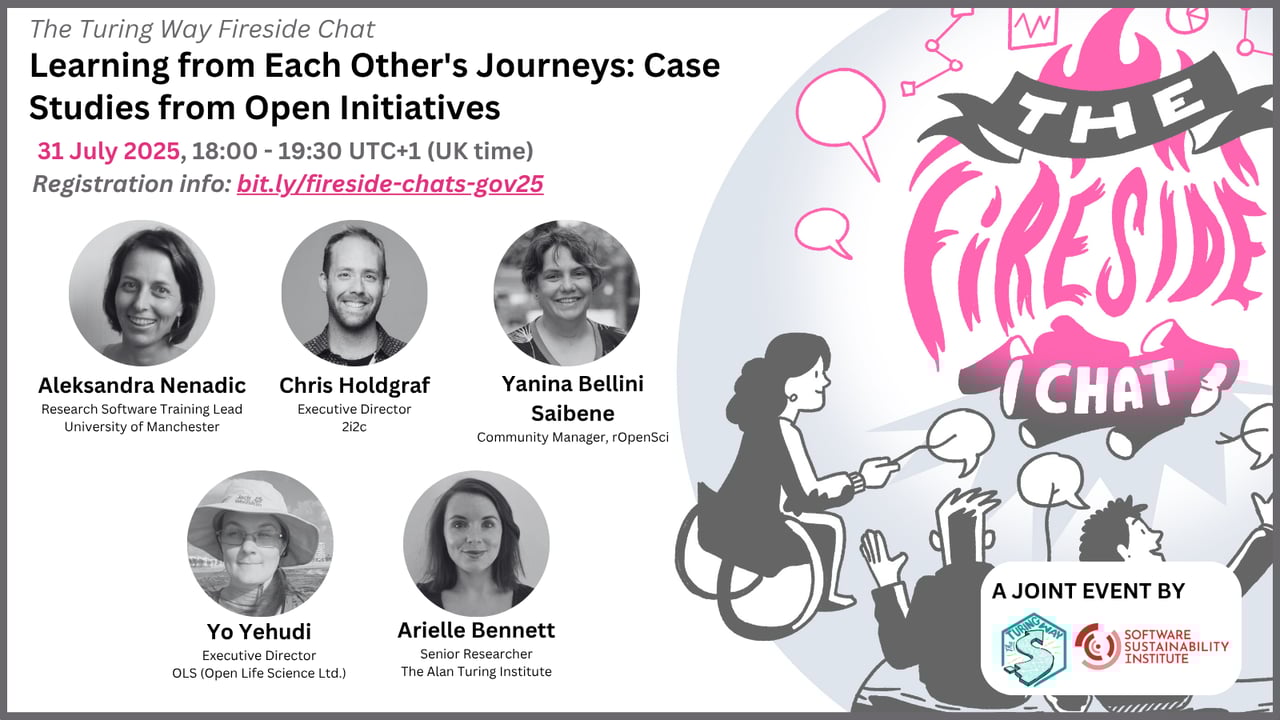
Promotional image of Fireside Chat Seminar Series with portraits of the five speakers and their affiliations.

We are pleased to announce the The Turing Way Fireside Chat Series on Governance, co-hosted by The Turing Way and the Software Sustainability Institute (SSI). Relaunched in 2025, this special series brings together experts and community members to explore the many dimensions of governance in research and open science.

The series began in June and has already featured engaging and thought-provoking sessions:

We’re now thrilled to announce the third event in the series, taking place on 31 July 2025, from 17:00 to 18:30 UTC (18:00–19:30 UK time):

Fireside Chat: “Learning from Each Other's Journeys: Case Studies from Open Initiatives”

This session will spotlight speakers from a range of globally impactful open science and training communities, sharing real-world examples and lessons learned in community-driven governance. Confirmed speakers include:

  • Yanina Bellini Saibene – Community Manager, rOpenSci
  • Chris Holdgraf – Executive Director, 2i2c
  • Aleksandra Nenadic – SSI Research Software Training Lead, University of Manchester
  • Arielle Bennett – Senior Researcher, The Alan Turing Institute
  • Yo Yehudi – Executive Director, Open Life Science (OLS)

Communities represented include rOpenSci, 2i2c, The Carpentries, R-Ladies, The Turing Way, Jupyter, and OLS — all bringing rich insights into collaborative models of leadership and learning.

Event details:
Date: 31 July 2025
Time: 17:00–18:30 UTC (18:00–19:30 UK time)
More information and registration: https://the-turing-way-fireside-chats.start.page/

This session is part of a broader monthly series running from June to November, with upcoming topics including:

  • 28 August: Exploring Distributed, Collaborative and Decentralised Governance Models, featuring insights from The Climate Sensitive Infectious Disease Network (CSID Network), Open Research Community Accelerator (ORCA) and The Engine Room.
  • 25 September: Governance frameworks, examples and resources from open source networks, featuring leaders from CURIOSS, CHAOSS and Open Source Research.
  • 30 October: Good Governance Practices for the Long-Term Health of Open Initiatives, featuring researchers and leaders from Organisational Mycology and MetaDocencia.

All sessions are free and open to everyone. Whether you're a long-time contributor or just discovering these communities, we warmly welcome your participation.

Catch up on past events via our YouTube channel and learn more about this series and our speakers on The Turing Way website.
 

HomeNews and blogs hub

Fellowship of the Data - International RDM Community Meeting

Bookmark this page Bookmarked

Fellowship of the Data - International RDM Community Meeting

Author(s)
Saskia Lawson-Tovey

Saskia Lawson-Tovey

SSI fellow

Posted on 3 July 2025

Estimated read time: 5 min
Sections in this article
Share on blog/article:
LinkedIn

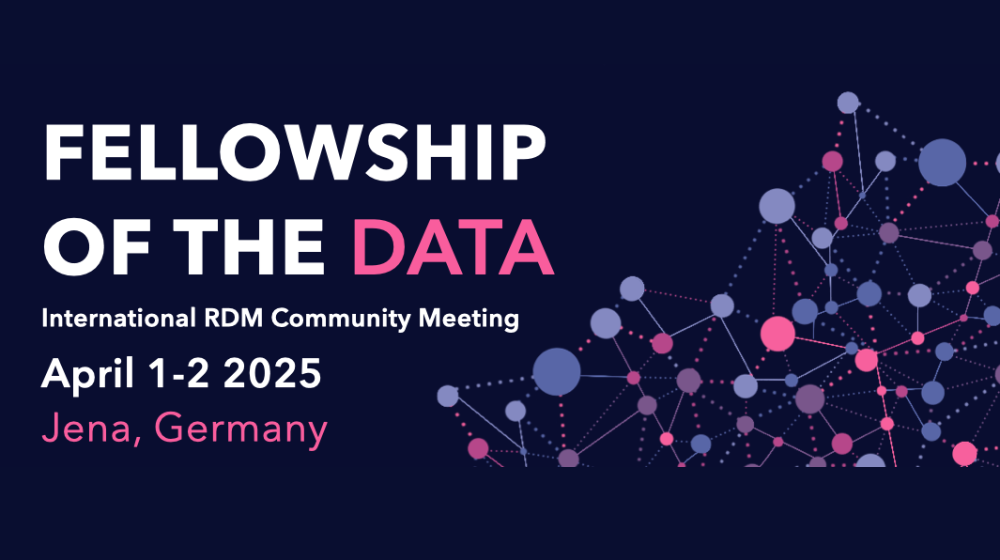
Fellowship of the Data - International RDM Community Meeting

Fellowship of the data

Event info

On the 1st and 2nd of April 2025, I attended the Fellowship of the Data event in Jena, Germany’s second national Research Data Management (RDM) community meeting. This is a community-driven event to bring together RDM professionals at various career stages. I went to present a poster on my research, “RDM, FAIR, and data sharing practices and perceptions of people who work with sensitive health data”.

Despite being a German meeting with most attendees from German research institutions, it was a surprisingly international community, with people from all over Europe and beyond! The event was full of community, interesting discussions, lots of Lord of the Rings memes, and as with many international meetings, I made new connections with UK colleagues I had not managed to meet in the UK. 

Day 1

Day 1 kicked off with a lovely welcome from the organisers, and Benjamin Slowig gave an overview of the whole German RDM landscape. The first keynote was made up of 2 interesting talks; Britta Petersen (Kiel University), in a Matrix themed presentation, covered how learning objectives could be the foundation of future training for data stewards, and Mijke Jetten (Health-RI) gave examples of how the Netherlands are bringing together community, training and practice in FAIR data stewardship, including through networks like ELIXIR, and the Dutch Data Steward Interest Group.

After an all-important lunch break, the day continued with a session around diversity of RDM tasks and roles. Kevin Lindt (TU Ilmenau) and Stefan Kirsch (EAU Jena) took us on an entertaining Lord of the Rings-themed journey of their Rent a Data Steward initiative in Thuringia. Michael Feichtinger (University of Vienna) then walked us through building a data stewardship network and team in Vienna.

I and the other poster presenters for Day 1 then gave flash talks - a mini advert to pique people’s interest in our poster - before the full poster session with snacks. I had some fascinating conversations and made new connections with colleagues from NFDI4Health, Germany’s national research data infrastructure for personal health data. 

The day ended with parallel sessions (Arts & Humanities, Life Sciences, and Data Competence Centres) where I got to know data stewards working in similar disciplines and had open, honest discussions on common issues we all faced. Again, building a supportive community was a key part of the event.

Day 2

In the morning of Day 2, I joined the community workshop session for data stewards to share essential tasks and how to overcome challenges. There were several ‘stations’ with different topics in the room which we rotated around every 15 minutes or so.

The third keynote of the event came from Antje Manske (GESIS/Base4NFDI) who explored how data stewards and other RDM professionals could use change management techniques to influence culture change at their institutions - inspiring to say the least!

Following another networking lunch, Samantha Pearman-Kanza (University of Southampton) gave the fourth keynote of the meeting, an in-depth talk on the ups and downs of using Electronic Research Notebooks. There was also a sneak peek into the new Careers and Skills for Data-Driven Research (CaSDaR) network she is leading, with some familiar faces appearing as co-leads, Simon Coles, James Baker, and the Software Sustainability Institute’s very own Director of Strategy, Simon Hettrick.

The final session of Day 2 was another poster flash talk and presentation session; most posters and presentations from the event are available on the Fellowship of the Data Zenodo page. Finally, the event closed with a summary from the wonderful organisers before we parted ways until next time.

Conclusions

A key theme and stand-out of the event was community and peer learning, which was really important and lovely to see. Everyone was incredibly welcoming and refreshingly open and honest. A lot of RDM professionals work in isolation or very small teams so meetings like this are vital to professionalising our roles and feeling connected and heard in an academic world that often sees RDM as an afterthought.

It was interesting how similar the RDM challenges in Germany are to the UK. I came away full of inspiration for both my SSI Fellowship and research, and feeling inspired to keep building connections and community internationally. Hopefully I’ll be able to attend a future iteration of this fantastic event!

Thank you to the Software Sustainability Institute for funding my travel and attendance at this meeting.


HomeNews and blogs hub

BioFAIR Fellowship Programme

Bookmark this page Bookmarked

BioFAIR Fellowship Programme

Author(s)
Denis Barclay

Denis Barclay

Communications Manager

Posted on 26 June 2025

Estimated read time: 1 min
Sections in this article
Share on blog/article:
LinkedIn

BioFAIR Fellowship Programme

BioFAIR logo, a group of people

BioFAIR has launched its fellowship programme. BioFAIR Fellows will become ambassadors for excellence in research workflow and data management across the UK life science research community, and will contribute to the creation of the BioFAIR People Commons. This is an opportunity to be an early part of the newly established and ambitious BioFAIR programme, which aims to deliver a BioCommons infrastructure for the UK, including end-to-end FAIR research data management and analysis capabilities along with the necessary support and training for UK researchers working in the life sciences. A BioFAIR Fellowship will fund 20% of your time for one year to support ambassadorial activities within your institution, across your broader research domain and the wider scientific community. 

HomeNews and blogs hub

NES Col-Lab Retreat: 27 - 29 August

Bookmark this page Bookmarked

NES Col-Lab Retreat: 27 - 29 August

Author(s)
Denis Barclay

Denis Barclay

Communications Manager

Posted on 25 June 2025

Estimated read time: 1 min
Sections in this article
Share on blog/article:
LinkedIn

NES Col-Lab Retreat: 27 - 29 August

TDCC NES logo, dunes

The NES Col-Lab Retreat will take place in Schoorl, Netherlands, from Wednesday 27 to Friday 29 August. The event will bring together researchers, data stewards, software engineers and support staff with an affinity for the Natural and Engineering Sciences.

Subscribe to Events
Back to Top Button Back to top