


Skip to main content Site map
HomeNews and blogs hub

Calling for Beta Pilot Workshops: Building Better Research Software

Bookmark this page Bookmarked

Calling for Beta Pilot Workshops: Building Better Research Software

Author(s)
Aman Goel

Aman Goel

SSI Fellow

Aleksandra Nenadic

Aleksandra Nenadic

Training Team Lead

Toby Hodges

Posted on 18 September 2025

Estimated read time: 4 min
Sections in this article
Share on blog/article:
LinkedIn

Calling for Beta Pilot Workshops: Building Better Research Software

The Carpentries logo, a lit keyboard

We recently published a new version of Building Better Research Software, a lesson in The Carpentries Incubator designed to serve as a “next steps” workshop after Software Carpentry. Previously known as FAIR Research Software, the curriculum has undergone significant changes over the last few months, and we are now seeking Carpentries Instructors willing to teach it in their communities and provide feedback to further improve it.

Lesson Profile

Learning Objectives

After following the lesson, learners will be able to:

  • List challenges typically faced by researchers developing software and managing data.
  • Enhance their research software development workflows by structuring, clarifying, documenting, testing, sharing, and reusing code.

The lesson teaches skills in three areas:

  1. Things learners can do with their computing environment to enhance the software
    1. Using virtual development environments.
  2. Things learners can do to improve the source code of the software itself
    1. Organising and structuring code and project directories.
    2. Following coding conventions and guides to improve code readability.
    3. Writing unit tests to ensure code correctness.
  3. Things learners can do to make the software easier for other people to use
    1. Collaborating via version control platforms like GitHub, GitLab, and CodeBerg
    2. Fostering a community around their software.
    3. Documenting the usage, licensing, and citation information of the software.

Target Audience

The lesson is aimed at post-graduate students, early career researchers or junior Research Software Engineers (RSEs) who want to develop software to support their research using established best practices. They have foundational knowledge of Python, version control and using software tools from the command line shell (as might be obtained through participation in a Software Carpentry workshop). It is also suitable for researchers or scientists who have foundational software training but wish to refresh, reinforce, or improve their skills and practices in the wider context of FAIR research, sharing, and writing software for open and reproducible research.

The curriculum has been designed to build on the mental model and skills taught in a novice Software Carpentry (Python) workshop. The learner profiles provide some examples of learners who would benefit from the workshop.

State of Development

The lesson has been extensively tested in multiple workshops, including events delivered as part of the UK Reproducibility Network (UKRN). More recently, the content was modified to improve accessibility and align its prerequisite knowledge more closely with the learning outcomes of a Software Carpentry workshop.

How You Can Help Develop This Lesson

Please try teaching the lesson and let us know how it goes!

Two beta pilot workshops of the lesson are already scheduled, and we are hoping to find more Instructors in the community who are interested in testing it out and providing feedback. Since it builds on the themes of existing Software Carpentry lessons, we expect that the content will be relevant to many in the Instructor community.

Our goal is to submit the lesson for adoption as a curriculum for official Software Carpentry workshops. All feedback and suggestions for improvement that we receive from the community will help us achieve this goal.

If you are willing and able to teach the lesson to your community in a beta pilot workshop, please let us know by contacting Aleksandra Nenadic or opening an issue on the lesson repository. The maintainers will be delighted to meet with you and answer any questions you have to help you prepare for the workshop.

After a pilot is complete, we ask Instructors to submit feedback based on their experience via a templated issue form on the repository. We would also be happy to meet with you again to debrief on your experience.

Acknowledgments

The development of the lesson has been supported so far by The Carpentries and the UK’s Software Sustainability Institute, via grants from the EPSRC, BBSRC, ESRC, NERC, AHRC, STFC, and MRC (EP/S021779/1) and the UKRN.

The current maintainers express their sincere gratitude to all previous developers and maintainers of the lesson, including:

  • Sarah Gibson
  • Sarah Jaffa
  • Kamilla Kopec-Harding
  • Sam Mangham
  • Alan O’Cais
  • Etienne Roesch
  • Colin Sauze
  • Sarah Stevens
  • Zhian Kamvar


HomeNews and blogs hub

Lessons on Lessons: How CLDT Is Shaping Our Approach

Bookmark this page Bookmarked

Lessons on Lessons: How CLDT Is Shaping Our Approach

Author(s)
Deborah Udoh Profile Picture

Deborah Udoh

SSI fellow

Posted on 24 April 2025

Estimated read time: 3 min
Sections in this article
Share on blog/article:
LinkedIn

Lessons on Lessons: How CLDT Is Shaping Our Approach

Close up of hands working on a laptop. The Carpentries logo.

By the Pre-Seeds Team

From the 25th to the 28th of March, the Pre-Seeds team participated in Part One of the Carpentries Collaborative Lesson Development Training (CLDT). It was an enriching experience, and we are deeply grateful to our facilitators, Toby Hodges, Aleksandra Nenadic, and the larger Carpentries leadership team. We learned a lot and want to share our reflections on what worked well, what could be improved, and how this training will shape our approach moving forward.

What Worked Well?

One of the standout aspects of the training was the simplicity and clarity of the sections. The lessons were structured in a way that was easy to follow, with a great balance of theoretical concepts and hands-on practice. The “show and tell” approach made it easier to understand and retain information, ensuring that learning was interactive rather than passive.

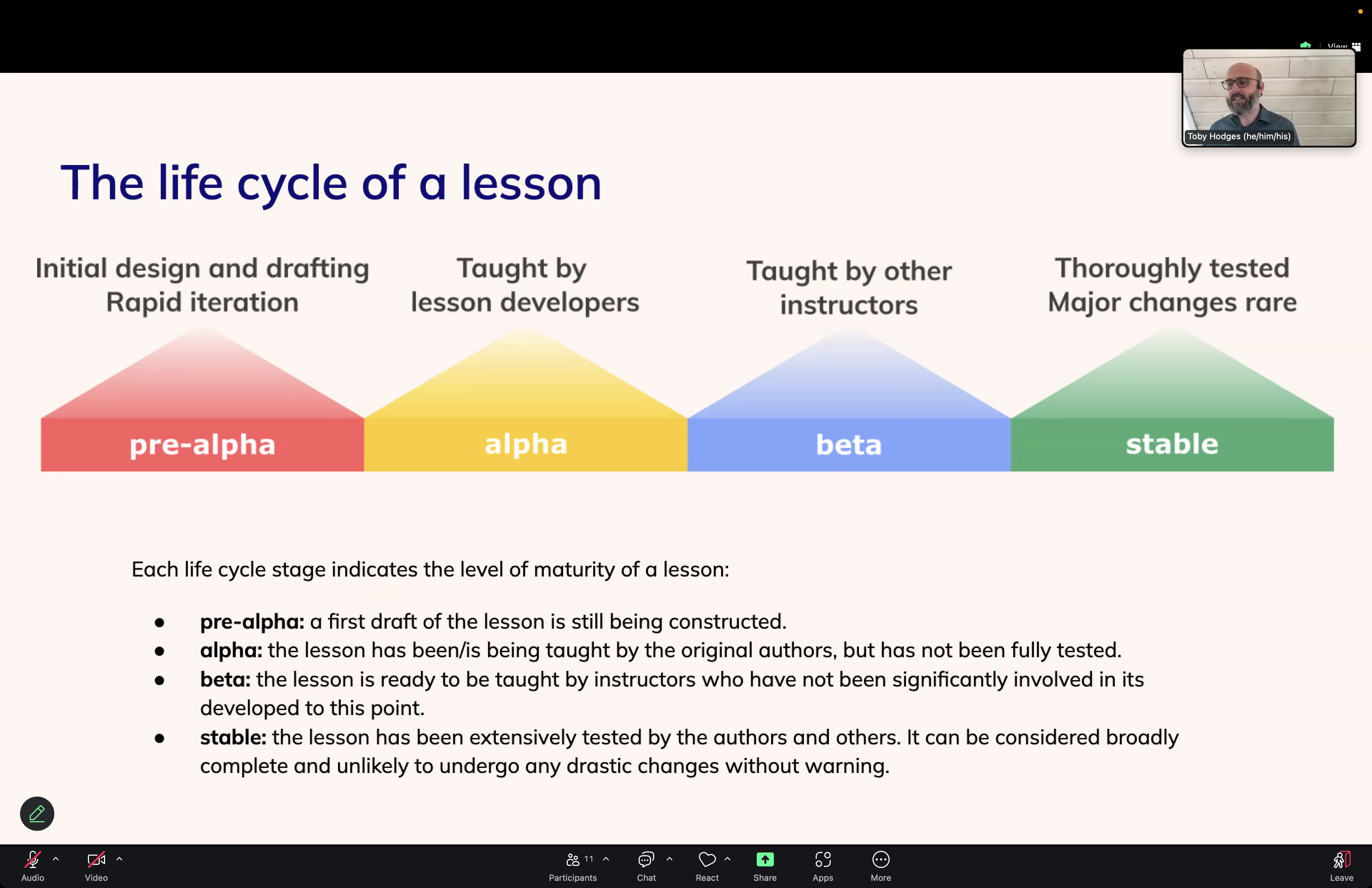
The life cycle of a lesson

The training was highly interactive, with numerous breakout sessions that encouraged teamwork and the application of new knowledge. These sessions allowed us to collaborate effectively, refine our lesson drafts, and exchange ideas. We also appreciated the facilitators’ commitment to continuous feedback—at every step, they checked in to ensure we understood the content and had space to ask questions.

A particularly memorable part of the training was the structured approach to lesson development. We learned to start with preliminary considerations, such as identifying our target audience, understanding their prerequisite knowledge, and pinpointing knowledge gaps. From there, we moved into crafting clear learning objectives and exercises, and using storytelling to make lessons more engaging.

We were also introduced to the Carpentries Workbench as a platform for hosting our lesson, which was incredibly exciting. Learning about different types of fenced divs and how they render on the site was an eye-opener. The wealth of additional reading resources provided us with valuable opportunities to explore concepts further at our own pace.

What Could Be Improved?

While the training was well-structured and engaging, we felt that having a little more time for collaboration in breakout rooms would have been beneficial. Given the depth of each section, we sometimes felt rushed to complete activities. We understand that extending the training time may not be feasible, but perhaps adjusting the pacing slightly could help balance deep learning with time constraints.

What Will We Do Differently?

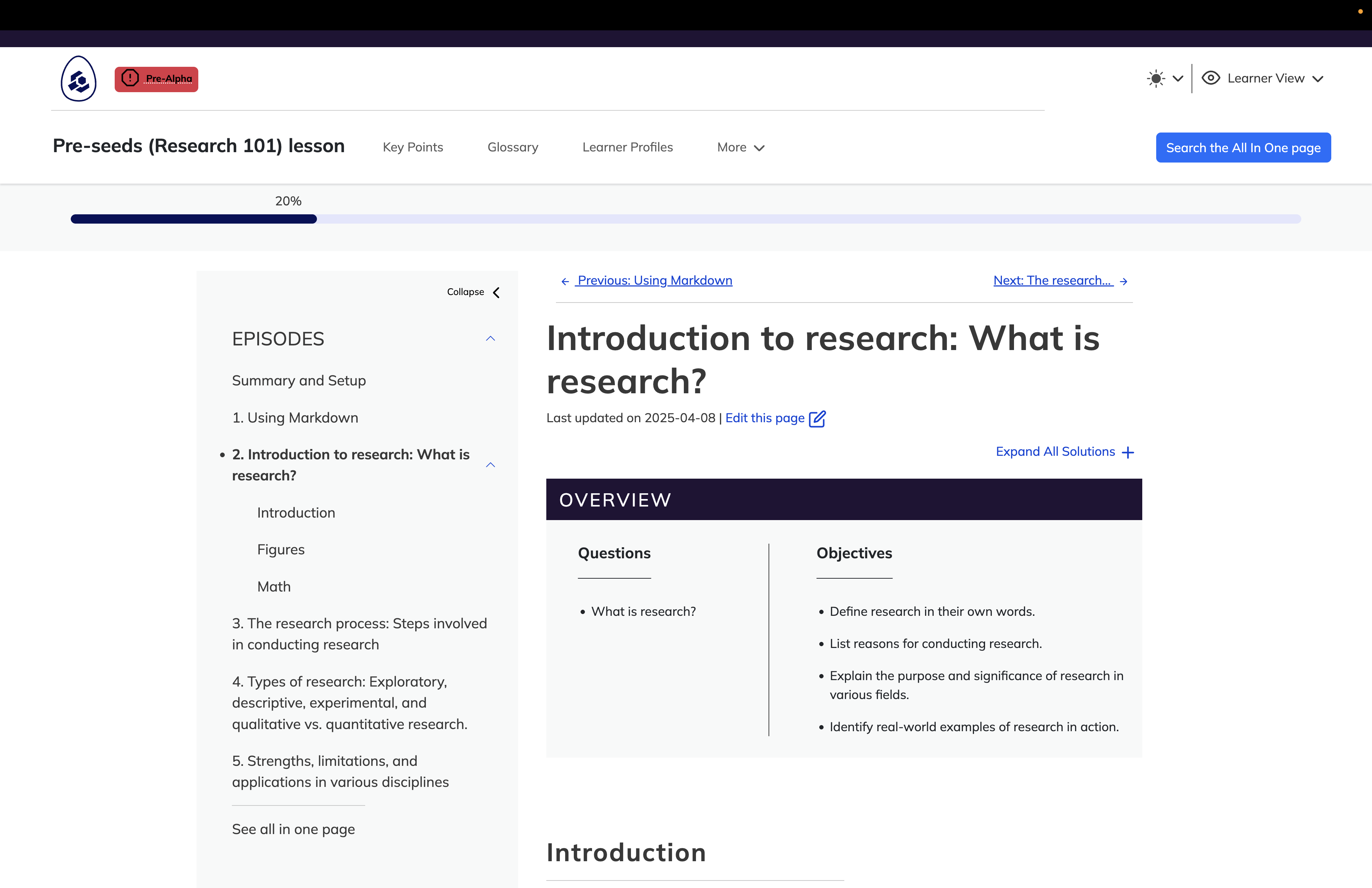
Introduction to research: What is research?

The insights we gained from CLDT will significantly impact how we design and refine our lessons. Moving forward, we will:

  • Design our lessons as episodes, using a storytelling approach to enhance engagement.
  • Integrate both formative and summative exercises into each episode.
  • Leverage breakout rooms to encourage collaboration in our training sessions.
  • Pilot our lesson with a small group (5–20 people) to gather feedback and iterate on improvements.
  • Host our course on the Carpentries Workbench, ensuring it is well-structured and accessible.

The training has given us not just the tools but also the confidence to build high-quality, collaborative lessons. We appreciate the patience and support of our facilitators and look forward to applying everything we’ve learned.

Once again, a huge thank you to Toby, Aleks, and the Carpentries team for this incredible learning experience!

HomeNews and blogs hub

CarpentriesOffline at CCHB24

Bookmark this page Bookmarked

CarpentriesOffline at CCHB24

Author(s)
Jannetta Steyn

Jannetta Steyn

SSI fellow

Posted on 3 March 2025

Estimated read time: 7 min
Sections in this article
Share on blog/article:
LinkedIn

CarpentriesOffline at CCHB24

The Carpentries logo, wires

I was fortunate enough to get my request for funding to attend CarpentryConnect Heidelberg submitted and approved just before the major clamp down on expenses at my university. Just as well as I had two sessions, a workshop and a mini hackathon, accepted. My next bit of fortune came when the Software Sustainability Institute approved funding, from the Further Development Fund, to purchase more Raspberry Pis (and some peripherals) which could be used for the workshop as well as further development of the miniHPC which is part of my SSI Fellowship project.

I boarded the plane with probably enough computing power to send a rover to Mars, let alone a flight to Germany from England. From the beginning, I did not want to have the hardware put in the hold luggage because if the airline decided to lose my luggage I’d end up not being able to run the workshop. I bought a really fancy protective case but as I got closer to the departure date I realised that the case itself was very heavy and there was no way I was going to get everything I needed into the hand luggage with the case’s extra weight. I also decided that I didn’t want to check any other luggage in since that would mean lugging several items between trains, planes and automobiles on the several legs between Durham, UK, and Heidelberg, Germany. I was pretty impressed with myself when I managed to pack 10+ Raspberry Pis, five mini network switches, 3 Anker charging stations, loads of ethernet cables, USB cables, USB to Ethernet connectors and whatnot, AND all my clothes in a carry-on case and a backpack. There was one thing I couldn’t take along as I was worried it would break and that was a little monitor. And then there was one thing that I, somehow, forgot and that was an HDMI to micro HDMI cable.

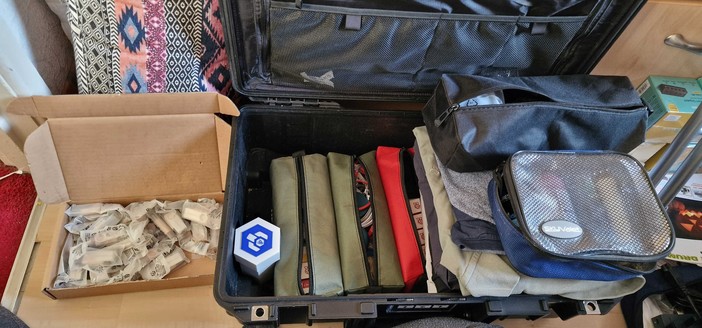
Packing for CCHB25.

Packing for CCHB25. This is all the stuff that I had to take along. In the end, I didn’t use the hard case which you see in the photo because it is just too heavy. I used a normal carry on of about the same size and I packed my clothes in a small backpack.

Apart from having had to run from what felt like the west to the east of the Netherlands, through Amsterdam airport because my first flight was late and then to freeze at the station in Frankfurt because the train was delayed, the trip went really well. I managed to, successfully, lug all 17kg of the allowed 12kg of hand luggage all the way to Germany and back with no complaints, extra charges or dislocated shoulders.

The conference itself was really good and I thoroughly enjoyed myself. I could only attend the keynotes and poster session because, obviously, I had my sessions to deliver at the other times. The keynote speakers were Radhika Khetani, Yanina Bellini Saibene and Malvika Sharan. It was such a privilege to hear them speak in person.

The mini hackathon was on the last day. There were only four of us but I think we managed to get a few things done. Redesigning the CarpentriesOffline website has been on my list for a long time and although we didn’t get much done I did come away from the session with some solid ideas and a good deal of motivation for the redesign.

My plan for the workshop was as follows. I set a limit of 10 people for the workshop because I have 10 Raspberry Pi 5s. I also have 5 mini USB switches. When I realised that the power supplies I ordered for the RPis would not work in Germany, I returned them and bought some Anker USB power banks. Each power bank could supply up to 200W distributed between its six ports (2 USBC and 4 USB A). I have an RPi 4 which runs RaspAP and could act as an access point. If RaspAp won’t connect to Eduroam there is the option to tether from a mobile phone connected to either Eduroam or data (if all else fails). Attendees were asked to bring laptops and I had a few USB to ethernet converters for those new laptops that do not have Etherports.

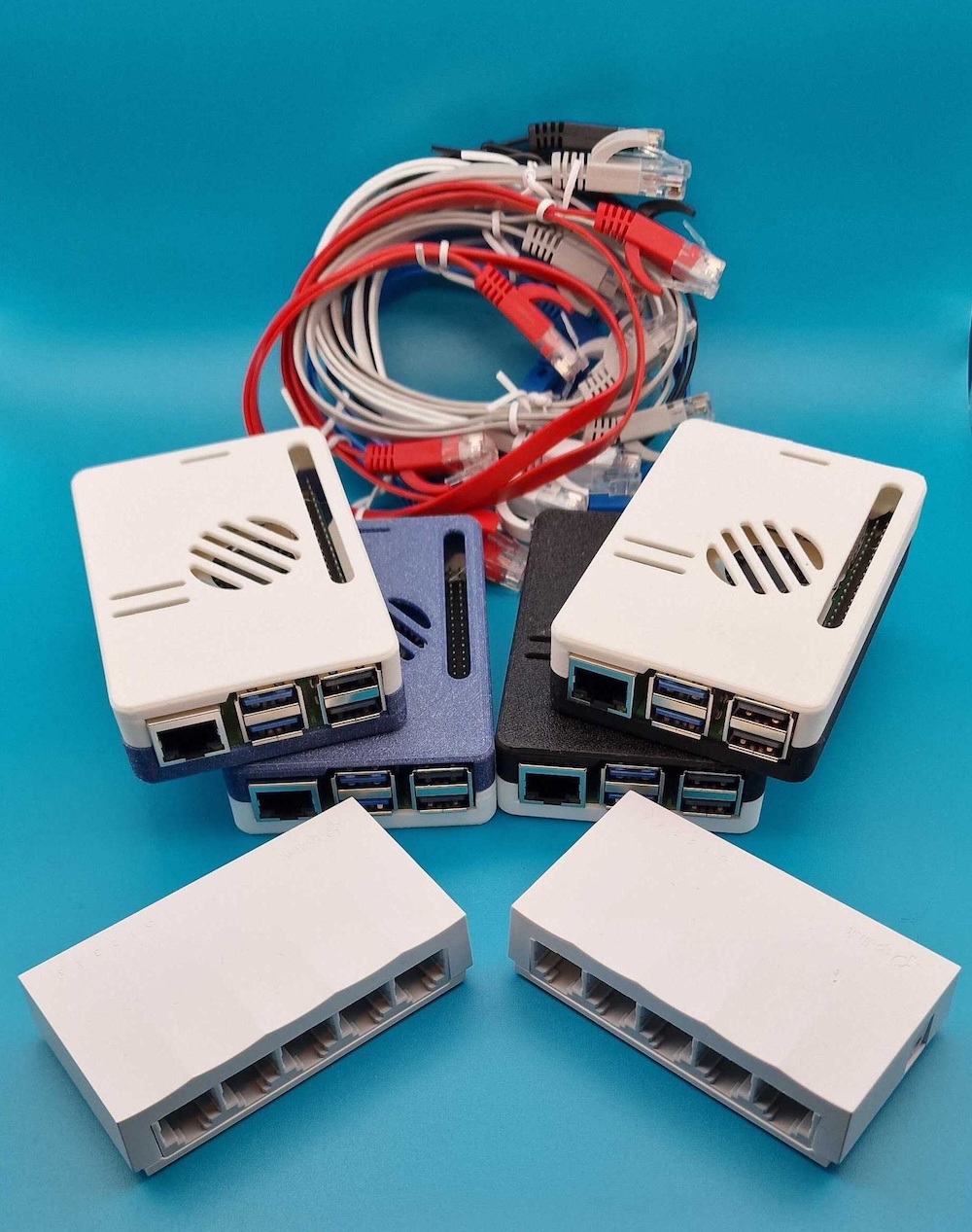
Four Raspberry Pi 5s, two mini ethernet switches and ethernet cables.

Four Raspberry Pi 5s, two mini ethernet switches and ethernet cables.

I pre-prepared 10 SD cards, five for login nodes and five for compute nodes. Attendees had to work in pairs, using two RPi 5s which they had to connect to a mini switch. One loaded with the login node SD card and the other with the compute node SD card. One laptop also had to be connected to the switch as this would be the only way to connect to the RPis if, for some reason, they wouldn’t connect to the RaspAP.

Anker USB Power Bank

I would say that things went according to plan up to this point. But, the moment we switched the RPis on it all went to pot! Some of the RPis wouldn’t boot. I discovered beforehand that, sometimes, the RPis need their EPROMS reflashed and I had an SD card at hand for that. Despite the reflashing, some still wouldn’t boot. We suspected that some of the SD cards might have a problem, so we went through the steps of installing the Raspberry Pi Imager and writing pre-prepared node images to the cards. Some RPis would still not boot, so we thought that my node image might be faulty. We then wrote the RPi Os Lite to the SD cards and attendees started following my lesson notes to install the software manually. We still had some RPis that wouldn’t boot at all and some problematic SD cards. Some of the RPis would boot but not connect to the RaspAP access point and without a monitor and a keyboard we were stuck.

One of the attendees managed to get the login and compute node to work. My hope was that it could be done without access to the Internet but at this point, we realised that, because the nodes were set up to use EESSI, they still needed Internet access.

My worry was that attendees would have been disappointed with the session but they all said that it was good fun to get their hands on the RPis and to be able to work through the process of trying to get everything up and running.

We did learn several lessons with regards to what works and what can go wrong and all this experience will be documented (eventually) on the CarpentriesOffline website. I am still looking for a server where I can make the RPi OS images available for anyone to download. They are too large for GitHub, unless one zips and splits the files which I don’t really want to do. In the meantime, do keep an eye on the website as I have been updating it over the last couple of months.

As always, I would welcome any help and/or suggestions with our CarpentriesOffline projects. Do get in touch if you are interested. You should be able to track me down on the Carpentries and RSE Slack workspaces and I also lurk around on Mastodon, BlueSky and LinkedIn.


HomeNews and blogs hub

UK activity blooms at European ‘CarpentryConnect’ community event in Heidelberg, Germany

Bookmark this page Bookmarked

UK activity blooms at European ‘CarpentryConnect’ community event in Heidelberg, Germany

Author(s)
Phil Reed Profile Picture

Phil Reed

SSI fellow

Posted on 30 January 2025

Estimated read time: 5 min
Sections in this article
Share on blog/article:
LinkedIn

UK activity blooms at European ‘CarpentryConnect’ community event in Heidelberg, Germany

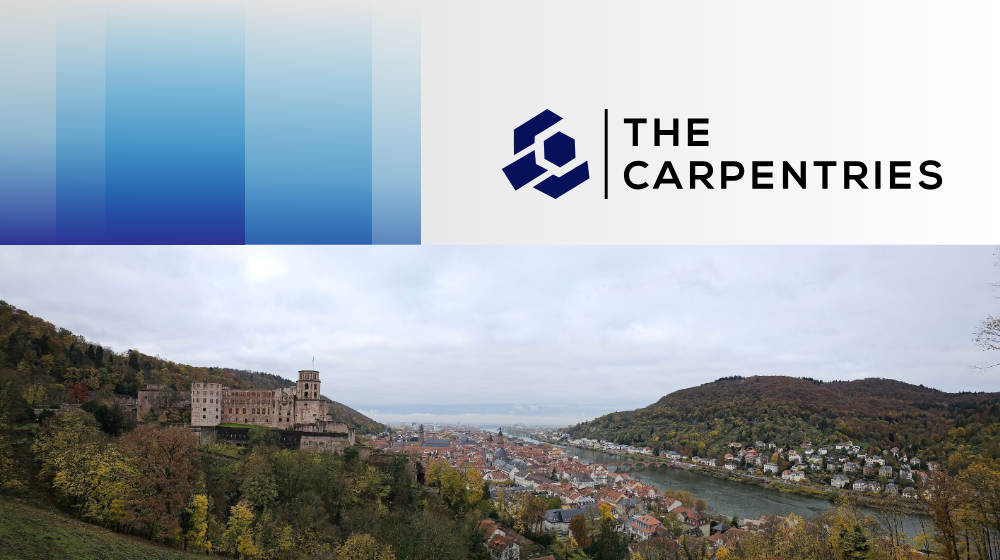
Panorama of Heidelberg castle and old town.

Panorama of Heidelberg castle and old town. Photograph by Phil Reed.

From 12 to 14 November 2024, I attended the joint BioNT and The Carpentries event titled ‘CarpentryConnect Heidelberg 2024’. Participants travelled from all over Europe for this conference and mini hackathon, with one keynote speaker flying in from South America. In this blog post, I will look at the presenters with UK connections, the keynote presentations, sharing my thoughts and highlights, then look ahead at what is next for the community of research software trainers. Thank you to BioIndustry 4.0 who funded my travel. I presented some of these reflections at the UK monthly Carpentries call on 17 December 2024.

About the host

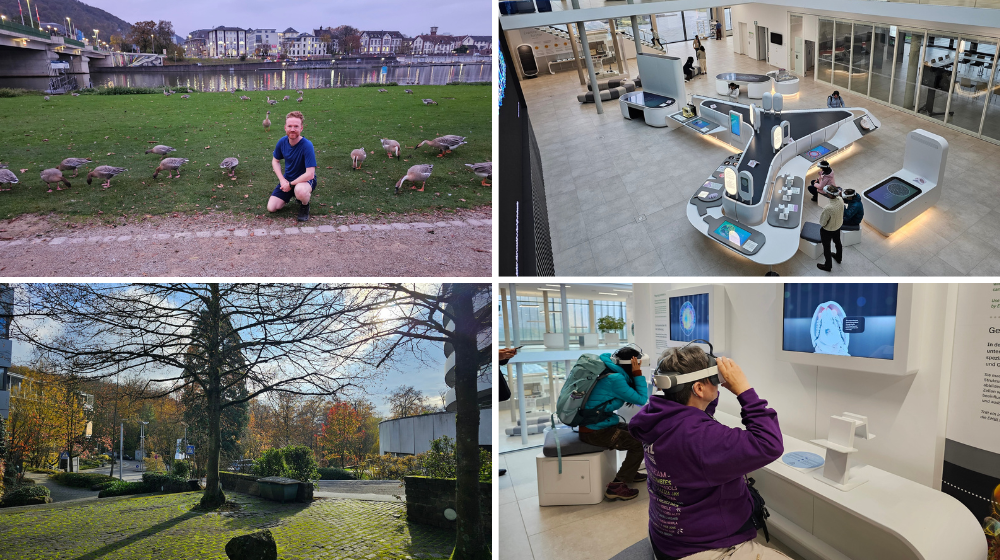
EMBL campus and Heidelberg city.

Photos of EMBL campus and Heidelberg city. 

The event took place at EMBL (European Molecular Biology Lab) in the city of Heidelberg in Germany and was hosted by BioNT (Bio Network for Training). BioNT is a collective that empowers digital skills in life sciences, particularly working with biotech and biomedicine SMEs, and everyone is welcome. They have provided quality training and community development with over 10 years of Carpentries activity. My travel founder was BioIndustry 4.0 who are revolutionising technology for a sustainable future and I'm very grateful for their support.

Many presenters with UK connections

Seven of the presenters had UK connections:

  • Malvika Sharan (Turing Institute, OLS) gave the first keynote presentation.
  • Matthew Bluteau (UK Atomic Energy Authority) co-hosted a hackathon project and presented a poster.
  • Aleksandra Nenadic (SSI), Jannetta Steyn (Newcastle University) and Samantha Ahern (UCL) each co-hosted a hackathon project, workshops and breakout sessions.
  • I presented a lightning talk.

These presenters (and the other UK attendees) played an important role in the overall engagement and delivery of the event.

My highlights and discussion points

In Malvika Sharan’s keynote (Carpentering Communities), Malvika spoke about lessons learned from working with communities in open science. Throughout these lessons, she considered two concurrent aspects: community and community management. In other words, there are different lessons to learn if you are a member of a community as opposed to being a manager or organiser of a community. A lesson which stood out for me is “clarity is kindness”; where ‘clarity’ means different things to different people. As community members, when new ideas merge, we must be strategic about where we put our time. As community managers, the focus is different; for example, we should set up clear processes for on- and off-boarding members. 

Hugo Gruson (data.org) described how the Carpentries Workbench (latest lesson template) is being used in other communities already, including universities and businesses on both sides of the Atlantic. He found it tricky to identify all these users since there is no registry or requirement for people to share their intentions when they fork the open-source code. I have observed equivalent concerns with my work when we wish to audit or communicate with everyone who has adapted our team’s code. It was helpful to hear Hugo’s approach to the problem.

The third keynote speaker was Yanina Bellini Saibene (rOpenSci, LatinR).  

Yanina spoke about her experience of building connections through community participation. She mentioned how she applied the CSCCE Community Participation Model which describes four modes of member engagement that can occur within a community. These modes are: convey/consume, contribute, collaborate, and co-create. I will take some more time to study this model to see how it could improve my own work.

Sarah Kaspar (EMBL) led a breakout session looking at tools for creating training materials, whether the materials are for Carpentries-related work or otherwise. We discussed how there is much overlap between the tools and their applications, there is no one-size-fits-all solution. We created a shared list of free products to create scalable vector graphics (SVG) that can be used in documentation, illustration and web design. I have since used one of these (draw.io) in documentation I maintain for the ELIXIR TeSS platform.

Prosperity for early 2025

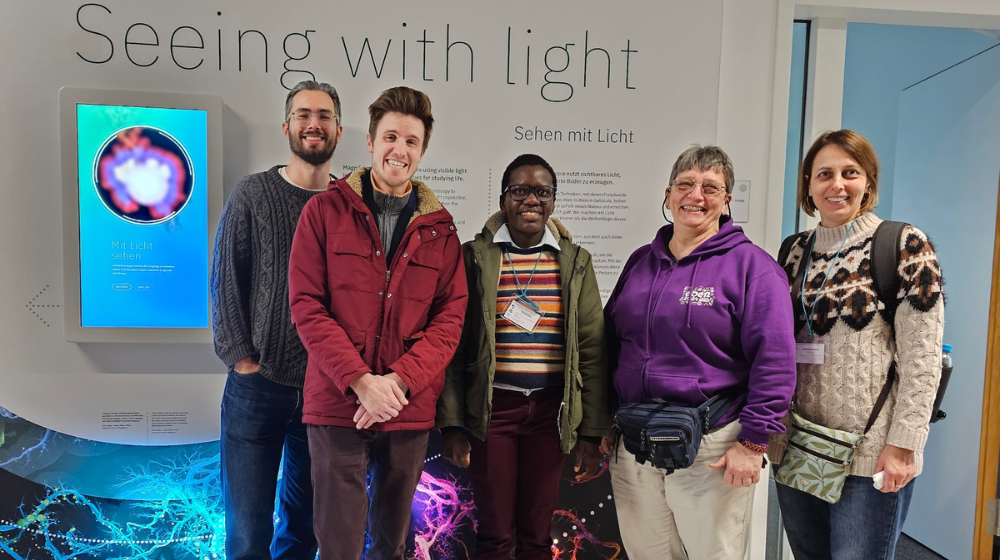
Participants enjoying a visit to the EMBL exhibitions.

Participants enjoying a visit to the EMBL exhibitions.

All of the mini hackathon projects progressed, not always in the ways that people anticipated. Most relevant to the SSI are the materials being developed regarding lesson translation and how to develop intermediate level training.  Several community events are planned in the coming weeks and months, relating to the activity in Heidelberg. For example, there are community calls in January 2025 for how to move Software Carpentry forward, and there are monthly calls for progressing CarpentriesOffline and miniHPC. Details can be found in my December 2024 UK Carpentries presentation, slide 7

Conclusions

I could see from attending CarpentryConnect that The Carpentries community is maturing, its priorities are adjusting since I was first involved in 2018. The scope is expanding but the core message remains true. I made more connections than I expected relating to my core job; I am a Research Community and Training Manager, mostly facilitating life sciences research data, tools and training. It was great to overlap with people I know through ELIXIR Europe, some of whom I had never met face-to-face.  

I found inspiration on how to better run my own mini hackathons, events and other activities, experiencing how the CarpentryConnect sessions were so well organised and planned.  Finally, I could see how there is no one-size-fits-all solution to many challenges yet we can still work together harmoniously and collaboratively.


HomeNews and blogs hub

Designing Effective Intermediate-Level Courses: Challenges and Insights

Bookmark this page Bookmarked

Designing Effective Intermediate-Level Courses: Challenges and Insights

Author(s)
Matthew Bluteau

Matthew Bluteau

SSI fellow

Aleksandra Nenadic

Aleksandra Nenadic

Training Team Lead

Colin Sauze

Colin Sauze

SSI fellow

Samantha Wittke

Samantha Wittke

SSI fellow

Lisanna Paladin

Jacobo Miranda

Simon Christ

Sven van der Burg

Candace Moore

Samantha Ahern

Posted on 28 January 2025

Estimated read time: 7 min
Sections in this article
Share on blog/article:
LinkedIn

Designing Effective Intermediate-Level Courses: Challenges and Insights

The Carpentries logo, a lit keyboard

From: Breakout session “Developing and Delivering Training Material at the Intermediate Level”, CarpentryConnect Heidelberg 2024

One of the most common questions from learners who have completed a Carpentries workshop on foundational computational or data analysis skills is “What course should I take next?” This is not only relevant for recent attendees but also for those who participated in a workshop some time ago. Addressing this question requires us to focus on intermediate-level learning, something that an estimated one-third of the lessons in the Carpentry Lesson Incubator are already aiming to do. These lessons cover topics such as containerization, advanced Git workflows, and machine learning skills - topics that go beyond the novice level but are not yet aimed at experts. Within the Carpentries pedagogical model, we are helping learners advance from novices to competent practitioners.

But how do these intermediate lessons differ from the foundational ones?  At a breakout session “Developing and Delivering Training Material at the Intermediate Level” delivered at CarpentryConnect Heidelberg 2024, Matt and Aleks shared their insights as lesson developers in creating lessons on more intermediate topics and, together with the audience, explored key considerations, challenges, and strategies for designing and delivering effective intermediate-level courses.

Key objectives were to:

  1. Leverage community expertise: Collect insights from educators who have experience teaching intermediate-level courses.
  2. Establish guidance and document pitfalls: Develop a resource that outlines best practices for course design and delivery.
  3. Invite community feedback: Share this guidance widely to refine and expand it based on collective input.
  4. Integrate with existing resources: Eventually, incorporate these principles into established training frameworks, such as Collaborative Lesson Development Training.

Existing Principles for Lesson Design

We started by recapping the existing lesson design principles as taught by The Carpentries in their “Collaborative Lesson Development Training” Programme”:

  • Understanding your learners (target audience) is critical. 
  • Drawing from the Dreyfus model of skill acquisition, we know that: novices benefit from worked examples and step-by-step instructions. Competent practitioners need space to explore options and develop their own solutions and overly prescriptive lessons may hinder their learning.
  • Creating learner personas and defining prerequisites can help set realistic expectations and ensure the course is appropriately tailored.
  • Clearly defining learning objectives should be based on the target audience's needs.
  • Focusing on authentic tasks in training that reflect real-world challenges similar to those they are facing makes lessons more engaging, learners more motivated and aids learning.

All of the above remains highly relevant for lesson development at any level; however, intermediate-level instruction may diverge from the standard delivery techniques typically used in novice workshops.

Challenges and Insights from Experience

  • Audience diversity: defining the audience is harder at the intermediate level. Learners arrive with even more pronounced variations in the levels of expertise, making it difficult to design a one-size-fits-all curriculum. Preliminary assessments and a clear definition of prerequisites can partially address this. Design lessons with optional exercises to accommodate varying expertise levels. This has the added benefit of helping with the pacing of the course: instructors won’t feel as much pressure to keep the course moving to avoid too many learners waiting with nothing to do.
  • Effective pre-workshop assessment and prerequisites list: developing and enforcing some kind of assessment is even more important; it is not just enough to list prerequisites and self-assess - learners should go through a quiz (“sorting hat”) to “sort” them based on the number of points they scored or are asked to solve some coding puzzles (e.g. Advent of Code - small programming puzzles for a variety of skill sets and skill levels). Making the pre-course assessment more like a game or puzzle has been anecdotally well-received, but it is important to note that it should be fairly restricted in scope and usage. These gateway mechanisms should be complemented with guidance on natural learning pathways - clear, structured routes through curricula of varying difficulty, with links to prerequisite courses for advanced levels (e.g. see Rosalind's platform for learning bioinformatics).
  • Expanding course formats and teaching methods: traditional 2-day workshop format is sometimes insufficient for intermediate topics; live-coding that is used as an effective teaching method for novices may not be suitable for intermediate learners who may appreciate a more self-paced, self-learning style with guidance from instructors or helpers. Flipped classrooms may work better here - learners are given course material to read beforehand, then meet with instructors and work through the given exercises to apply the learned content along with some group activities.
  • Post-course engagement practicing what you have learned is a more effective way to advance from one level to another. Self-guided follow-up projects to allow learners to work on independent projects after the course with opportunities for trainer feedback. At the advanced level, it is also possible to provide “bring your own code” sessions: learners are encouraged to apply the tools and techniques learned in a workshop to their own work and can join a support session a few weeks after the workshop.
  • Alternative structures: short, biweekly meetings with instructors paired with challenging assignments in between; guided online learning through a community-supported platform where answers can be provided by more experienced members of the community. Advanced workshops can be more niche topics, and reaching learners can be hard. With the “bring your own classroom” one can provide training, stream it and encourage smaller groups/teams in different locations to follow the stream and do the exercises with their peers (scales well but time zones could pose an issue).
  • New content and presentation techniques: intermediate learners may require a greater emphasis on theoretical concepts, which take longer to teach than novice-level skills, and a mix of instructional methods, including live coding and slides (diagrams), to effectively convey complex ideas. However, the connection to authentic tasks should not be lost. The “intermediate” mental model has more connections that need to be explored and correspondingly an instructor will often not be able to reside solely in one tool / environment (e.g. the terminal). Instructors should be prepared to demonstrate multi-step tasks that span tools or multiple facets of a tool (e.g. the many components of an IDE).
  • Adaptability of the content and timing: structure lessons with flexible, modular components and allow for adjustments (a selection of sections to cover) based on the cohort, while maintaining the overall session duration the same. Creating detailed instructor notes on how to deliver the lesson becomes even more critical to help instructors tailor the depth of content delivery to the audience's needs. 
  • Diverse exercise formats: incorporate optional and supplementary materials, including varied exercises that scale in complexity (e.g., basic code answers, optimised code solutions, or optimised code solutions with documentation). Increase paired activities where students collaborate on challenges, either solving them together or individually and then teaching each other. 

Conclusion

Intermediate-level courses play a critical role in supporting learners on their journey from novice to expert. By addressing challenges, refining principles, and leveraging community expertise, we can create engaging, effective, and inclusive learning experiences. Together, we can build a roadmap that bridges the gap between foundational skills and advanced mastery.

We invite you to share your insights, vote on priority topics, and contribute to this evolving conversation - please get in touch with Matt and Aleks, other Carpentries lesson developers (via incubator-developers mailing list or #lesson-dev Slack channel), or come to one of our community discussion sessions.


HomeNews and blogs hub

Instructor training workshop announced as part of the Research Software Camp

Bookmark this page Bookmarked

Instructor training workshop announced as part of the Research Software Camp

Author(s)
Aleksandra Nenadic

Aleksandra Nenadic

Training Team Lead

Posted on 17 October 2024

Estimated read time: 2 min
Sections in this article
Share on blog/article:
LinkedIn

Instructor training workshop announced as part of the Research Software Camp

RSC logo, man in fron of filing cabinet

We are delighted to announce the Carpentries Instructor Training workshop will take place on 19-22 November 2024, 1-5pm GMT, as part of the Research Software Camp: Digital Skills for Research Technical Staff

Register your interest to take part. Spaces are limited and we will allocate this on a first-come-first-serve basis. The organising team will contact participants in early November 2024. 

Please note attendees must have some previous exposure to Carpentries workshops, either as a student, helper, observer or co-instructor - to help set the things we will teach at the workshop in the right context.

What is Instructor Training?

Instructor Training teaches evidence-based approaches and pedagogy for teaching computational and data skills to novices effectively. It is part of the official training for becoming a certified Carpentries instructor. It also:

  • Teaches how to create a positive environment for learners at workshops and classes and motivate your learners.
  • Provides opportunities to practise and build your own teaching skills.
  • Prepares you to use these teaching skills in Carpentry workshops (but are also useful across any teaching you may do).
  • Helps you become an integrated member of the Carpentries community.

Find out more about the Research Software Camps and SSI training services

HomeNews and blogs hub

Latest updates about CarpentryConnect Heidelberg 2024

Bookmark this page Bookmarked

Latest updates about CarpentryConnect Heidelberg 2024

Author(s)
Denis Barclay

Denis Barclay

Communications Manager

Posted on 30 May 2024

Estimated read time: 2 min
Sections in this article
Share on blog/article:
LinkedIn

Latest updates about CarpentryConnect Heidelberg 2024

The Carpentries logo

The Bio Network for Training, BioNT consortium with all its international partners will host the second European CarpentryConnect event from November 12 to 14, 2024 at EMBL - Heidelberg in Germany. This event will be happening alongside the BioNT community event, creating a great opportunity for collaboration and networking.

The keynote speakers will be:

  • Radhika S Khetani (Sweden): Director of Data Science Learning at AstraZeneca
  • Yanina Bellini Saibene (Argentina): Community Manager at rOpenSci, Co-Founder of MetaDocencia, Co-Founder and Chair of LatinR, R-Ladies Leadership Team
  • Malvika Sharan (United Kingdom): Senior Researcher at The Alan Turing Institute, Co-Founder & Co-Director of OLS (formerly Open Life Science)

A provisional programme that includes lightning talks, posters, workshop sessions, breakout discussions and mini-hackathon sessions can be viewed here.

The BioNT Community Event & CarpentryConnect Heidelberg 2024 aims to be accessible to everyone and will provide Inclusivity Tickets designed to support those facing financial or other barriers to attending the event. Application for these tickets is now open and can be accessed here.

Further Information

  • The deadline for submitting your abstract for the Inclusivity Ticket is July 12
  • Notification of acceptance will be sent to winners no later than July 26
  • Event registration will open on June 17
  • A definitive programme will be released on June 17
  • CarpentryConnect and BioNT community event takes place 12 - 14 November
  • For updates, announcements, and information about the event, please visit the event website.
  • If you need any support completing the form or have any questions, please get in touch at programme-biont@embl.de


HomeNews and blogs hub

Proposal Submission Opens for CCHD24

Bookmark this page Bookmarked

Proposal Submission Opens for CCHD24

Author(s)
Denis Barclay

Denis Barclay

Communications Manager

Toby Hodges

Posted on 1 April 2024

Estimated read time: 3 min
Sections in this article
Share on blog/article:
LinkedIn

Proposal Submission Opens for CCHD24

The Carpentries logo

The CarpentryConnect and BioNT community event - Heidelberg 2024 is expected to be the key community-building and networking event for The Carpentries and BioNT’s community in Europe, with worldwide participation. Taking place 12 - 14 November 2024, this event will provide the opportunity to bring together newer and more experienced community members to share knowledge, network, develop new skills, and develop strategies for training beyond academia and building strong local and regional training communities. The event will be held in a hybrid format, allowing workshops to be conducted virtually.

We invite you to submit proposals to share your knowledge and skills to help enhance research and learning outcomes in different communities. Proposals should align with the theme Community-led training beyond academia, and focus on topics such as:

  • Widening career perspectives through training
  • Bridging sectors and fostering collaborations through skill-up training
  • Exploring the advantages and disadvantages of different formats with different training audiences, possibly comparing ‘The Carpentries’ with different formats
  • Empowering local and global training communities, considering their geographical distribution, as well as their distribution across topics and sectors
  • Expanding beyond the boundaries of one’s community and engaging others
  • Sharing helpful tools for teaching and examples of using them in a workshop
  • Training on a range of practical skills
  • Running an effective online workshop/teaching effectively online
  • Developing novel or existing lesson/curricula, both Carpentries-style and from other training communities (on day 3)

Submit a proposal

To propose a session, please use the online submission form. #CCHD2024 will have four types of sessions plus a day and a half dedicated to the Mini-hackathon and Curriculum Development Session:

  • Breakout discussion sessions will be 1.5 hours long and conducted in a round table or general discussion format. These discussions will be crucial in connecting participants based on shared interests and stimulating discussion on relevant topics.
  • Skill-up or training sessions will allow participants to develop new skills in a 1.5-hour or 3-hour session. In this session, you can share technical or transferable skills with others
  • Workshops are a way for you to pass on your ideas and expertise to other participants in a 1.5-hour or 3-hour session. You can reach out to larger numbers of people by conducting workshops on the topic that you find important and facilitate a positive learning environment for the attendees
  • Lightning talks and posters will allow you to present your work, idea, interest, etc., in short, 3 to 5-minute presentations or within a poster
  • Mini-collaboration drive and Curriculum Development Sessions (on Day 3): If you have an idea for a new lesson or if your lesson is in the early stages of development, feel free to submit the idea/lesson using the same form. There are two sessions scheduled, each lasting 1 hour and 30 minutes.

We are so excited to learn about your ideas for the event!

Important Information

  • The deadline for proposal submissions is the end of the day on 2 April 2024, anywhere on Earth. We will start reviewing the submitted proposals as they are received.
  • Notification of accepted proposals will be sent to participants no later than 20 April
  • Event registration will open on 2 May
  • For updates, announcements and information about the event, please visit the event website
  • If you need any support completing the proposal submission form or have any questions, please get in touch
HomeNews and blogs hub

The Carpentries Lab: Good Enough Practices in Scientific Computing

Bookmark this page Bookmarked

The Carpentries Lab: Good Enough Practices in Scientific Computing

Author(s)

Toby Hodges

Edward Wallace

Posted on 6 March 2024

Estimated read time: 7 min
Sections in this article
Share on blog/article:
LinkedIn

The Carpentries Lab: Good Enough Practices in Scientific Computing

The Carpentries logo
Blog originally published on The Carpentries website.

We are delighted to (belatedly) announce the addition of a new community-developed lesson, Good Enough Practices in Scientific Computing to The Carpentries Lab. The curriculum was peer reviewed in the Lab Reviews repository, and approved for inclusion in The Carpentries Lab on 17th July 2023.

The Carpentries Lab was set up as a space for peer-reviewed lessons developed by the community. Designed to complement The Carpentries Incubator, where the community collaborates on the development of new lessons on a wide range of topics, the Lab is intended to serve as a platform for open peer review of these community-developed lessons and the hosting of lessons that have passed through that review process.

About the lesson

The lesson was inspired by, and adapted from, the paper Good enough practices in scientific computing [1] by Greg Wilson, Jennifer Bryan, Karen Cranston, Justin Kitzes, Lex Nederbragt, and Tracy Teal, which “presents a set of good computing practices that every researcher can adopt, regardless of their current level of computational skill.”

This lesson addresses good practices for data analysis, computing, and collaboration that are broadly useful for researchers. The underlying principles of planning, modular organization, good names, and documentation, are important for both novices and experts who take computational approaches. The lesson helps novices to learn these good practices in their own right, empowering them to learn other computational skills. For example, novice programmers can struggle with poor planning, poorly organized files and projects, unclear names for variables, documenting and describing their code. Teaching good practices separately means that programming lessons can focus on programming concepts and syntax. Making good practices explicit also helps more advanced researchers to collaborate with others, and to explicitly teach good practice to novices.

The lesson was developed by a team based primarily at the University of Edinburgh: Tomasz Zieliński, Andres Romanowski, Emma Wilson, Felicity Anderson, Elvina Gountouna, Matthias Mimault, Alison Meynert, Edward W.J. Wallace. The team has a mixture of roles in research support, biological and biomedical research, and bioinformatics. Many members are Carpentries instructors, and all are committed to helping colleagues to use computing better in their research, especially bioinformatics. For example, Edward Wallace is a quantitative biologist whose research group investigates gene regulation in fungi, and Alison Meynert was a Research Fellow and Bioinformatics Analysis Core Manager who’s about to transition to a role at Fulcrum Genomics.

“After many years teaching computational skills, we came across the same problems repeatedly: learners get stuck on names, concepts, and organization.” said Edward Wallace. “We first adapted the Good Enough Practices paper into a workshop, initially as PowerPoint slides. Within the UKRI-funded Ed-DaSH project, we turned the material into a Carpentries-style lesson, which required distilling key messages and concepts using less text, while adding more interactive material. After years of iterative improvements based on learner and instructor feedback, we find the material to be very effective.”

He adds, “From another perspective, the target audience is ourselves several years ago: it’s the skills that we value now, that we wish we had learned earlier.”

About the Review Process

The lesson was reviewed in a public issue thread on The Carpentries Lab reviews repository. After some initial editorial checks, the curriculum was reviewed by two volunteers from The Carpentries community: Lex Nederbragt and Heidi Seibold. Lex is a Carpentries Instructor and Instructor Trainer, an Associate teaching Professor at the University of Oslo, and one of the authors of the original paper that inspired the lesson. Heidi is an Open Science trainer and consultant, and an independent researcher at IGDORE.

The authors shared these reflections on the review process and how it impacted the quality of the lesson:

Peer review brought in a whole host of improvements that collectively made the lesson far better. It clarified the core messages and reduced duplication. We were delighted that Lex Nederbragt was a reviewer, as he is one of the authors of the original Good Enough Practices paper and star of the memorable “a video introduction to live coding, part 1 and part 2” , used in Instructor Training.

The peer review experience was very helpful and positive. Everyone was constructive and really worked to make the material better. The review process took a long while, many months, and far longer than we’d budgeted in our grant application to fund staff time to develop the workshops.

Next steps

The authors routinely use the lesson for training of first-year graduate students in biological and biomedical sciences in Edinburgh. Feedback is overwhelmingly positive, which they find gratifying after putting so much work into developing good material.

They shared this advice for other Carpentries Instructors who might wish to use the lessons:

We recommend the workshop for first-year PhD students, for researchers who are moving through collecting data towards larger-scale data analysis, and for those who have started to write code and need help organising it. We particularly recommend it as a preliminary before learning about version control with Git, and have designed it with that in mind. It addresses a gap in the Software Carpentry Git lesson, where our learners had reported that the lesson told them how to use Git but did not explain what Git is for. For researchers in biomedical sciences, the workshop prepares for Project Management and Organization for Genomics, which gives practical applications of the principles outlined in this workshop.

The wider Carpentries community can now find the lesson in The Carpentries Lab, use and adapt it to teach their own workshops, contribute feedback, and suggest improvements. A paper about the lesson recently entered review for publication in The Journal of Open Source Education.

The Carpentries Lab is looking for reviewers! To volunteer to review a lesson in the Lab, please read our Guide for Reviewers, and register as a reviewer so we can contact you when relevant lessons are ready for review. Lessons in the Incubator can be submitted for review in the Lab by opening an issue on the reviews repository.

Acknowledgements

We are very grateful to everyone who helped make this review in The Carpentries Lab a success. Congratulations to the authors for creating an excellent lesson that will prove a useful resource to so many people:

  • Tomasz Zieliński
  • Andres Romanowski
  • Emma Wilson
  • Felicity Anderson
  • Elvina Gountouna
  • Matthias Mimault
  • Alison Meynert
  • Edward W.J. Wallace

And huge thanks to the reviewers, who devoted a significant amount of time to reviewing the lessons, and exemplified the communication, diligence, and expertise required for a successful peer review process:

  • Lex Nederbragt
  • Heidi Seibold

1: Good enough practices in scientific computing, Wilson et al., PLOS Computational Biology, 2017 https://doi.org/10.1371/journal.pcbi.1005510

HomeNews and blogs hub

CarpentryConnect Heidelberg 2024

Bookmark this page Bookmarked

CarpentryConnect Heidelberg 2024

Author(s)
Denis Barclay

Denis Barclay

Communications Manager

Posted on 30 January 2024

Estimated read time: 4 min
Sections in this article
Share on blog/article:
LinkedIn

CarpentryConnect Heidelberg 2024

The Carpentries logo

Originally posted on carpentries.org

We are very excited to announce the upcoming CarpentryConnect Heidelberg 2024 (CCHD2024), scheduled to take place in Heidelberg, Germany, from November 12th to 14th, 2024.

Following the success of CarpentryConnect Manchester 2019, we aim to create an event where members of The Carpentries community from Germany and beyond can come together to explore and discuss community-led software and data skills training as well as capacity building initiatives.

CCHD2024 will feature a diverse range of sessions. The event will include breakouts, posters, lightning talks, workshops and curriculum co-working sessions, all centred around the Theme: “Community-led training beyond academia”.

Attendees can expect engaging discussions, hands-on learning experiences and the opportunity to network with various communities.

Who is organising the event?

The event will be hosted by The Bio Network for Training (BioNT) consortium with all its international partners and in collaboration with The Carpentries and their community members. CCHD2024 will run parallel to the BioNT community event, fostering collaboration and networking opportunities. The organising committee, consisting of experts with various backgrounds, includes (in alphabetical order):

  • Renato Alves, EMBL - Heidelberg
  • Silvia Di Giorgio, ZB MED - Cologne
  • Anne Fouilloux, Simula Research Laboratory - Oslo
  • Toby Hodges, The Carpentries - Heidelberg
  • Claudia Kapp, IQWiG - Cologne
  • Rabea Müller, ZB MED - Cologne
  • Teresa Müller, University of Freiburg
  • Lisanna Paladin, EMBL - Heidelberg
  • Isabela Paredes Cisneros, EMBL - Heidelberg
  • Giacomo Peru, SSI - Edinburgh
  • Till Sauerwein, ZB MED - Cologne

Over the coming months, the organising committee will lead several initiatives to ensure a successful CCHD2024. These efforts include:

  • calling for workshops and session contributions
  • drafting a program
  • seeking sponsors for the event

For updates, announcements, and detailed information about CarpentryConnect Heidelberg 2024, please visit our event website. Stay tuned for exciting developments as we work to bring this vision to life!

Get Involved: Call for Volunteers

To ensure the success of CCHD2024, we invite you to be a part of the organisation team. Whether you’re interested in shaping the program, coordinating logistics, or helping with outreach and communication, your involvement is invaluable. If you are passionate about community-led training and would like to contribute your skills, we encourage you to contact Silvia Di Giorgio.

Get Involved: Call for Sponsors

We are looking for sponsors to join us in supporting this event. Various sponsorship levels are available, and we are flexible in modelling them according to your needs. Could you contact Silvia Di Giorgio to explore options and discuss how your support can make a difference?

Help us find the perfect sponsors! If you know someone interested in supporting community-led training, share this call for sponsors. Together, let’s make CCHD2024 an unforgettable event.

About the Venue

The EMBL Heidelberg campus is located in the hills of Heidelberg, surrounded by forest, and a well-renowned venue for holding scientific conferences and courses. Several rooms with different sizes and features were booked for the event and will allow hosting workshops of different types. The rooms are distributed between two buildings, the main one and the EMBL Imaging Centre. A detailed map and guide to move around the campus will be shared with the participants later. Additionally, a room for prayer is available in the Advance Training Center on level E0 behind the auditorium on campus. The public bus 39A serves the EMBL campus and reaches the city centre and the train station. Taxis can be easily booked from the campus reception.

Subscribe to The Carpentries
Back to Top Button Back to top